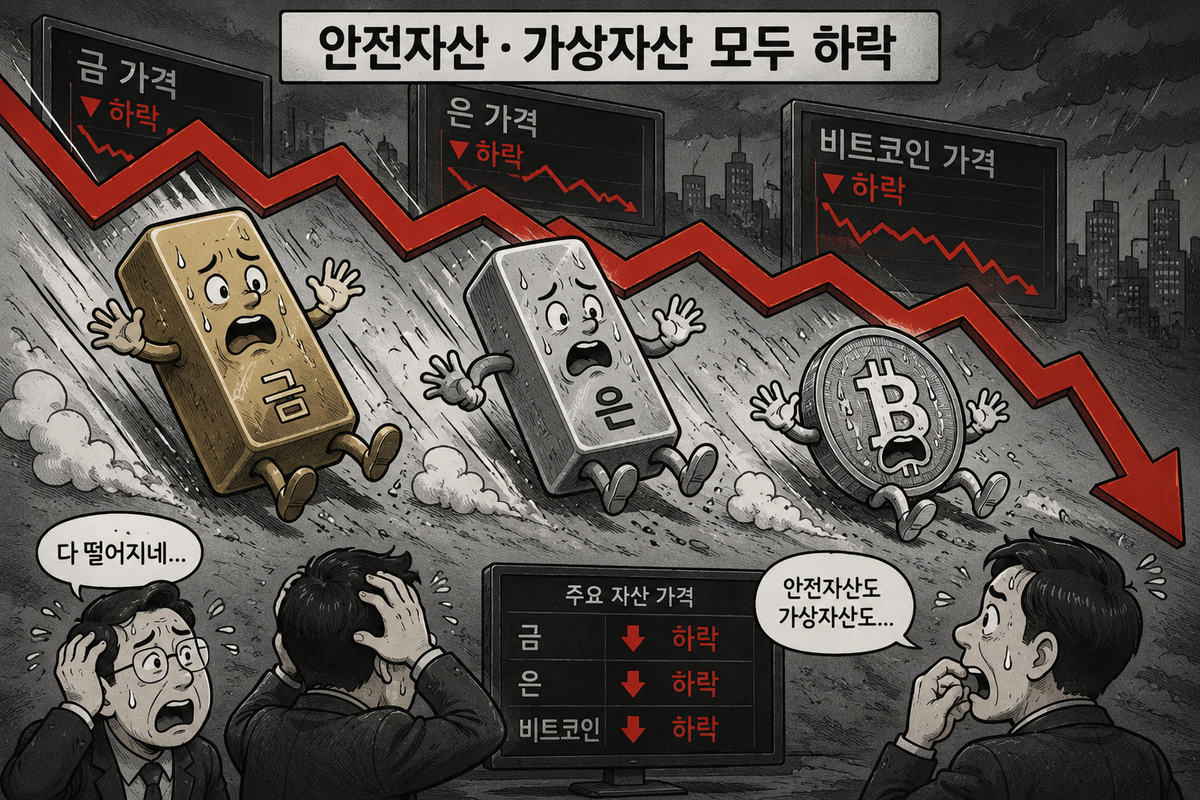
Gold, silver and bitcoin fell sharply in unison on 24th June, as a combination of macroeconomic pressures overwhelmed risk appetite across asset classes. In a report published the following day, iM Securities, a South Korean brokerage, identified six interlocking forces behind the sell-off.
Gold closed the session down 2.9%, at $3,997 per troy ounce—breaching the psychologically significant $4,000 level for the first time in recent months. Silver suffered even steeper losses, falling 5.4% on 23rd June and a further 6.8% the following day. Bitcoin declined 3.1% and 2.3% over the same two sessions, touching an intraday low of $59,118—its weakest level since September 2024.
Measured from recent peaks, the damage is more striking still. Gold has shed roughly 26% from a January high of $5,417 per ounce. Silver has plunged 54% from its all-time high of $116.7, recorded on 28th January. Industrial commodities have not been spared: copper slid alongside oil, with West Texas Intermediate crude falling to $70.34 per barrel, approaching its level of 27th February—before the outbreak of hostilities involving Iran.
iM Securities attributed the broad-based decline to six factors. First, fears of further Federal Reserve tightening were reignited after the June meeting of the Federal Open Market Committee raised the prospect of an interest-rate increase before the year is out. Second, a stronger dollar weighed on dollar-denominated commodities. Third, speculative demand evaporated rapidly. Fourth and fifth, liquidity drained towards high-profile artificial-intelligence plays: the anticipated stock-market listing of SpaceX in particular drew capital away from alternative assets, as part of a wider global rotation into AI-centred investments. Sixth, China's economic recovery continued to disappoint, with fixed-asset investment contracting 4.1% year on year in May—a sign of persistent weakness in domestic demand that bears directly on appetite for industrial metals and precious commodities alike.
Park Sang-hyun, an analyst at iM Securities, counselled against reading too much into the move. "The liquidity contraction is temporary," he argued, forecasting that asset-market momentum would reassert itself in the second half of the year as disinflation takes hold. He pointed to stabilising oil prices and a favourable base effect from earlier tariff increases as factors likely to bear down on inflation—and, by extension, to ease pressure on the Fed—in the months ahead.