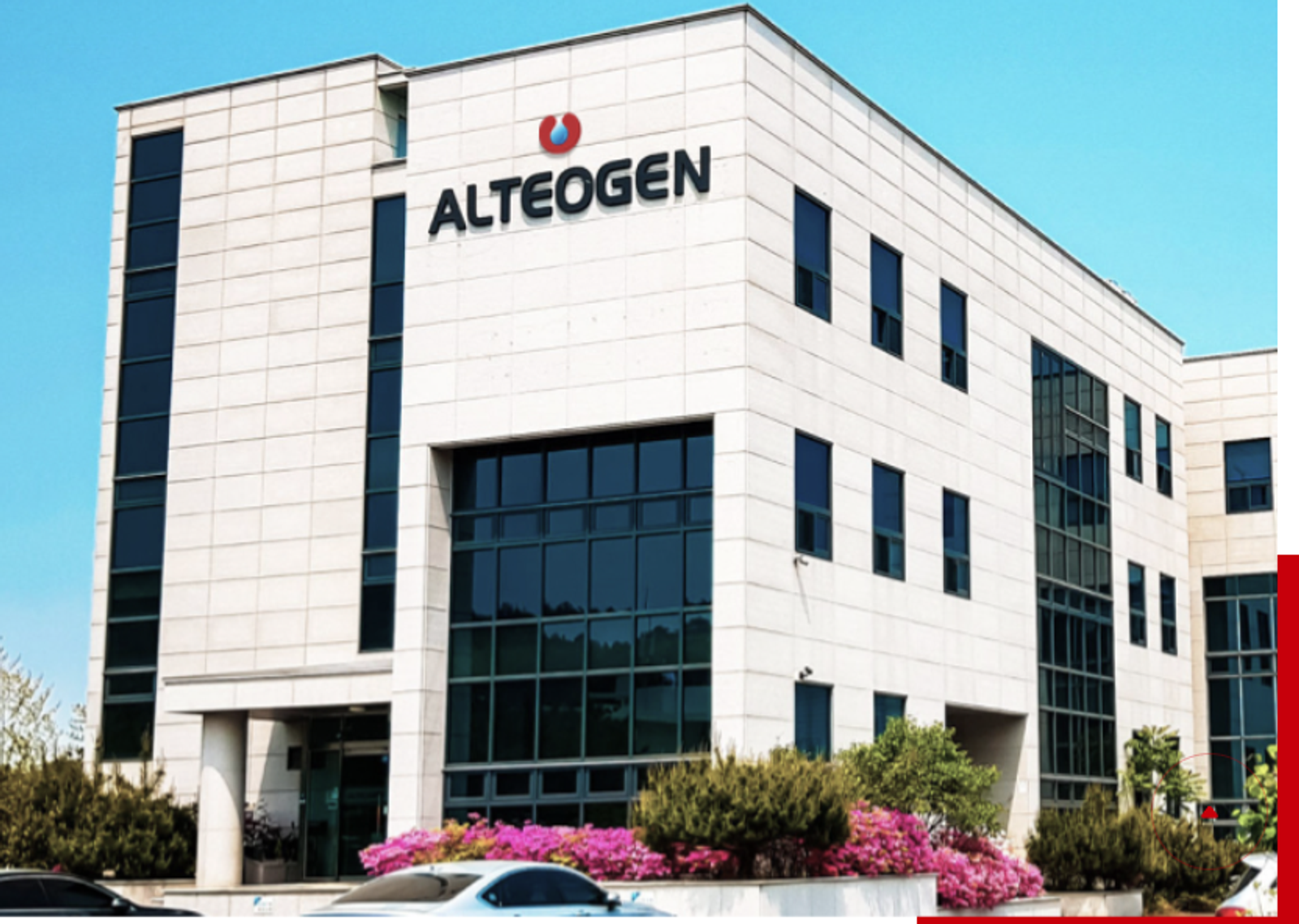
Hana Securities maintained a "Buy" recommendation on Alteogen (KOSPI: 196170) on 8th September whilst lowering its target price from 580,000 won to 450,000 won. The brokerage was quick to clarify that the revision reflects a bonus share issue Alteogen carried out in August and does not imply any change in its assessment of the company's underlying value. At the prevailing share price of 286,000 won (as of 7th September), the implied upside stands at 57.3%.
The centrepiece of the report is a technology-licensing agreement that Alteogen signed with Swiss pharmaceutical giant Novartis on 2nd September. The deal is worth up to $3.223bn (approximately 4.4trn Korean won) in upfront payments and milestone fees, with royalties on top — the largest single contract in Alteogen's history.
Hana Securities estimates the agreement bundles 10 to 11 drug candidates into a single package. Given that recent per-product licensing deals have been valued at between $285m and $365m, the bank reckons the Novartis contract implies a per-product value of roughly $294m–$322m plus a $20m option exercise fee.
Despite the headline scale of the deal, the share-price reaction was muted — and for understandable reasons. Most of Novartis's major blockbuster products are already administered via subcutaneous injection, so the 10 to 11 products covered by the agreement are likely to be clinical-stage pipeline candidates rather than approved drugs. That means investors cannot expect the rapid cash flows associated with already-marketed drugs such as Keytruda or Imfinzi, and this tempered enthusiasm.
Hana Securities nonetheless argues the deal carries significant strategic weight over the medium to long term. Novartis is advancing a broad range of drug modalities — antibodies, antibody-drug conjugates (ADCs), and the emerging class of antibody-oligonucleotide conjugates (AOCs) — through late-stage clinical development. Among the products for which Novartis plans to file for regulatory approval within three years, AOC candidates alone number three. Hana Securities believes it is likely that at least one option under the agreement will be exercised every year.
The AOC candidate drawing the most attention is del-zota (delpacibart zotadirsen), a treatment for Duchenne muscular dystrophy. Having successfully completed its Phase 2 EXPLORE44 trial, del-zota has been submitted to the United States Food and Drug Administration for accelerated approval and is expected to launch in the first half of 2027 as the world's first approved AOC therapy. Novartis acquired this pipeline asset through its takeover of Avidity Biosciences, which holds foundational AOC technology.
The Novartis agreement also signals a broader industry shift. The bundling of multiple products into a single licensing deal — the so-called "package deal" — appears to be gaining traction as standard practice among large pharmaceutical companies. In May 2025, Pfizer signed a co-development agreement with China's Innovent covering 12 programmes, including ADCs and multi-specific antibodies. Hana Securities believes this trend works in Alteogen's favour, making further multi-product agreements more likely.
The financial outlook is striking. Hana Securities forecasts Alteogen's revenue at 580.7bn won and operating profit at 368.2bn won in 2026, representing increases of 169% and 245% respectively against 2025 estimates of 215.9bn won and 106.9bn won. To put this in context, the company posted revenue of 102.9bn won in 2024; on current projections, that figure will more than quintuple within two years. Operating margin is forecast to surge from 24.7% in 2024 to 63.4% in 2026.
Specific earnings triggers are visible in the near term. In the third quarter, Alteogen is expected to book an upfront payment from the Novartis deal (estimated at around $40m), an upfront payment from an undisclosed partner announced on 5th August (estimated at around $20m), and a milestone from partner Qlex tied to reaching $1bn in product sales (estimated at around $50m). The fourth quarter should bring a further milestone from Qlex upon reaching $3bn in sales (estimated at around $100m), as well as milestone payments linked to FDA approval from Intas and Sandoz's entry into Phase 1 clinical trials.
Investors should, however, be aware of material risks. The most pressing is the potential for price cuts on Qlex — the subcutaneous formulation of Keytruda that is Alteogen's primary source of royalty income — under the United States Inflation Reduction Act (IRA). The drug pricing negotiations envisaged by the IRA could weigh on royalty revenues from 2030 onwards. Hana Securities counters that by 2030, three or more additional products, including Imfinzi and Dupixent in subcutaneous form, should be generating revenue, reducing Alteogen's dependence on Qlex. Even so, the IRA remains an unresolved variable.
The broader macroeconomic backdrop — sustained high interest rates and a sector-wide revaluation of biotech equities — also constrains upside. It is worth noting that the target price was set as high as 490,000 won as recently as November 2025 before being trimmed to the current 450,000 won. On a 12-month forward price-to-earnings basis, Alteogen trades at roughly 54.7 times earnings, a substantial premium to domestic large-cap peers Samsung Biologics (EV/EBIT of 23.8 times) and Celltrion (20.9 times). That premium reflects the company's growth profile, but any clinical failure or milestone delay could trigger a sharp de-rating.
Hana Securities summed up its view thus: "What makes this agreement especially noteworthy is not a one-off revenue boost, but its capacity to generate recurring events over the medium to long term. The time has come for investors to shift their focus from the number of deals signed to actual revenues and cash inflows."