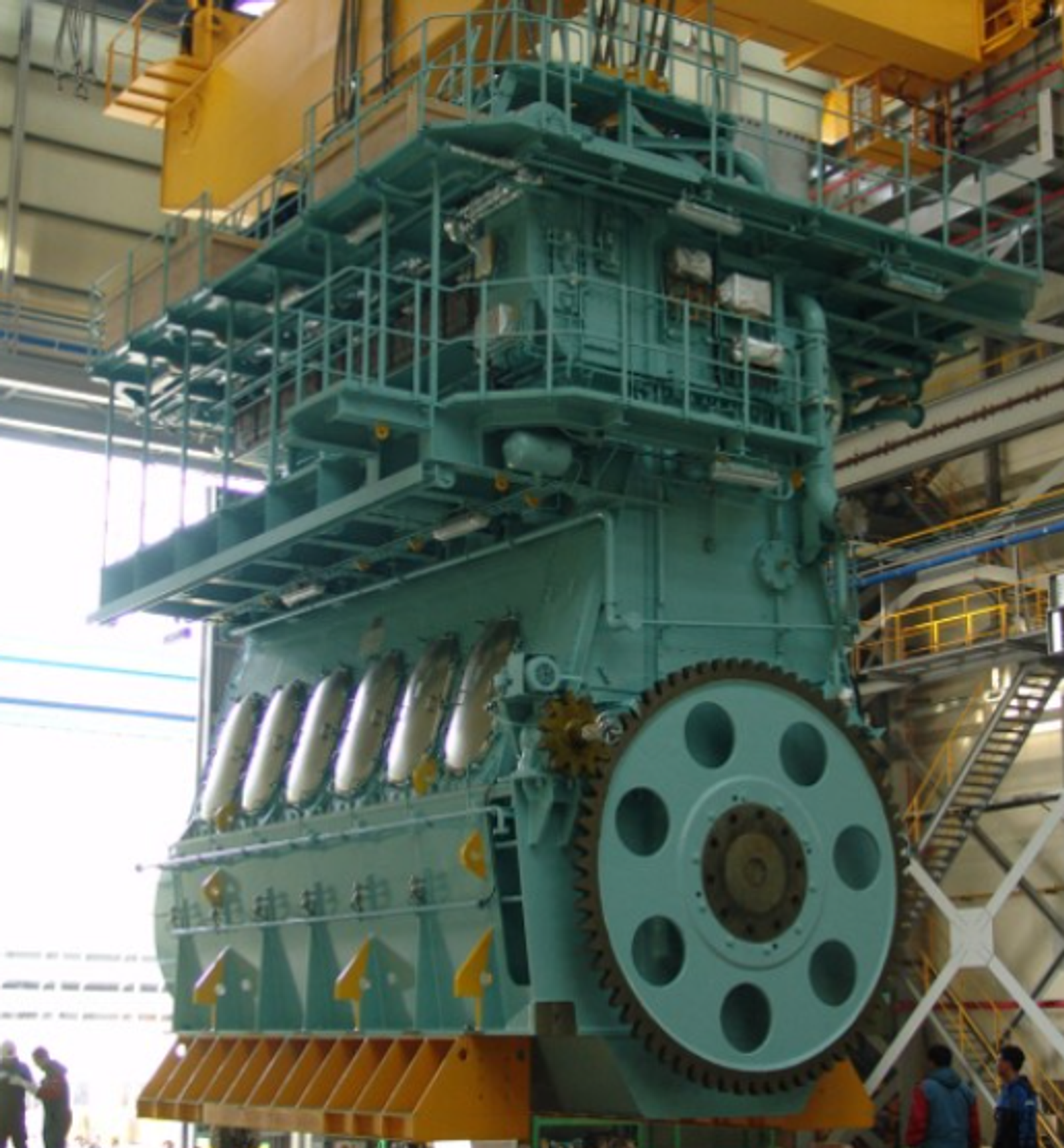
Company Overview
HD Hyundai Marine Engine is a mid-sized specialist manufacturer of marine propulsion systems and a subsidiary of the HD Hyundai Group, one of South Korea's most powerful industrial conglomerates. Listed on the KOSPI — South Korea's main stock exchange — the company produces two main product lines: low-speed, large two-stroke engines used in container ships, bulk carriers, and tankers; and medium-speed four-stroke engines suited to smaller vessels and power generation. Its financial performance is closely tied to the global shipbuilding cycle.
Operating within HD Hyundai's vertically integrated maritime value chain, the company has long served as a critical components supplier to the group's shipbuilding operations. It was drawn into South Korea's broader "Korea Value-Up" debate after regulators launched a formal programme in 2024 to address the country's persistent market discount — the phenomenon whereby Korean equities trade at structurally lower valuations than comparable companies in other markets. Attention on HD Hyundai Marine Engine has intensified as the parent company, HD Korea Shipbuilding & Offshore Engineering, achieved its value-up targets ahead of schedule, raising expectations that improved shareholder returns will cascade down to subsidiaries.
Business Foundations and Financial Performance
*Core Business*
Marine engine manufacturing is the company's primary revenue source. Its two-stroke engines power large ocean-going vessels; its four-stroke engines serve medium and smaller ships as well as onshore power applications. The product mix is evolving: demand for LNG-fuelled propulsion systems and retrofit upgrades for existing vessels is growing, as shipowners race to meet tightening environmental standards. The company's order momentum remains intact — in June 2026 it announced a supply contract worth 46.81 billion won, equivalent to 11.6% of annual revenues.
*Group Interdependence*
HD Hyundai Marine Engine is tightly woven into the HD Hyundai Group's vertical supply chain, supplying engines to sister companies including HD Korea Shipbuilding & Offshore Engineering and HD Hyundai Heavy Industries. When the group's consolidated operating profit surged 120.4% year-on-year in the first quarter of 2026 to a record 2.8348 trillion won, HD Hyundai Marine Engine was among the beneficiaries. Heungkuk Securities set a target price of 400,000 won for HD Hyundai, citing broad-based growth across its subsidiaries.
*Performance Trajectory (2022–2026)*
The company emerged from the post-pandemic shipping recovery around 2022, when engine orders began a gradual climb despite elevated raw-material costs. By 2023, the global push towards greener shipping had accelerated demand for LNG-fuelled engines. The formal launch of South Korea's value-up programme in 2024 brought shareholder return discussions into focus. The cycle reached a new peak in 2025, with the group posting record results as a large order backlog was converted into revenue. In the first half of 2026, a fresh supply contract and the company's potential inclusion in the Korea Value-Up Index kept the stock in the market's attention.
Value-Up Milestones
*2024 — Benefiting from the Korea Value-Up Launch*
South Korea's financial regulators introduced the Korea Value-Up Programme to tackle the chronic undervaluation of domestically listed companies. The initiative prompted HD Hyundai Group to review shareholder return policies across its listed subsidiaries. HD Hyundai Marine Engine was included in that review, though it had yet to publish any independent shareholder return commitments of its own.
*2025 — Group Achieves Value-Up Targets Early*
By May 2026, reports confirmed that HD Korea Shipbuilding & Offshore Engineering had met its value-up targets ahead of schedule, with a shareholder return ratio — encompassing dividends and share buybacks relative to earnings — of 140%. The success of the parent is creating spillover pressure on subsidiaries, stoking market interest in HD Hyundai Marine Engine's own dividend and treasury-share policies.
*May 2026 — Korea Value-Up Index Disclosure*
On 28th May 2026, HD Hyundai Marine Engine filed a disclosure relating to the Korea Value-Up Index. Inclusion in, or association with, the index is widely read by investors as a signal that a company is committed to improving shareholder returns and corporate governance. The precise implications of this disclosure, however, remain difficult to assess from publicly available information alone.
*June 2026 — 46.81 Billion Won Engine Supply Contract*
On 12th June 2026, the company announced a marine engine supply contract valued at 46.81 billion won, representing 11.6% of revenues. The deal reinforced confidence in the underlying business and was interpreted as supporting the earnings capacity from which future dividends would be funded. The announcement coincided with broader market coverage of major shipbuilding-related disclosures, alongside peers such as Hanwha Ocean.
Challenges and Assessment
*Outstanding Challenges*
Three structural weaknesses stand between HD Hyundai Marine Engine and a credible value-up story of its own.
First, it has yet to formalise an independent shareholder return plan. At present, the company relies on the group's broader declarations rather than publishing its own dividend payout targets or share-cancellation schedule. Markets find it difficult to trust value-up rhetoric unsupported by concrete numerical commitments.
Second, a strategy for improving return on equity and price-to-book ratios has not been articulated. The marine equipment sector carries heavy capital expenditure requirements and highly cyclical earnings. Durable profitability improvements — for instance by capturing demand for green-energy engines and data-centre power generation — must come first if the company is to sustain any meaningful return of capital.
Third, governance transparency remains a work in progress. Within HD Hyundai's closely integrated conglomerate structure, the market continues to scrutinise whether independent board oversight and minority shareholder protections function effectively at the subsidiary level.
*Overall Assessment*
HD Hyundai Marine Engine is building its business from a position of strength, backed by a favourable shipping upcycle and a group whose culture of shareholder returns appears to be maturing. The parent's 140% return ratio and early achievement of value-up targets send a positive signal down the corporate hierarchy. The June 2026 supply contract demonstrates that earnings capacity remains robust. Yet the translation of group-level progress into subsidiary-level commitment will take time. Investors seeking a standalone value-up thesis should wait for the company to publish its own specific targets before drawing firm conclusions.
Controversies and Limitations
*Dependence on the Parent's Agenda*
The most persistent criticism of HD Hyundai Marine Engine's value-up narrative is that it is derivative rather than original. The shareholder return disclosures that attract market attention belong to HD Korea Shipbuilding & Offshore Engineering and HD Hyundai Heavy Industries; the subsidiary's own communications are comparatively thin. For investors trying to assess the company on its own merits, the lack of an independent roadmap is a genuine obstacle.
*Cycle Risk and Dividend Sustainability*
Marine engine manufacturing is inherently procyclical. Should the current shipbuilding boom peak and order volumes decline, operating profits would fall, and the resources available for dividends would shrink accordingly. Sustainable shareholder returns require diversification of revenue streams and stable cash generation across the cycle — neither of which has yet been clearly demonstrated.
*Uncertainty Around New Business Ventures*
Several HD Hyundai Group affiliates — including HD Hyundai Heavy Industries and HD Hyundai Marine Solution — are moving into adjacent growth markets such as AI data-centre power generation and small modular reactors (SMRs). HD Hyundai Marine Engine's own strategy in these areas has not been publicly defined. Some brokerage research has flagged potential benefits from data-centre engine demand, but whether those gains would accrue directly to this entity remains unclear. There is also a risk that capital earmarked for new ventures would dilute funds available for shareholder returns.
*Uncertain Impact of Korea Value-Up Index Inclusion*
Although HD Hyundai Marine Engine appeared in disclosures related to the Korea Value-Up Index in May 2026, the nature and extent of any formal inclusion — and its practical consequences — cannot be confirmed from public information alone. If index membership proves to be a procedural technicality rather than a substantive change, its effect on the share price and underlying shareholder value may prove limited.
Key Data Summary
Period | Dividend Status | Treasury-Share Policy | Operating Profit Trend | Est. Price-to-Book | Notes
2022 | Modest dividend (estimated) | No separate disclosure | Recovery phase | Low | Early shipbuilding recovery
2023 | Dividend maintained (estimated) | No separate disclosure | Improving | Undervalued | LNG engine demand rising
2024 | Under review for value-up | Group-level review begun | Strong | Improving | Korea Value-Up launch
2025 | Enhanced returns anticipated | Group return ratio: 140% | Record-level | Rerating phase | Parent hit targets early
2026 H1 | Disclosure-based monitoring | Value-Up Index disclosure | 46.81bn won contract | Improvement ongoing | Group posts quarterly record
*Dividend and treasury-share figures require verification against individual regulatory filings and annual reports. Operating profit figures reference both group consolidated and standalone bases.*