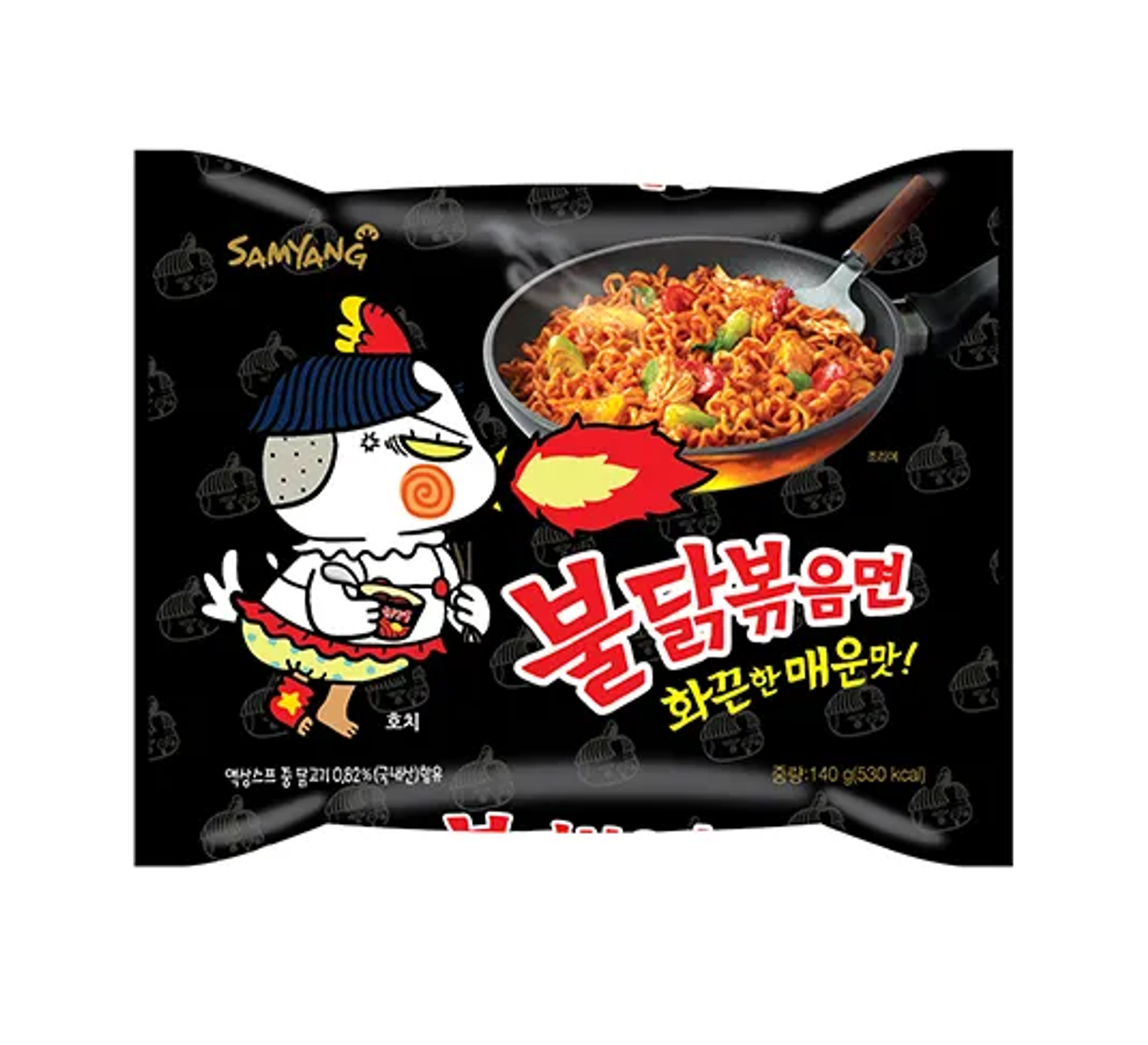
South Korean ramen exports are on course to reach $2bn this year, and one company is doing the heavy lifting. Samyang Foods, maker of the incendiary Buldak Bokkeum Myeon — literally "fire chicken stir-fried noodle" — has become a force that is reshaping the country's food export statistics almost on its own.
According to South Korea's Ministry of Agriculture, Food and Rural Affairs, ramen exports grew 27.9% year on year in the first half of this year, with cumulative exports virtually certain to have crossed the $1bn mark during July. The full-year figure is expected to reach $2bn. Samyang sits at the centre of this surge. The share of its revenue generated overseas dwarfs that of its domestic rivals — roughly 40% for Nongshim and around 10% for Ottogi — to the point where analysts credit Samyang with driving a disproportionate share of the entire Korean ramen industry's export performance.
The vehicle for this achievement is Buldak, launched in 2012. Cumulative sales passed 5bn units in 2023 and reached 7bn last year. In the first half of this year alone, a further 1bn units were sold, pushing the lifetime total beyond 8bn. The product is now exported to more than 100 countries. Industry observers attribute its global appeal to its aggressively spicy flavour profile, the viral "fire noodle challenge" that spread across social media platforms, and a localisation strategy that has tailored recipes and product variants to individual markets.
Financial forecasts are being revised sharply upward. According to data compiled by FnGuide, a Korean financial data provider, consensus estimates for Samyang's 2026 revenue have risen 27.71% over the past year, reaching 2.989trn won ($2.2bn). Over the same period, forecast operating profit for 2026 jumped 41.70%, from 499.8bn won to 708.2bn won. At this trajectory, the company appears on the cusp of joining South Korea's informal "3 trillion won club" — the threshold at which a company's annual revenue crosses 3trn won — this year.
Quarterly results are equally robust. Securities analysts projected second-quarter consolidated revenue of around 750bn won, up 37% year on year, with operating profit of approximately 178.9bn won, a 39% increase. Combined ramen export growth of 32.7% for the March-to-May period suggested that second-quarter momentum may even exceed the already-strong first quarter. Demand has been broadly balanced across the United States, China, Europe and South-East Asia, while production capacity has been expanded through the addition of two-shift operations at the company's second factory in Miryang, in South Korea's South Gyeongsang province.
Risks remain, however. Because all of Samyang's products destined for the American market are manufactured domestically, the company is exposed to tariff pressure. In October last year it raised its US wholesale prices by 9% on key lines, including Buldak, to offset rising tariff costs. Yet demand held firm, and analysts conclude that the price increase caused little lasting damage to its financial performance.
Capacity expansion continues apace. The company's total production capacity is estimated to have grown 50% in 2025 compared with the previous year, with a further 25% increase projected for 2026. A new factory in China is scheduled for completion in January 2027, which would give Samyang a local manufacturing base to pursue growth in its second-largest target market more aggressively, following the model it has developed in America.
Reflecting this trajectory, NICE Credit Rating, one of South Korea's leading rating agencies, recently upgraded Samyang's credit rating to AA-.
Samyang's story has become a striking illustration of how a single product — a packet of spicy instant noodles — can move a nation's export data. That a domestic food company should generate the majority of its revenues abroad is highly unusual in South Korea. For that reason, Samyang is likely to remain the defining case study in the internationalisation of Korean food for some time to come.