SK Securities reiterated its buy recommendation and 12-month price target of 4,000,000 won on Hyosung Heavy Industries (KOSPI: 298040) on the 24th. The target implies upside of 47.0% from the current share price of 2,721,000 won — itself 40.9% below the 52-week high of 4,601,000 won. The target has already been trimmed once, from 4,700,000 won set in April.
A changing client roster
The most significant detail in SK Securities' latest report concerns HICO America, Hyosung Heavy Industries' US sales subsidiary. Alongside the traditional roster of electricity utilities, AI-related companies have now appeared as named customers. The disclosed breakdown of major revenue sources is as follows: Constellation 15%, Intersect Power 13%, Dominion 9%, SoftBank 9%, PSE 8%, AEP 8%, LS Power 5%, Southern 4%, and Elon Musk's xAI 3%. At the Memphis manufacturing plant specifically, Eversource accounts for 22%, AEP for 17%, and Intersect Power for 15%.
The arrival of SoftBank and xAI on the client list marks a noteworthy inflection. Conventional power-infrastructure companies still generate the bulk of revenues, but AI data-centre operators are establishing themselves as an additional source of demand. As grid investment becomes intertwined with AI infrastructure build-out, the structural case for ultra-high-voltage transformers is strengthening from multiple directions simultaneously.
Depth over breadth
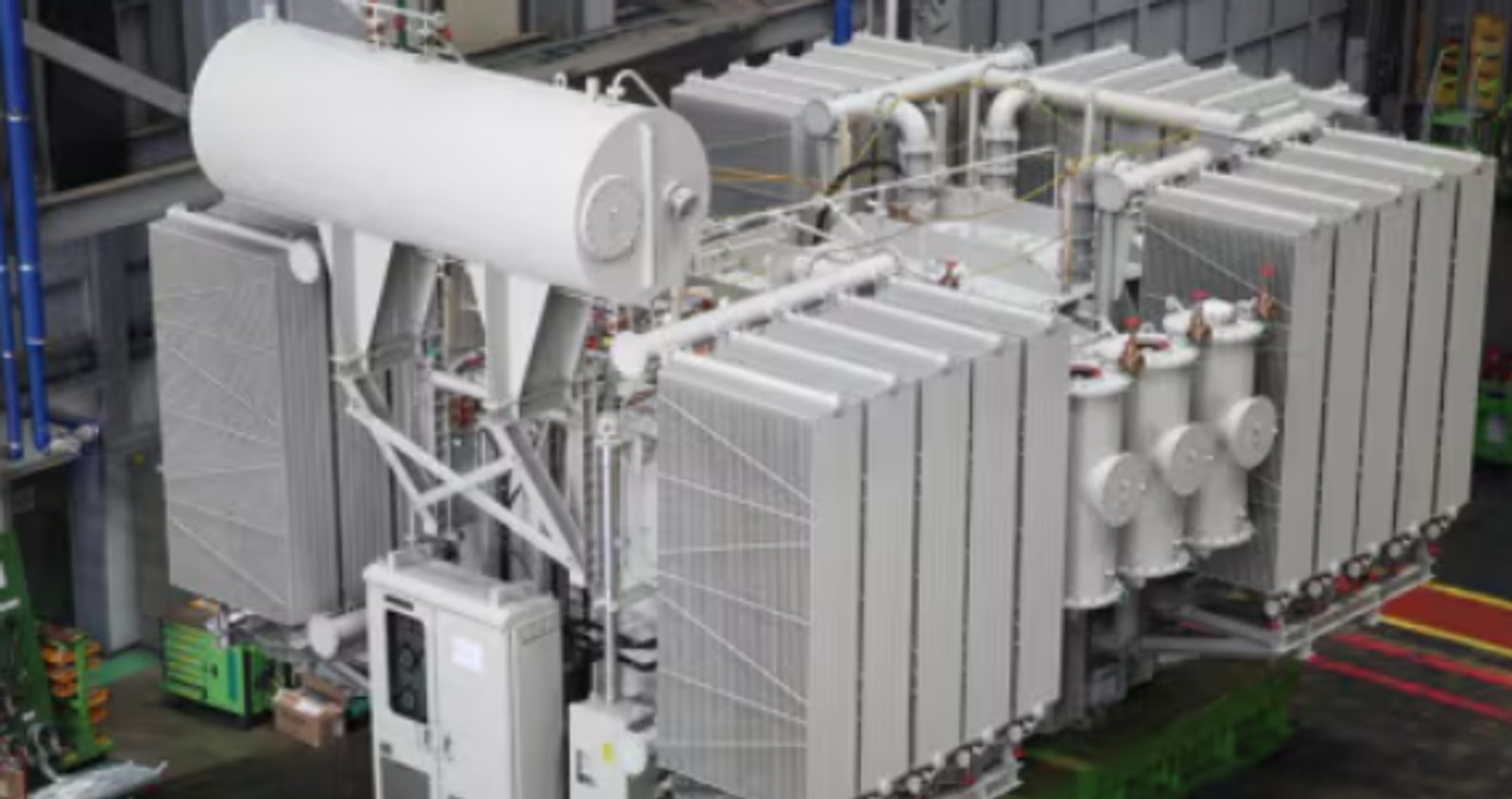
Strategically, Hyosung Heavy Industries has chosen to deepen its specialisation in ultra-high-voltage transmission rather than diversify across product categories. Its competitive edge rests on being the only Korean manufacturer with domestic US production capability for both 765kV transformers and 800kV gas circuit breakers (GCBs). The Memphis factory is the sole US production site for 765kV transformers and holds roughly 50% of all cumulative installation references in that voltage class.
In February this year, the company disclosed a purchase contract worth approximately 787 billion won for 765kV transformers and reactors, covering deliveries from February 2026 to January 2031. The products involved are understood to carry the highest specifications and correspondingly high margins. Through a joint venture with Quanta Services, the company can also offer bundled packages combining transformers and ultra-high-voltage circuit breakers — an increasingly relevant capability as project complexity grows. Quanta Services has confirmed on its own earnings calls that 765kV transmission projects are being reflected in its order backlog.
A rapidly lengthening backlog
Order intake momentum is accelerating. The heavy-industry division's consolidated backlog stood at 10.712 trillion won at end-2024; by the second quarter of 2026 it had surged to 23.834 trillion won. SK Securities projects further growth to 26.502 trillion won by end-2026 and 30.843 trillion won by end-2027. The time horizon of the backlog itself is extending, with 765kV deliveries spread across 2028 to early 2031 — a timeline consistent with US utilities' capital-expenditure planning cycles, which now stretch well beyond 2030.
Earnings on a steep upward trajectory
SK Securities forecasts revenues of 7.406 trillion won for 2026, a 24.1% increase year-on-year, with operating profit of 1.130 trillion won, up 51.3%. The operating margin is expected to reach 15.3%, more than double the 7.4% recorded in 2024. By 2027, revenues are projected at 8.919 trillion won and operating profit at 1.590 trillion won. Looking only at the heavy-industry division, operating margins are forecast to rise steadily from 10.1% in 2024 to 16.8% in 2025, 18.9% in 2026, and 22.1% in 2027.
Risks to watch
Several variables merit attention. Most pressing is the anti-dumping investigation being conducted by US authorities into large power transformers: depending on its outcome, shipment schedules to the United States in the second half of this year could be disrupted. SK Securities has identified the timely commencement of US shipments for transformers subject to potential anti-dumping duties — and the ability to sustain heavy-industry margins — as the key variables to monitor.
Delays to Middle Eastern orders also warrant scrutiny. Uncertainty over when profits from goods in transit will be recognised could amplify quarter-to-quarter earnings volatility. Separately, the procurement timetable for South Korea's domestic HVDC (high-voltage direct current) "energy highway" has yet to be formalised.
Taken together, the picture is one of compelling structural momentum — a lengthening backlog, rising margins, and a broadening customer base that now spans both utilities and AI infrastructure — set against near-term risks from trade policy and logistical disruption that could inject volatility into the share price.