Company Overview
Hyundai Mobis is the core parts affiliate of the Hyundai Motor Group and the largest automotive components company in South Korea. Its business rests on two pillars: supplying finished-vehicle modules to Hyundai Motor and Kia, and providing after-sales (AS) replacement parts through a nationwide service network. A blue-chip constituent of the KOSPI (South Korea's main stock exchange), the company has delivered steady results for decades on the back of captive supply relationships with its parent group. As the global automotive industry shifts towards electrification, Hyundai Mobis has been expanding into electric-vehicle (EV) drivetrains, advanced driver-assistance systems (ADAS), and hydrogen mobility components. More recently, a potential move into robotics has attracted market attention.
Yet for years Hyundai Mobis has been synonymous with chronic undervaluation. Its price-to-book ratio (PBR) has remained stubbornly below 1x, weighed down by a hybrid structure that blends holding-company functions—through large stakes in Hyundai Motor and Kia—with operating business activities, by circular cross-shareholding arrangements typical of South Korea's family-controlled conglomerates (chaebol), and by a historically restrained shareholder-return policy. Since 2024, when South Korea's financial regulator launched its "Value-Up Programme" to encourage listed companies to improve capital efficiency and shareholder returns, Hyundai Mobis has faced mounting pressure from institutional investors and retail shareholders alike to address governance and payouts. What follows is the story of that journey.
Business Foundation and Financial Performance
Business Structure: Three Pillars
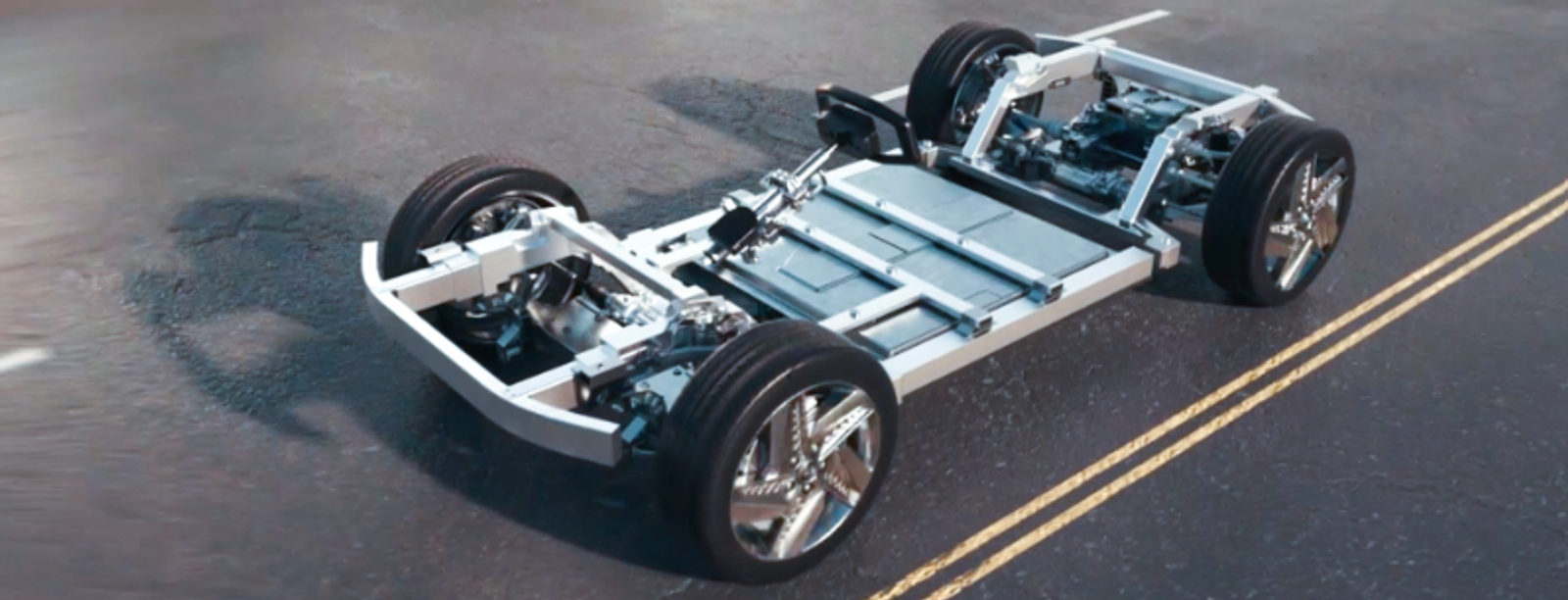
Hyundai Mobis operates across three segments. First, its module business supplies chassis, cockpit, and front-end modules to Hyundai Motor and Kia. Second, its core components business manufactures high-value parts including EV power-electronics (PE) systems—comprising inverters, motors, and reducers integrated into a single unit—airbags, lamps, and braking systems. Third, its after-sales parts business distributes replacement components through an extensive repair network, generating stable, recurring revenues that grow in proportion to the cumulative number of Hyundai and Kia vehicles on the road. This last segment functions as the company's cash cow.
The share of electrification components in total revenue has risen sharply through the 2020s. PE systems in particular have emerged as a key driver of margin improvement, given the global expansion of EV sales. As of 2026, however, the outlook is clouded by American tariff risks and a deceleration in EV demand growth, both of which introduce meaningful earnings uncertainty.
Financial Performance by Year
Year | Revenue | Operating Profit | Operating Margin | Net Profit
2020 | c. ₩36tn | c. ₩1.5tn | c. 4.1% | c. ₩1.4tn
2021 | c. ₩38tn | c. ₩1.4tn | c. 3.7% | c. ₩1.3tn
2022 | c. ₩51tn | c. ₩2.0tn | c. 3.9% | c. ₩1.8tn
2023 | c. ₩57tn | c. ₩2.7tn | c. 4.7% | c. ₩2.4tn
2024 | c. ₩59tn | c. ₩2.8tn | c. 4.7% | c. ₩2.5tn
2025 | c. ₩61tn | c. ₩2.9tn | c. 4.8% | c. ₩2.6tn
From 2022 onwards, stabilising raw-material costs, recovering demand, and growing electrification-component revenues combined to drive simultaneous top-line and margin expansion. Revenue of ₩61tn in 2025 is reported to be the highest in the company's history. Analysts nonetheless note that the company's heavy dependence on a handful of captive customers limits its independent pricing power and constrains the operating leverage available to it.
The Value-Up Timeline
2023 — Governance Reform Back on the Agenda
Speculation about a structural reorganisation of Hyundai Motor Group had circulated on and off among South Korean brokers for years, and in 2023 the question of unwinding the circular cross-shareholding arrangement involving Hyundai Mobis resurfaced. At the time, Hyundai Mobis held approximately 21% of Hyundai Motor and around 17% of Kia, making it the linchpin of the group's ownership structure. Domestic and foreign institutional investors repeatedly argued that this arrangement distorted the company's intrinsic value and demanded reform. No formal timetable for restructuring was announced.
2024 — Value-Up Disclosure and Shareholder-Return Foundations
With the government's Value-Up Programme formally under way, Hyundai Mobis publicly outlined its medium-to-long-term improvement ambitions for the first time. The company identified total shareholder return (TSR) as its headline metric and sketched the contours of a dual-track strategy combining share buybacks and cancellations with higher dividends. Institutional investors began voicing their demands more openly and publicly during this period.
August 2025 — Share Cancellation Announcement Lifts the Stock
When Hyundai Mobis fleshed out a share cancellation plan in August 2025, the stock rose by roughly 5% in short order. Markets responded warmly because cancelling treasury shares reduces the total number of shares in issue, directly boosting per-share value. Brokers at the time noted that the scale of cancellation would be the critical variable to watch in subsequent announcements.
October 2025 — Value-Up Report Sets a TSR Target in the 30s
In an official Value-Up Report published in October 2025, Hyundai Mobis set a medium-to-long-term TSR target in the range of 30%. The company reaffirmed its dual-track strategy of investing for growth—in electrification and software—while progressively scaling up annual shareholder returns. A higher dividend pay-out ratio, alongside continued buybacks and cancellations, was identified as the primary mechanism.
November 2025 — Group-Wide Value-Up Co-ordination
As Hyundai Motor Group affiliates began co-ordinating their value-enhancement strategies, the consensus view among investors was that Hyundai Mobis's shareholder-return programme was on track. Under chief executive Lee Kyu-seok, the company stepped up investor-relations activity and broadened engagement with institutional shareholders, with building trust among long-term investors emerging as a central management priority.
March 2026 — National Pension Service Votes Against Treasury-Share Disposal
A dispute over how Hyundai Mobis intended to use its treasury shares brought the Value-Up agenda into sharp focus. The National Pension Service (NPS)—South Korea's state pension fund and one of the country's most influential institutional investors—publicly declared its opposition to the company's proposed treasury-share disposal plan, arguing that it conflicted with the spirit of shareholder returns. The NPS contended that treasury shares should be cancelled outright or returned directly to shareholders, and that transferring them to third parties—for instance, to finance acquisitions or compensate employees—would dilute existing shareholders' interests. The dispute became one of the defining issues of the 2026 annual general meeting season.
April 2026 — ₩500bn Buyback and Cancellation Approved
In April 2026, Hyundai Mobis's board approved the acquisition and subsequent cancellation of treasury shares worth ₩500bn (approximately $370m), explicitly citing shareholder-value enhancement as the rationale. The decision was widely interpreted as a partial concession to the demands of the NPS and other institutional investors. Management emphasised that its shareholder-return commitments were being honoured on schedule, while noting that detailed plans for new businesses—including robotics manufacturing—would be disclosed in the second half of 2026.
June 2026 — Medium-to-Long-Term Value-Up Strategy Formally Unveiled
In June 2026, Hyundai Mobis formally published its medium-to-long-term value-creation strategy, declaring its intent to achieve a "decisive improvement in shareholder value." Building on record revenues of ₩61tn, the company set out three strategic priorities: improving profitability, optimising capital allocation, and expanding shareholder returns. Specific targets included higher dividends, continued buybacks and cancellations, and a recovery of PBR to above 1x over the medium term. The announcement was seen as the defining statement of Mr Lee's second term as chief executive.
Challenges and Assessment
Challenges Ahead
Hyundai Mobis faces several substantial obstacles on the road to genuine value creation.
The most fundamental is governance reform. Its large stakes in Hyundai Motor and Kia prevent the market from valuing Hyundai Mobis as a pure-play components business. Until the company provides a clear roadmap for how those stakes will be dealt with—whether through disposal, distribution in kind to shareholders, or exchange—structural discount will persist.
The second challenge is the sustainability of margin improvement. Stabilising profitability in an environment of American tariff pressures, slowing EV demand growth, and persistent unit-price negotiations with captive customers is no easy task. The operating margins on electrification components such as PE systems also remain below those of traditional internal-combustion-engine parts.
Third is delivering on new-business promises. The prospect of entering the robotics market excited investors, but the absence of concrete plans has generated an uncomfortable cycle of raised and dashed expectations. In July 2026, enthusiasm over a potential robotics push evaporated rapidly, and the share price fell by roughly 40% within a single month.
Assessment
On the positive side, Hyundai Mobis made meaningful progress between 2024 and 2026 in formalising its commitment to value creation at a level of seriousness not previously seen. A TSR target in the 30% range, and a ₩500bn share-cancellation commitment, represent a genuine step forward compared with earlier practice. Practitioners in the market also note that investor-relations quality and institutional-investor engagement improved markedly under Mr Lee's leadership.
The market's verdict, however, remains sceptical. A return to PBR above 1x has been declared as a goal on numerous occasions without materialising, and questions persist about whether shareholder returns are sufficiently large relative to the company's cash-generation capacity. The NPS's public opposition to the treasury-share disposal plan illustrates the rising bar for governance transparency that the company must now clear.
Controversies and Structural Limitations
The Treasury-Share Disposal Row: Cancellation or Opportunistic Use?
The dispute that erupted in March 2026 over treasury-share disposal crystallised the tension at the heart of Hyundai Mobis's value-up effort. The NPS's objection was straightforward: buying back shares and then deploying them for mergers and acquisitions or employee compensation, rather than cancelling them, dilutes the interests of ordinary shareholders. The episode illustrated the gap between announcing a shareholder-return policy and actually delivering one.
The Robotics Theme: A Cautionary Tale
In the first half of 2026, Hyundai Mobis's share price surged on expectations of a move into robotics, then plunged by close to 40% within a month when those expectations proved premature. The episode exposed the dangers of share-price formation driven by thematic speculation rather than disclosed business plans, and highlighted that the company's external communications have not yet reached the standard of precision that sophisticated investors expect. Retail shareholders who bought at the peak suffered real losses—a fact that invites criticism regardless of the company's longer-term intentions.
The Governance Discount: The Root Cause of Chronic Undervaluation
Hyundai Mobis's stakes in Hyundai Motor and Kia are worth trillions of won at book value, yet the path by which those assets might be returned to shareholders remains unclear. Foreign institutional investors have consistently demanded that the stakes be distributed as dividends in kind, exchanged for treasury shares, or otherwise addressed as part of a broader group restructuring. But because the issue is inseparable from Hyundai Motor Group's overall ownership architecture, Hyundai Mobis cannot resolve it unilaterally.
Captive-Customer Dependence: A Ceiling on Independent Valuation
The overwhelming share of revenues derived from supplying Hyundai Motor and Kia makes it difficult for the market to treat Hyundai Mobis as a standalone components business. Limited pricing power vis-à-vis its principal customers, and vulnerability to unit-price cuts, cap the operating margins the company can realistically achieve. Some analysts note that Hyundai Mobis's profitability metrics compare unfavourably with those of global automotive-components peers.
Summary of Key Metrics
Year | Operating Profit | Dividend (per share) | Buyback/Cancellation | PBR (year-end) | TSR Target
2020 | c. ₩1.5tn | c. ₩2,000 | — | c. 0.5x | —
2021 | c. ₩1.4tn | c. ₩2,000 | — | c. 0.5x | —
2022 | c. ₩2.0tn | c. ₩3,000 | Partial buyback | c. 0.5x | —
2023 | c. ₩2.7tn | c. ₩5,000 | Cancellation under review | c. 0.6x | —
2024 | c. ₩2.8tn | c. ₩6,000 | Cancellations begin | c. 0.6x | Being defined
2025 | c. ₩2.9tn | c. ₩7,000 | Cancellations continue | c. 0.7x | 30%+
2026 | c. ₩2.9tn+ | To be increased | ₩500bn cancellation | Target: 1x | 30%+