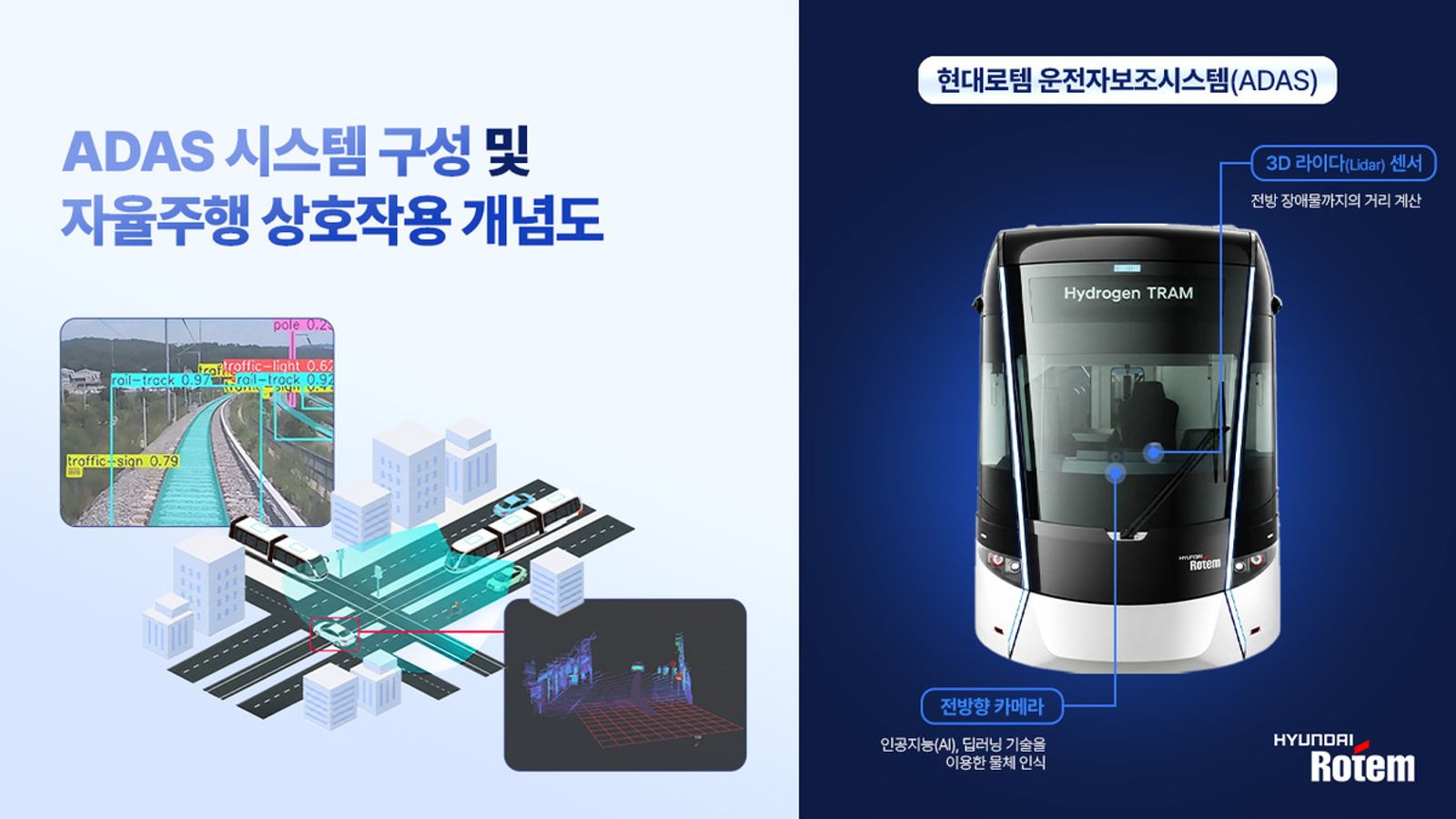
Hyundai Rotem has launched a full-scale development programme for an AI-based advanced driver-assistance system (ADAS) designed specifically for railway vehicles, accelerating its push towards the commercial deployment of fully autonomous trams. The initiative, which places software and artificial intelligence at the heart of the company's strategy, is being watched as more than a technical upgrade — it signals a potential transformation in how cities move people.
AI comes to the rails
ADAS technology originated in the automotive industry, where it underpins collision avoidance, lane-keeping and emergency braking. The same capabilities have been refined by companies such as Tesla and Mobileye into the building blocks of self-driving cars. Bringing them to railways, particularly trams, is a logical but demanding extension.
Trams occupy an unusual operational niche. Unlike metro trains or intercity rail, they share urban streets with pedestrians, private vehicles, traffic signals and illegally parked cars, yet remain bound to fixed tracks. Existing automatic train protection (ATP) systems were not designed for this chaotic mixed-traffic environment. Hyundai Rotem's rail ADAS is understood to address this gap by fusing data from cameras, LiDAR and radar to detect obstacles ahead, with an AI algorithm assessing risk levels and triggering automatic braking or driver alerts as appropriate. The system is designed as a foundational technology for reaching Grade of Automation 4 (GoA4) — fully driverless operation — as defined by the International Union of Railways (UIC).
A global race already under way
Rival manufacturers are not standing still. France's Alstom commercialised GoA2 semi-automated tram operations on a Bordeaux line in 2023. Germany's Siemens, working with drivetrain specialist Voith, has successfully demonstrated AI-based obstacle detection and automatic braking on the Dresden tram network. China's state-backed CRRC ran GoA3-level autonomous tram trials in Wuhan and Chengdu in 2022, backed by substantial government resources.
South Korea, by contrast, still lags. Tram lines are planned or under construction in Suwon, Wirye and Busan, but none is expected to exceed GoA2 on launch. If Hyundai Rotem can bring its ADAS to maturity, analysts say it would not only narrow this technology gap domestically but also improve the company's competitiveness in export markets.
The hardest problem: mixed traffic
Experts identify mixed urban traffic as the defining technical obstacle to tram autonomy. Metros and commuter railways run on dedicated, controlled infrastructure, making ADAS integration comparatively straightforward. Trams must navigate signalised intersections, pedestrian crossings and unpredictable side streets.
"Tram autonomy is not fundamentally a sensor-accuracy problem — it is a question of the reliability of the situational-judgement AI," says a researcher at the Korea Railroad Research Institute. "The critical challenge is validating algorithms that minimise both false positives and false negatives across the full range of conditions: night, heavy rain, strong backlighting." This mirrors the edge-case problem that has proved the most stubborn barrier to full autonomy in the automotive world.
Cybersecurity adds another layer of complexity. Connecting AI systems on railway vehicles to networks creates vulnerabilities that demand redundant and triple-redundant safety architectures. Any commercial deployment would need to satisfy the international standard IEC 62280 on railway cybersecurity and EN 50129 on safety integrity for railway control systems.
Policy tailwinds, and some headwinds
Hyundai Rotem's programme aligns with the South Korean government's ambitions. The Ministry of Land, Infrastructure and Transport designated autonomous urban-rail technology — including trams — as a strategic priority in its Fourth Railway Network Development Plan (2021–2030), and has been steadily increasing budget allocations for autonomous tram demonstration projects since 2024. The public-private structure is designed to accelerate commercialisation.
The commercial prize is considerable. The global urban-rail market is projected to reach roughly $250 billion by 2030, according to the Korea Railroad Industry Promotion Agency, with smart and autonomous systems among the fastest-growing segments. Securing ADAS capability early could give Hyundai Rotem a differentiated edge in prospective export markets across the Middle East, South-East Asia and Europe.
There are social frictions to manage as well. Trade unions have raised concerns about the effect of expanding automation on train-driver employment — a worry not unique to South Korea. In several European cities, labour negotiations over GoA4 driverless services have caused significant delays to deployment. Proponents of the technology argue that early investment in job-reclassification schemes and retraining programmes is essential to building the social consensus that smooth adoption requires.
The platform imperative
In the near term, Hyundai Rotem's AI-based rail ADAS is expected to improve safety and operational efficiency on domestic tram networks. Over the medium to long term, it represents a technical bridgehead towards fully autonomous commercial service. The automotive industry's experience offers an instructive parallel: those who established dominant platforms early — in mapping, sensor fusion or decision-making software — have largely determined the competitive landscape that followed. In railway autonomy, the same logic is likely to apply. The manufacturer that internalises the core technology first will be difficult to displace.
As trams re-emerge as a centrepiece of urban mobility planning worldwide, the question of how far AI running on rails can reshape South Korea's railway industry — and its place in the global market — is one worth watching closely.