Company Overview
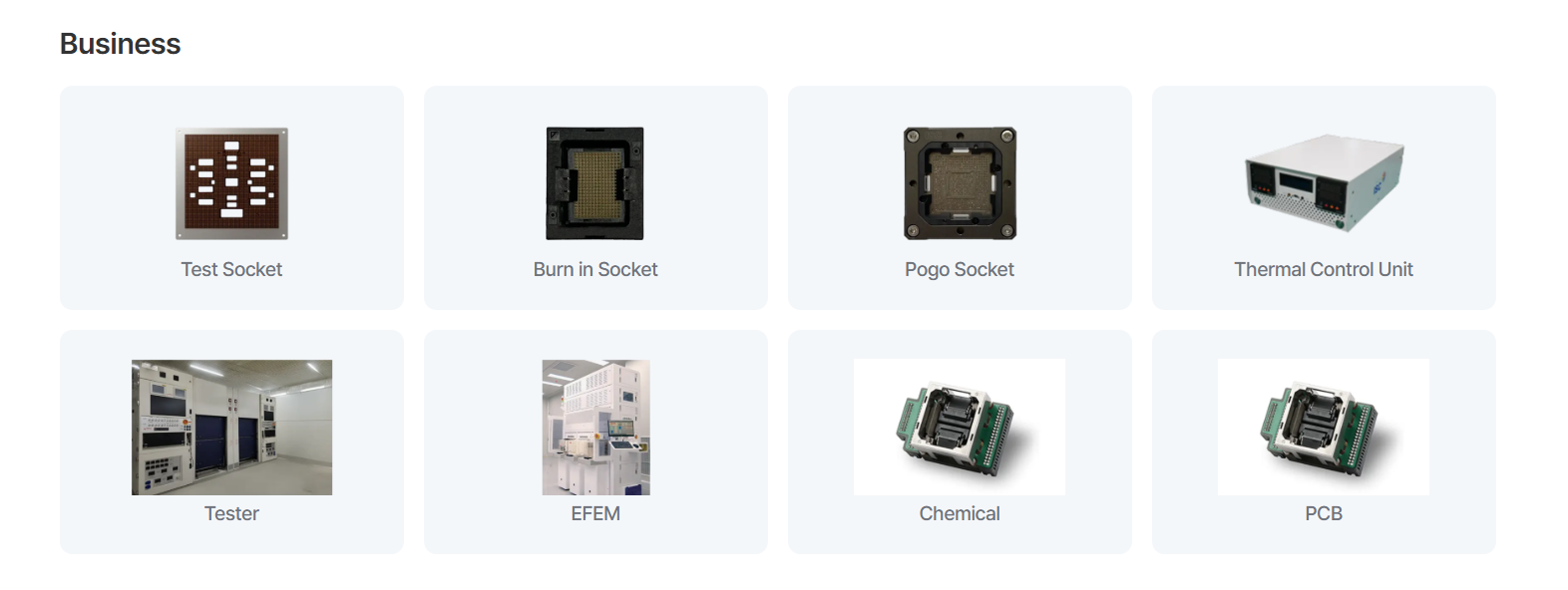
ISC (ticker: 095340) is a specialist manufacturer of semiconductor test sockets listed on South Korea's KOSDAQ exchange, the technology-heavy junior market equivalent to Nasdaq. Its core products are consumable sockets used during the electrical testing of semiconductor packages before shipment—components that must be custom-made to precise specifications and replaced frequently. The company counts major global fabless chip designers and memory-chip producers among its customers.
ISC has attracted growing attention as a critical supplier in the test-socket market, at a time when demand for high-bandwidth memory (HBM) and AI accelerator chips is expanding rapidly. SKC, the chemicals and materials arm of South Korea's SK Group (one of the country's large family-controlled conglomerates, known as chaebol), was previously a significant shareholder. SKC subsequently transferred its stake to Helios Private Equity through an exchangeable bond structure, triggering a visible change in ownership.
In late 2024, ISC published a formal corporate value-enhancement plan—part of a government-backed programme to improve capital efficiency and shareholder returns among Korean-listed companies—and has since been cited as a representative case from the KOSDAQ semiconductor components sector. The combination of record financial results and a strengthened shareholder return policy, arriving just as AI chip demand accelerates, has drawn considerable market interest.
Business Foundation and Financial Performance
Business Model and Competitive Position
ISC's business revolves around semiconductor test sockets—consumable components that are indispensable during the electrical characterisation of chips before they leave the factory. Their short replacement cycles and the need for bespoke engineering to match each chip's specifications tend to produce long-term supply relationships with customers. Once a supplier's socket is qualified and approved by a chipmaker, it typically enjoys a sustained, predictable revenue stream: what market participants call "sticky" sales.
The rise of AI computing has materially accelerated demand for testing high-value chips such as HBM stacks and AI accelerators. ISC is actively pursuing greater market share in these segments. In March 2026, the company was reported to have acquired iSemi and TechDream, extending its reach into AI accelerator testing. In the same month, iM Securities raised its target price for ISC, citing the company's ongoing exposure to AI semiconductor tailwinds and an increasingly stable revenue base.
Annual Financial Highlights
Year | Revenue | Operating Profit | Notes
2023 | Undisclosed (estimated) | Undisclosed | Semiconductor industry downturn
2024 | Estimated ₩180bn+ | — | Recovery phase
2025 | ₩220.2bn (record high) | — | Strong year-on-year growth
2026 | High-growth forecast | — | AI chip demand in full swing
ISC's full-year 2025 revenue of ₩220.2bn (approximately $160m), confirmed by a regulatory filing in February 2026, was the highest in the company's history. A surge in test-socket shipments driven by AI chip demand was the primary factor. Brokers expect continued strong growth in 2026, underpinned by anticipated long-term supply contracts linked to AI accelerator customers.
Value-Enhancement Milestones
November 2024 — Formal Plan Announced: ROE of 20% and Total Shareholder Return of 30% by 2027
On 29th November 2024, ISC published its official value-enhancement plan. The headline targets are a return on equity (ROE) of 20% and a total shareholder return ratio of 30%, both by 2027. The plan was notable for linking profitability improvement explicitly to shareholder returns, rather than merely pledging higher dividends in the short term. An ROE of 20% would substantially exceed the average for KOSDAQ semiconductor components companies, and was interpreted as a statement of management confidence.
February 2026 — Record Results and Expanded Returns Trigger Share-Price Surge
In early February 2026, ISC disclosed its record 2025 revenue alongside plans to expand shareholder returns. The combination sent the share price up by approximately 9% in a short period—an illustration of how the market rewards companies that pair genuine earnings growth with credible capital-return commitments under the value-enhancement programme.
March 2026 — Acquisitions of iSemi and TechDream Extend AI Testing Footprint
On 16th March 2026, ISC announced the acquisitions of iSemi and TechDream, broadening its capabilities in AI accelerator testing significantly. The move was widely interpreted as more than routine diversification: it represents a strategic effort to embed ISC more deeply in the AI semiconductor supply chain. Integrating the acquired companies' technologies and personnel is expected to strengthen ISC's competitive position in HBM and AI accelerator test markets. iM Securities reportedly raised its target price again in response.
June 2026 — Long-Term Supply Contracts Come into Focus
By June 2026, brokers' research notes began highlighting the prospect of ISC securing long-term supply contracts for test sockets linked to AI chip programmes. Such contracts would improve revenue predictability and provide the stable earnings base needed to underpin the company's 2027 shareholder-return targets.
Challenges and Assessment
Outstanding Challenges
Several hurdles stand between ISC and its 2027 targets. First, the durability of the AI semiconductor cycle is the critical variable. Should customers curtail capital expenditure on chip manufacturing and testing equipment, demand for test sockets would fall in tandem; securing revenue visibility in advance is therefore essential.
The post-merger integration of iSemi and TechDream is a second area to watch. How quickly ISC can absorb the acquired companies' technologies and workforces will determine its competitive positioning in AI accelerator testing.
On corporate governance, the transfer of the controlling stake from SKC to Helios Private Equity introduces medium-term uncertainty. Private equity funds operate with defined investment horizons and eventual exit strategies; any change in ownership before 2027 could disrupt the consistency of the company's stated strategic and capital-return policies.
Assessment
ISC's value-enhancement plan stands out within the KOSDAQ semiconductor components sector for the specificity of its numerical commitments. Setting explicit targets for both ROE and total shareholder return signals that the promised distributions are grounded in genuine profitability improvement rather than financial engineering. The record 2025 revenue provides tangible evidence that those ambitions are achievable.
That said, the year-by-year path to the 2027 targets has not been fully disclosed, and the semiconductor cycle remains inherently volatile. Brokerages have repeatedly raised price targets on the back of AI tailwinds, but a consensus caution persists that the company's fortunes are highly sensitive to the pace of AI capital spending.
Controversies and Limitations
Ownership Uncertainty: From SKC to Helios Private Equity
Press reports from August 2025 indicated that SKC had effectively transferred its ISC stake to Helios Private Equity via exchangeable bonds. The concern among some investors is that a financial sponsor as the controlling or near-controlling shareholder may prioritise near-term returns over long-term strategic investment. Given that ISC's value-enhancement plan centres on a 2027 target, any shift in ownership before that date could undermine policy continuity.
Short-Selling Pressure and Market Volatility
In April 2026, ISC was reported to rank among the most heavily shorted stocks on KOSDAQ. A pattern of profit-taking and short-selling pressure following sharp share-price rallies is common among companies associated with thematic investment narratives. Should the share price gains prove short-lived without corresponding improvements in underlying business value, investor confidence could erode.
Insufficient Detail in the Value-Enhancement Plan
ISC's plan sets out headline targets for 2027 but does not publicly disclose the year-by-year trajectory, the precise split between dividends and share buybacks or cancellations, or the capital allocation priorities that will guide decisions along the way. This information asymmetry makes it difficult for institutional investors and regulators to evaluate the plan's credibility and monitor its execution rigorously.
Key Figures at a Glance
Year | Revenue | Operating Profit | Shareholder Returns | ROE Target | P/B Ratio
2023 | Undisclosed | Undisclosed | Undisclosed | — | —
2024 | Est. ₩180bn+ | Undisclosed | — | — | —
2025 | ₩220.2bn (record) | Undisclosed | Record level (announced) | — | —
2026 | High-growth forecast | Undisclosed | Expanding | — | —
2027 target | — | — | Total return ratio: 30% | 20% | —
> Key events: Formal value-enhancement plan announced, November 2024 · Record annual revenue reported, February 2026 · Share price rises ~9%, February 2026 · Acquisitions of iSemi and TechDream to expand AI accelerator testing, March 2026