Company Overview
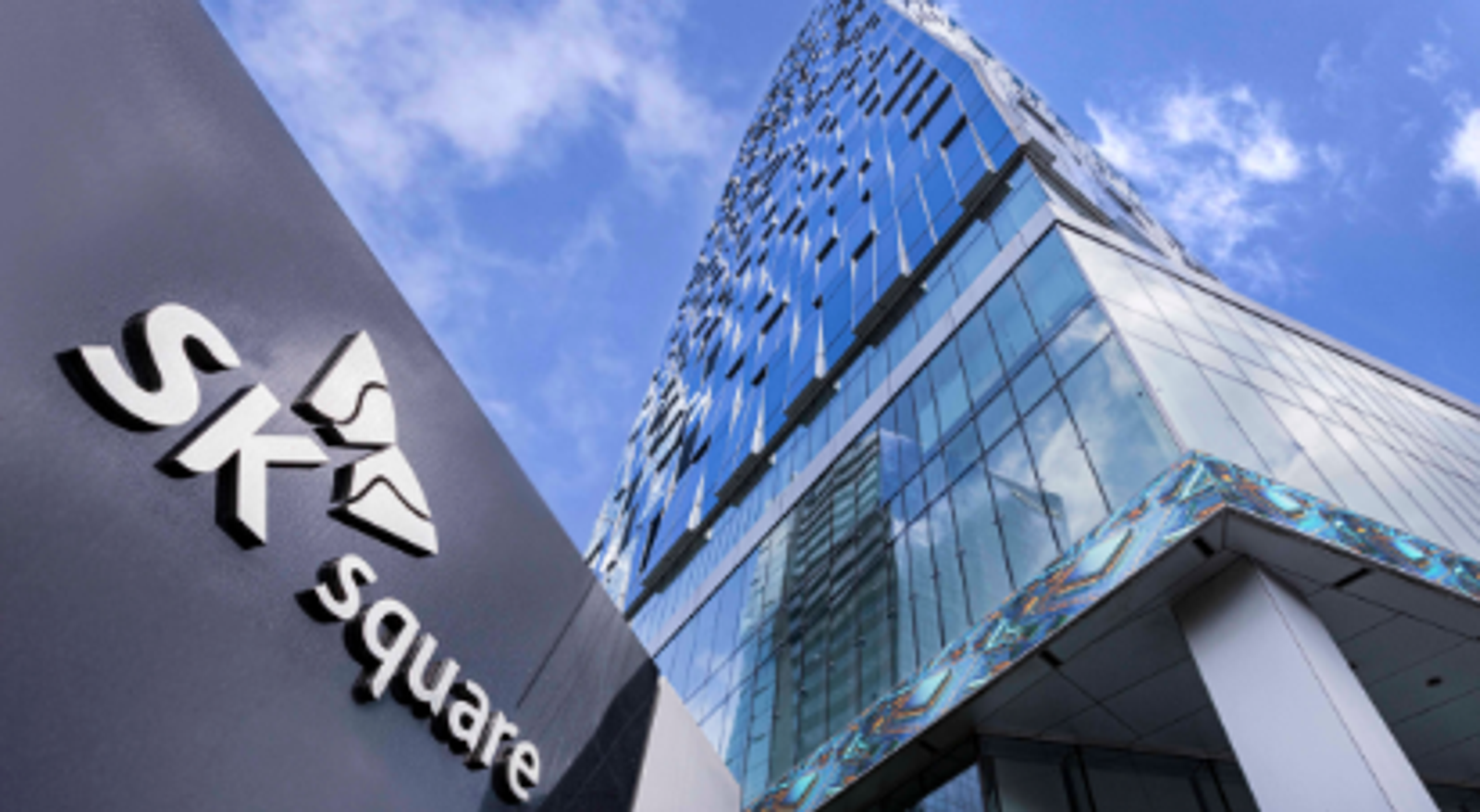
SK Square is a pure holding company created in November 2021 when SK Telecom carved out its ICT investment division into a separately listed entity on the KOSPI, South Korea's main stock exchange. Its crown jewel is a large stake in SK Hynix, the world's second-largest memory chipmaker, alongside a portfolio of smaller holdings including One Store, SK Shieldus, and Contentwaves.
From its very first day of trading, SK Square was dogged by a problem common to holding companies everywhere: its share price stubbornly traded at a steep discount to the combined market value of its subsidiaries. In South Korea, this "NAV discount"—where NAV stands for net asset value—has historically exceeded 50% for many conglomerates, reflecting investor scepticism about corporate governance, capital allocation, and the efficiency of the holding-company structure itself. At SK Square, with SK Hynix accounting for the overwhelming bulk of its assets, the discount attracted particular scrutiny. Management responded by making the reduction of that discount a central strategic priority—earning SK Square recognition as one of the more proactive participants in South Korea's broader push, formalised under the government's "Korea Value-Up Programme" in 2023, to improve returns to shareholders across listed companies.
Business Foundation and Financial Performance
The Core Asset: SK Hynix
SK Square's fortunes are inseparable from those of SK Hynix. As of June 2026, the Hynix stake is reported to account for roughly 99% of SK Square's NAV. The spectacular rise in SK Hynix's share price—driven by booming demand for high-bandwidth memory (HBM) chips used in artificial-intelligence applications—has lifted SK Square's asset value in lockstep. This concentration is a double-edged sword: it has delivered outsized gains during the AI semiconductor boom, but it leaves SK Square acutely exposed to any downturn in the chip cycle.
Portfolio Rebalancing
SK Square was originally assembled with a range of non-semiconductor holdings—One Store (an app marketplace), SK Shieldus (security services), Dreamus Company (music streaming), Contentwaves (video streaming), and 11Street (e-commerce), among others. Management has pursued what it terms a "rebalancing" strategy, divesting non-core assets. The paradox is that these disposals have, if anything, increased the company's concentration in SK Hynix rather than reducing it, fuelling both praise for disciplined capital allocation and criticism of dangerous over-reliance on a single asset.
Financial Performance by Year
Year | Key Financials | Shareholder Returns | Price-to-Book Ratio
2022 | Operating losses at holding-company level; equity-method losses from SK Hynix | Share buyback under consideration | 0.4–0.5×
2023 | Gradual improvement; benefiting from SK Hynix's recovery | Share buybacks begin in earnest | ~0.5×
2024 | Substantial equity-method gains as SK Hynix rides AI boom | Dividends increased; buybacks expanded | 0.5–0.6×
2025 | Stable equity-method income | Buybacks and cancellations proceed alongside dividend growth | High 0.6×
2026 (H1) | SK Hynix continues to rise; share price moves from 500,000 won to above 1,000,000 won | 76bn won share cancellation | Approaching 1×
*Note: SK Square's profits are reported primarily through the equity method, meaning its share of subsidiaries' earnings flows through to its income statement rather than being consolidated as direct revenues.*
Value-Up Milestones
2022–2023: Launching the Buyback Programme
From early in its listed life, SK Square recognised that a NAV discount exceeding 50% was unsustainable. Rather than relying solely on dividends—the traditional tool of South Korean holding companies—management opted for share buybacks as its primary mechanism for returning capital. The rationale was straightforward: reducing the share count mechanically increases per-share asset value, creating a more direct link between capital allocation and the discount-narrowing goal. This approach laid the groundwork for a more comprehensive shareholder-return framework that would later incorporate share cancellations.
November 2025: A Formal Value-Up Roadmap with a Specific Target
In November 2025, SK Square published a detailed medium-to-long-term value-up plan, committing to reduce its NAV discount to 30% by 2028. The precision of this target was notable—few South Korean holding companies have ever attached a specific number to their discount-reduction ambitions. The plan's tools included continued share buybacks and cancellations, dividend growth, and further portfolio rationalisation. By putting a quantified goal on record, management simultaneously signalled confidence and accepted accountability.
January 2026: The Share Price Breaks 500,000 Won
At the end of January 2026, SK Square's share price crossed the 500,000 won threshold for the first time, a level the market interpreted as tangible validation of the value-up strategy. Analysts pointed to a combination of factors: ongoing buybacks and cancellations, the AI-driven surge in SK Hynix's share price, and growing investor confidence that the NAV discount would continue to narrow. Sell-side brokers began to describe SK Square as a model of disciplined capital allocation among South Korean conglomerates.
March 2026: A 76bn Won Share Cancellation
In March 2026, SK Square announced the cancellation of 76bn won (approximately $55m) worth of treasury shares. Unlike a buyback alone—which merely parks shares in the company's own hands—a cancellation permanently extinguishes them, reducing the share count in perpetuity and directly boosting per-share NAV. The market greeted this as evidence that the company's shareholder-return commitments were more than rhetorical. DB Investment & Securities raised its target price to 1,450,000 won; other brokers followed suit.
June 2026: Outpacing SK Hynix; KOSPI's Third-Largest Company
By June 2026, SK Square's shares were rising faster than those of SK Hynix itself—an unusual inversion that reflected the additional re-rating premium investors were attaching to the discount-narrowing story. Daeshin Securities set a target price of 1,870,000 won, citing the expected further compression of the NAV discount and residual upside in SK Hynix. SK Securities highlighted a "dividend transmission effect": as SK Hynix expands its own shareholder returns, that cash flows up to SK Square, enhancing its capacity to reward its own investors. The company consolidated its position as the third-largest company by market capitalisation on the KOSPI, behind Samsung Electronics and SK Hynix.
Challenges and Assessment
Challenges Ahead
Reaching the 30% NAV discount target by 2028 requires addressing three structural problems.
Dependence on SK Hynix. With 99% of NAV tied to a single cyclical semiconductor company, SK Square's fortunes are hostage to memory-chip market conditions. A downturn in HBM demand or a broader semiconductor correction could rapidly reverse recent gains. The irony is that a rebalancing strategy ostensibly designed to diversify has instead concentrated the portfolio further.
Sustaining the dividend. Analysts have noted that "the next leg of the rally depends on dividends"—and SK Square's ability to pay them hinges almost entirely on the dividends it receives from SK Hynix. If SK Hynix enters a heavy capital-expenditure cycle and trims its own payout, SK Square's dividend capacity will shrink accordingly.
Keeping up the share cancellations. Whether the 76bn won cancellation announced in March 2026 becomes an annual fixture or remains a one-off is a critical question. Consistency matters: investors will discount promises of future cancellations if the track record is patchy.
Overall Assessment
SK Square's value-up journey has several claims to genuine novelty in the South Korean context: a quantified NAV discount target, a combination of buybacks and cancellations (rather than dividends alone), and a publicly acknowledged commitment to capital discipline. By the first half of 2026, the results appeared encouraging—the share price had outperformed SK Hynix, and analyst target prices had reached 1,870,000 won. Yet the sustainability of these gains is structurally contingent on SK Hynix's continued success. Until SK Square can demonstrate independent value-creation capacity—rather than acting, in effect, as a leveraged vehicle for a single chip company—that caveat will remain.
Controversies and Limitations
The Hynix Shadow: The Uncomfortable Truth of 99% Concentration
The most pointed criticism of SK Square is that it is less a diversified investment holding company than a leveraged proxy for SK Hynix. A portfolio that began with genuine breadth—app stores, cybersecurity, streaming services, e-commerce—has been progressively stripped back until one asset dominates almost entirely. Critics argue this makes SK Square's premium over a direct Hynix investment difficult to justify, and leaves shareholders with no meaningful buffer if the chip cycle turns.
Who Deserves Credit for the Rally?
It is genuinely difficult to disentangle the contribution of management's value-up initiatives from the external tailwind of the AI semiconductor supercycle. Share cancellations and a clear NAV discount target deserve credit; but had SK Hynix's shares remained flat or declined, SK Square's own price would almost certainly have done the same, regardless of how many treasury shares were cancelled. The internal and external drivers of performance are inseparable—and that is precisely the problem.
Can the 30% Target Actually Be Reached?
Reducing a NAV discount from roughly 60% to 30% in three years is an ambitious undertaking. Arithmetically, it requires either a significant rise in SK Square's share price relative to its NAV, a fall in NAV (which would be unwelcome), or both simultaneously. Unless SK Square can demonstrate genuine independent value creation—rather than relying on SK Hynix's share price to do all the heavy lifting—the target remains hostage to external variables the company cannot control.
The Structural Limits of Dividend Capacity
SK Square's own operating cash flows are modest. Its capacity to pay dividends depends on what flows up from subsidiaries, principally SK Hynix. When chip companies invest heavily in new capacity—as SK Hynix must to stay competitive in HBM—their free cash flow and dividends typically fall. That transmission risk runs directly from Hynix's capital-expenditure decisions to SK Square's shareholder-return policy: a dependency that the brokerage community has explicitly flagged.
Key Data Summary
Year | Dividend | Buybacks / Cancellations | Equity-Method Earnings | NAV Discount (est.) | Price-to-Book
2022 | Minimal | Under consideration | Losses (Hynix in red) | High 50s % | 0.4–0.5×
2023 | Small dividend | Buybacks begin | Hynix recovery | Mid-50s % | ~0.5×
2024 | Rising | Buybacks expand | Hynix AI boom | Low 50s % | 0.5–0.6×
2025 | Dividend + buybacks | Cancellations begin | Stable gains | 40s % | High 0.6×
2026 (H1) | Further increase expected | 76bn won cancellation | Hynix continues to rise | Approaching 30% target | ~1× (est.)
Key reference points - June 2026 broker target prices: Daeshin Securities 1,870,000 won; DB Investment & Securities 1,450,000 won (May) - November 2025 value-up commitment: NAV discount below 30% by 2028 - January 2026: share price exceeds 500,000 won - 2026 KOSPI ranking: third by market capitalisation, behind Samsung Electronics and SK Hynix