Justem (KOSDAQ: 417840), a South Korean manufacturer of semiconductor equipment components, achieved record quarterly earnings in the second quarter of 2026. In a research report published on 13th August, SK Securities forecast that the company's growth trajectory would be sustained through the second half of the year.
For the April-to-June quarter, Justem reported revenue of 29.3bn won, up 159.3% year on year. Operating profit surged 345.9% over the same period to 9.3bn won, pushing the operating margin to 31.6%—a record high on a quarterly basis.
SK Securities attributed the strong results to two main factors. First, demand for yield improvement on existing production lines ahead of new semiconductor fab construction drove a broad-based expansion in shipments of Justem's nitrogen-purge (N₂ Purge) systems across all of its customers. Second, the depreciation of the won against the dollar amplified the company's operating leverage.
In the second quarter, Micron accounted for roughly 50% of revenue, SK Hynix for 30%, and Samsung Electronics for 20%. The fact that Justem supplies all three of the world's major integrated device manufacturers (IDMs) is considered a structural source of earnings stability.
Order indicators are also strong. New orders in the first half of 2026 reached 71.8bn won, already surpassing the full-year 2025 figure of 54.4bn won with six months still to run. Even after accounting for revenue recognised during the first half, the order backlog remains above 40bn won.
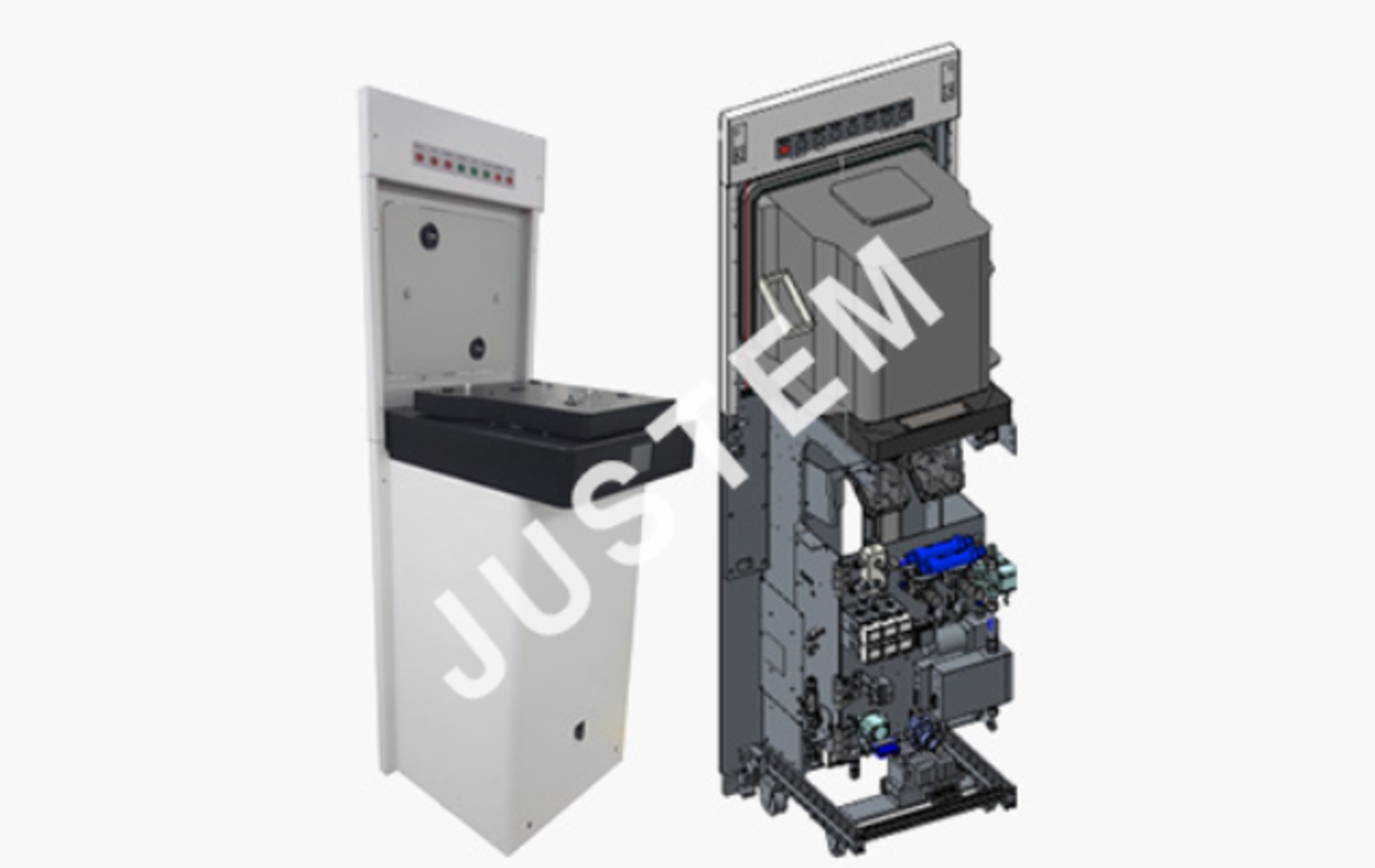
Justem's core product is a first-generation N₂ Purge system that injects nitrogen into FOUPs (Front Opening Unified Pods, the sealed containers used to transport silicon wafers) to prevent oxidation and contamination. Compatible with more than 110 models across 11 load-port-module (LPM) manufacturers, the system has been adopted as a standard by all three IDM customers, giving Justem a market share of over 80%. This product line accounts for approximately 75% of total revenue.
Also drawing attention is the upselling potential of the second-generation JFS (Jet Flow Straightener), which is sold as an add-on to the first-generation system. While the first-generation product has been installed in roughly 27,000 cumulative units, only around 2,300 second-generation units have been deployed—a penetration rate of just 8%. SK Securities estimates that rolling out the second-generation system across existing installed lines could unlock additional revenue potential of approximately 250bn won.
SK Securities projects Justem's full-year 2026 revenue at 112.1bn won, up 132.2% year on year, with operating profit of 33.7bn won—a 626.9% increase, representing a 30.1% operating margin. For 2027, it forecasts revenue of 147.3bn won and operating profit of 46.1bn won.
Three drivers are identified for 2027 growth: expanded shipments of Side Track Buffers (STBs) to Micron; the commissioning of SK Hynix's new Y1 fab in Yongin, scheduled for the first quarter of 2027; and a full-scale ramp-up of new supply agreements with Samsung Electronics. On Samsung specifically, SK Securities notes that while orders are growing at the P3, P4, and Taylor fabs, supply is also gradually penetrating the previously underserved P1 and P2 lines as well as Samsung's foundry operations—giving Samsung the greatest medium-to-long-term growth potential of the three customers.
Investors should nonetheless weigh several risks. Justem's revenue growth is closely tied to customer concentration: with Micron representing half of total sales, any downturn in the global semiconductor cycle or reduction in capital expenditure by that customer would have a direct impact on earnings.
The currency effect is a double-edged sword. Since the appreciation of the dollar against the won was one of the drivers of the second-quarter operating-profit surge, a reversal in the exchange rate could put corresponding pressure on margins.
Additionally, Justem's third-generation product, the JDM (EFEM Dry Module), has yet to enter mass production. Delays in commercialisation or failure to secure customer adoption remain variables in the medium-to-long-term growth scenario.
Based on its share price of 13,850 won as of 12th August, the stock trades at roughly seven times SK Securities' estimated 2027 net profit—approximately 27% below its 52-week high of 18,990 won. Its market capitalisation stands at 31.7bn won. SK Securities does not carry a target price on the stock and maintains a Not Rated designation.