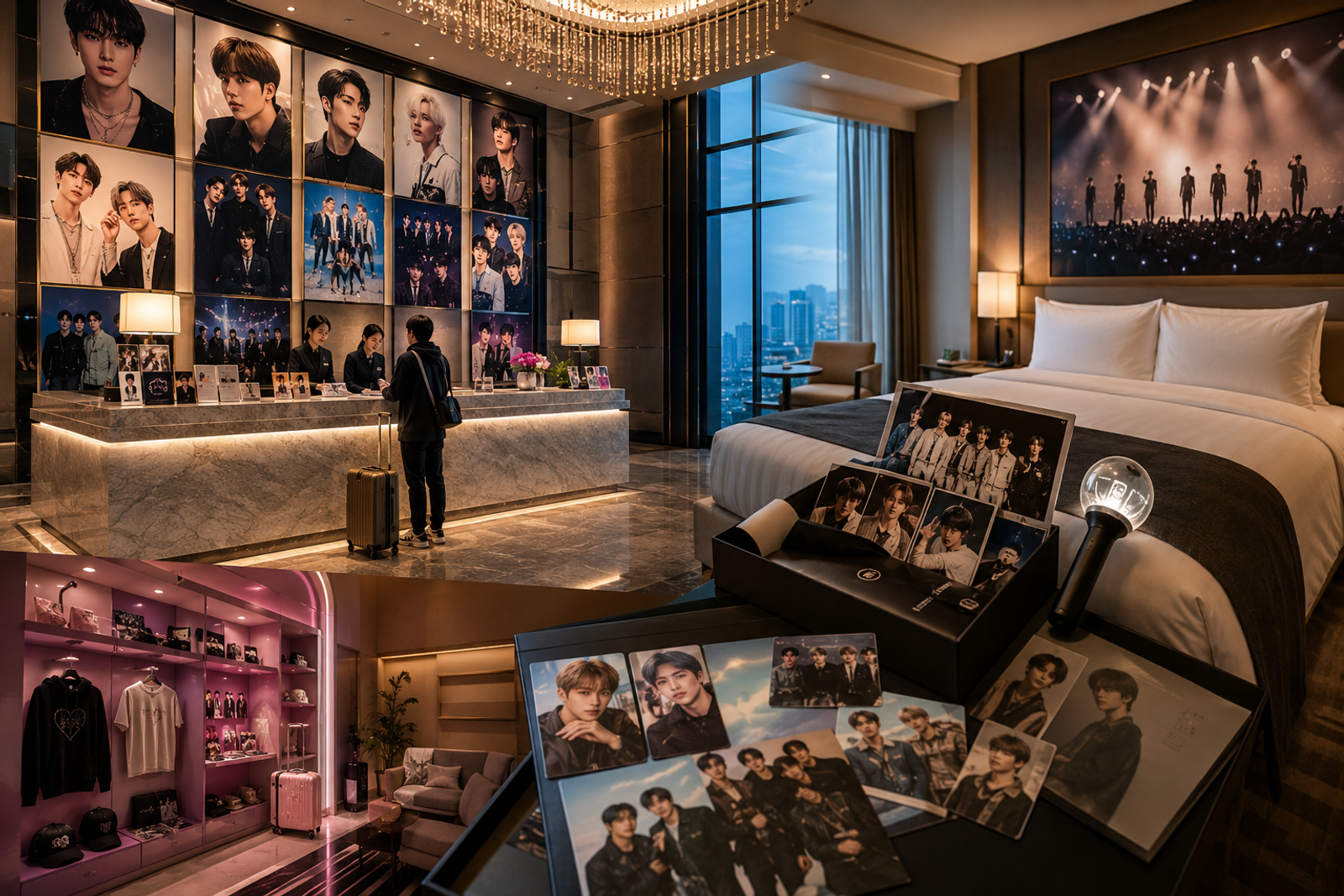
Walk into the lobby of a luxury hotel in Seoul's Yongsan district and the scene is unlike any conventional five-star welcome. Album artwork from a particular idol group covers the walls. Front-desk staff wear branded merchandise. In the room, a welcome kit contains photocards and a handwritten signature. "Fandom hotel packages" are establishing themselves as a serious new revenue stream in South Korea's hospitality industry.
According to the Korea Tourism Organisation, of the 11.03 million foreign visitors who came to South Korea in 2023, roughly 32.4% cited K-pop or Korean Wave content as a primary motive for their trip—up about 8 percentage points from a comparable survey in 2019. In Southeast Asia, Japan and North America, where female travellers in their 20s and 30s predominate, that share exceeded 40%. The numbers confirm that fandom spending is no longer the exclusive preserve of the music and concert industries.
Hotels chase the fandom economy
Among South Korea's luxury hotels, those running official collaboration packages with K-pop artists rose from five in 2021 to more than 30 by 2024, according to industry data. Lotte Hotels & Resorts launched an "Artist Stay" package tied to acts on HYBE's roster—HYBE being the entertainment conglomerate behind BTS—and reported that it sold out within 72 hours of going on sale. Grand InterContinental Seoul Parnas partnered with SM Entertainment to offer a dedicated package timed to a specific group's concert run; the hotel disclosed that its share of foreign guests during that period was 21 percentage points higher than usual.
The packages themselves are growing ever more elaborate. Beyond simple merchandise giveaways, hotels now offer "replica rooms" recreating the interiors where artists are said to have stayed, bundled deals combining fan-meeting tickets with accommodation, and "celebrity dining" menus reflecting an artist's reported food preferences. Some properties are piloting an AI-powered "fandom concierge" that mimics an artist's speech patterns.
The economics of fandom tourism
Fandom tourists spend more freely than ordinary visitors, which explains the hospitality industry's eagerness to court them. A 2023 report by the Korea Culture and Tourism Institute found that visitors whose primary purpose was K-pop fandom spent an average of 2.36 million won (roughly $1,770) per trip—59.5% more than general tourists, who spent around 1.48 million won. The gap in accommodation choices was equally striking: 61% of fandom tourists opted for four-star hotels or above, compared with 38% of all foreign visitors.
"Fandom tourists have their dates and length of stay fixed in advance around concert and fan-meeting schedules, which makes targeted marketing highly efficient," said one hotel industry executive. "The ability to attract a loyal, high-spending cohort at relatively low marketing cost is the main driver behind the expansion of these partnerships."
A structure that suits both sides
Entertainment companies find the arrangement equally attractive. A luxury hotel provides a premium platform that reinforces an artist's brand image, while the label earns royalties from package sales. SM Entertainment, YG Entertainment and HYBE all identified "licensing and brand collaboration" as a new revenue stream in their 2023–24 annual reports. HYBE's licensing-related revenues grew roughly 38% year on year in 2023, with hospitality and food-and-beverage partnerships reportedly accounting for a significant share of that increase.
"The strategy of K-pop agencies expanding their music intellectual property into lifestyle brands is structurally similar to the way Disney has monetised its IP through theme parks and hotels," said Lee Ji-haeng, a professor of media studies at Ewha Womans University.
A global phenomenon with Korean characteristics
The fusion of fandom and hospitality is not unique to South Korea. Japan has hosted "pilgrimage tourism" tied to anime and idol groups since the early 2000s, a market worth hundreds of billions of yen annually. Idol-collaboration hotels in Tokyo command average room rates 40–60% above comparable standard properties during peak periods, yet remain fiercely oversubscribed.
In the United States, Taylor Swift's Eras Tour pushed average hotel room rates up by as much as 300% in cities along the tour route—a phenomenon journalists dubbed the "Swift economy." The Federal Reserve Bank of Philadelphia published a report estimating the direct economic impact of Swift's concerts on the region at several hundred million dollars. South Korea's K-pop hotel model can be read as an attempt to institutionalise and make permanent what elsewhere has tended to be a sporadic, artist-dependent windfall.
The downsides: excess, barriers to entry and fan fatigue
The picture is not uniformly rosy. Fandom packages are typically priced at two to three times the standard room rate, and accusations of "exploiting fan devotion" surface regularly in online fan communities. When one major hotel last year priced a group collaboration package at over one million won per night, the hashtag #FandomExploitation spread rapidly across social media, sparking a short-lived boycott campaign.
Privacy concerns are also emerging. Marketing that advertises "the room where the artist actually stayed" can, critics point out, expose an artist's location without their consent or proper agreement. The Korean Entertainment Law Association has publicly called for clear legal guidelines delineating the boundary between protecting an artist's right of publicity and its commercial exploitation.
The model's structural weakness is its seasonal nature. Demand for fandom packages clusters around concert tours and album releases; during the inevitable quiet periods between an artist's activities, it can evaporate, making stable year-round revenue difficult to sustain.
Policy and industry challenges
The South Korean government designated K-pop fandom tourism as one of three high-value tourism categories—alongside medical and shopping tourism—under its 2024 "Korean Wave Tourism Promotion Plan." The Ministry of Culture, Sports and Tourism has established a dedicated unit to support hotel-entertainment partnerships and is considering streamlining visa procedures for fandom tourists.
Experts advise that long-term viability requires reducing dependence on individual artists and repositioning K-pop as a genre and industry—rather than any single act—as the tourism draw. "If you remain dependent on the popularity cycle of individual artists, sustainability cannot be guaranteed," said Yoon Ji-hwan, a professor at Kyung Hee University's College of Hotel and Tourism Management. "The industry needs to evolve towards 'meta-fandom tourism'—turning the entire production ecosystem into content, through experiences such as visiting recording studios or gaining an insight into trainee culture."
K-pop is evolving beyond a music genre into an integrated cultural economy that spans accommodation, dining and fashion. Just how far the Korean Wave's economic reach will extend is a question being answered, in real time, in hotel lobbies across Seoul.