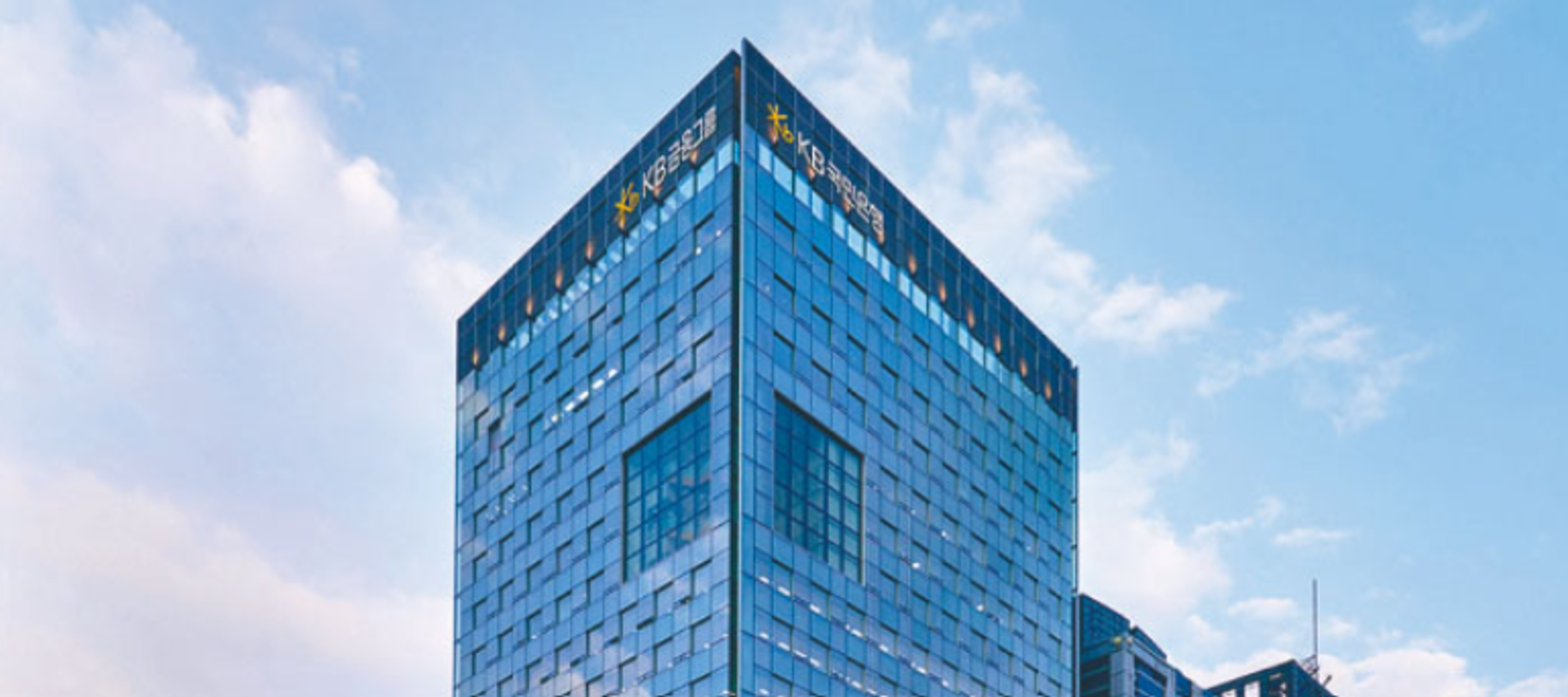
KB Financial Group posted net profit attributable to controlling shareholders of 1.9922 trillion won in the second quarter of 2026, setting an all-time record. The result was 5.3% higher than the previous quarter and 14.6% above the same period a year earlier. The driving force was non-interest income, which surged to 1.9780 trillion won — approaching the 2-trillion-won mark for the first time on a quarterly basis.
Non-interest income jumped 19.8% quarter-on-quarter and 38.2% year-on-year, propelled by a buoyant stock market. Average daily trading volume on Korean equity markets exceeded 90 trillion won in the second quarter, up 36.4% from the first quarter. That windfall swelled brokerage revenues at KB Securities and lifted fee income at the group's banking arm.
KB Securities had a particularly strong first half, earning 796.3 billion won in net profit — a 135% increase on the same period last year. The holding company injected 1 trillion won of fresh capital into the securities subsidiary in June alone and has pumped a total of 1.7 trillion won into it this year. Part of the rationale is straightforwardly commercial: expanding retail credit lines and strengthening investment-banking and trading capabilities during a period of market exuberance. But regulatory ambition also plays a role. KB Securities is building up its equity base to meet the criteria for an IMA (Integrated Management Account) licence, which requires maintaining at least 8 trillion won in shareholders' equity for two consecutive years. An IMA licence would allow the firm to manage client deposits and offer a broader range of investment products.
The interest-income side of the business was less inspiring. The bank's net interest margin (NIM) slipped 3 basis points to 1.74%, squeezed by intensifying competition for large corporate loans. The group-wide NIM fell 5 basis points to 1.94%, from 1.99% in the first quarter. Should interest-rate cuts continue — as many expect — pressure on interest income will persist, making the stability of the shift towards fee-based earnings the central question for investors going forward.
Asset-quality indicators remain relatively healthy. The common equity tier-1 (CET1) capital ratio stood at 13.74% at the end of June, up slightly from 13.63% at the end of March. Won-denominated loans grew 1.6% quarter-on-quarter to 385.067 trillion won. Credit costs fell 20.7% year-on-year to 52 billion won, signalling disciplined risk management.
One variable worth watching is the provisioning related to the default of Joongang Group, a Korean conglomerate. Daeshin Securities estimates that KB Kookmin Bank, KB Capital and KB Asset Management together face potential provisions of around 59 billion won related to the group (with an estimated 15 billion won yet to be set aside). For now, the exposure is manageable, but the fragility of the property project-finance market means the risk of further deterioration cannot be entirely dismissed.
Shareholder returns this year are the most generous among Korea's major financial holding companies. Combined cash dividends of 1.62 trillion won and share buybacks of 2.08 trillion won bring the total planned distribution to 3.7 trillion won. Daeshin Securities expects that, beyond the 700 billion won in buybacks already authorised for the second half, at least a further 180 billion won will be executed in the fourth quarter — meaning second-half buybacks alone will effectively approach 1 trillion won.
The trajectory of KB Financial's payout ratio tells its own story: 38.7% in 2023, 39.7% in 2024, and a projected 53.9% in 2026. Among Korea's four largest financial holding companies (KB, Shinhan, Hana and Woori), KB is the most aggressive in returning capital to shareholders, and its policy has become the benchmark against which the sector's valuation re-rating is being assessed.
On valuation, the group's projected price-to-book ratio for 2026 stands at 0.99 times — within striking distance of par. That represents a dramatic re-rating: KB Financial once traded for years at 0.3 to 0.5 times book value, but its share price has risen more than 75% over the past 52 weeks, from 106,000 won to 186,200 won, driven by the government's "value-up" programme encouraging listed companies to improve capital efficiency, and by KB's own expanding shareholder distributions. With 2026 earnings per share forecast to grow 15.1% and total returns by 21.5%, and given that most large banks globally trade above book value, some analysts argue that KB Financial remains undervalued.
That said, investors should be clear-eyed about the risks. NIM compression looks set to continue. Non-interest income, meanwhile, is closely correlated with equity-market trading volumes — meaning a cooling stockmarket could trigger a sharp reversal. The critical question is whether the current performance reflects structural improvement or merely the temporary spoils of an unusually active market. Two additional medium-term considerations deserve attention: how the large capital injection into KB Securities affects group-wide capital efficiency, and how quickly the securities arm can monetise the IMA licence, if and when it is granted.