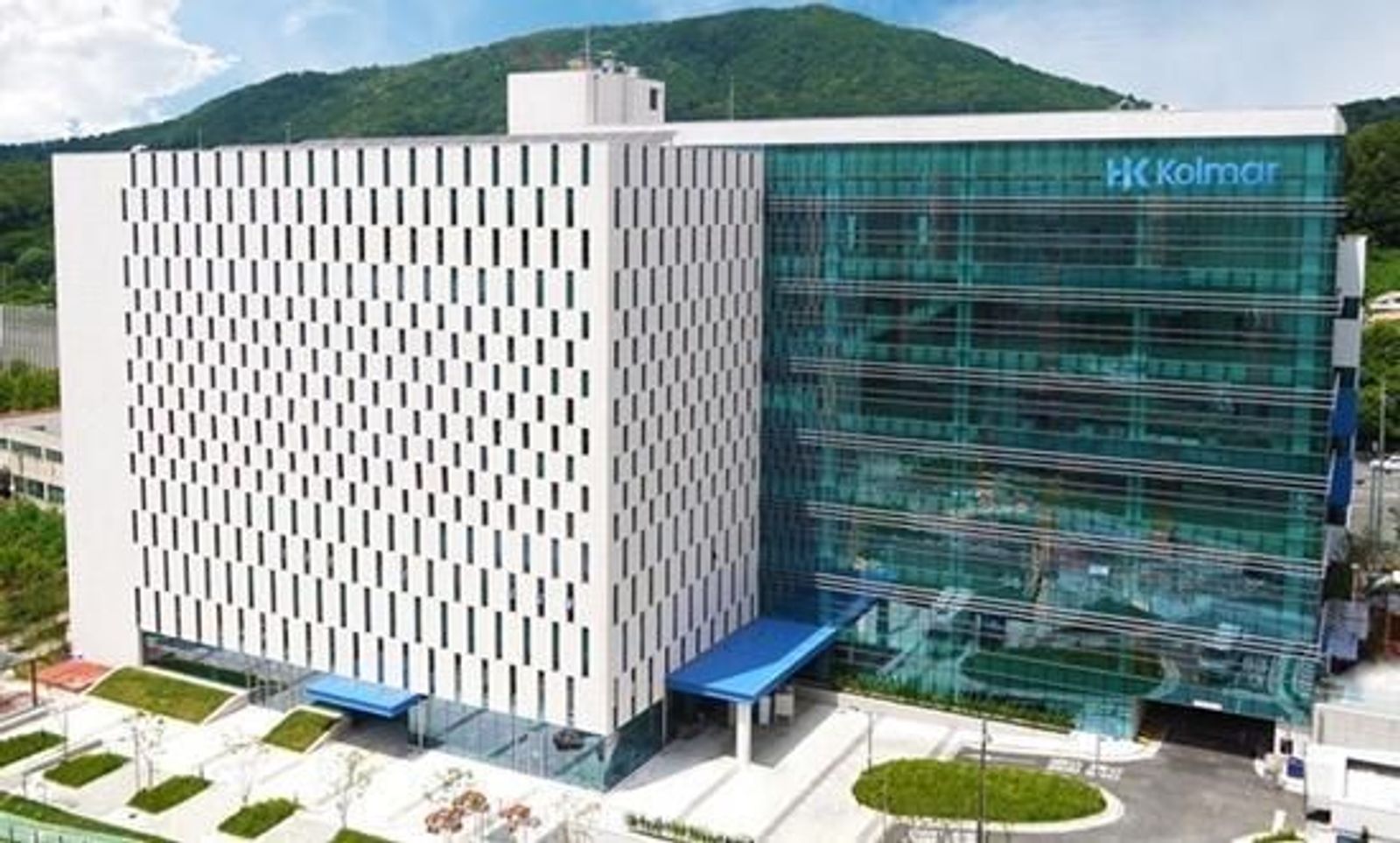
Korea Kolmar recorded its highest-ever quarterly operating profit in the second quarter of 2026, surpassing 100bn won for the first time in its history. The milestone is more than a numerical record: it encapsulates a structural shift now reshaping the entire K-beauty manufacturing ecosystem.
Breaking through the 100bn-won ceiling
Reaching 100bn won in a single quarter signals that Korea Kolmar has completed its transformation from a straightforward OEM (original equipment manufacturer) — producing goods to a client's specification — into a high-value ODM (original design manufacturer) that handles product conception, formulation, and production in its own right. Because ODM manufacturers control the full development process, their margins are substantially higher than those of pure OEMs. Industry estimates suggest Korea Kolmar's operating margin is approaching, or may already exceed, double digits — a level that places it among the most profitable cosmetics ODM companies globally.
The Korean cosmetics ODM market is effectively a duopoly, shared between Korea Kolmar and its rival Cosmax. Yet this result hints that the gap between the two may be widening. Korea Kolmar is regarded as having moved faster in diversifying both its global production footprint and its product portfolio.
Three engines driving the surge
Three factors account for the profit leap.
First, an explosion in K-beauty exports to North America and Europe. Demand in the United States for Korean functional skincare and sun-care products has grown at an unprecedented pace, turning Korea Kolmar's American subsidiary into a profit centre comparable in importance to its domestic parent. Independent beauty brands in the US, lacking their own manufacturing infrastructure, have come to rely structurally on Korean ODM suppliers.
Second, premiumisation within the sunscreen and skincare categories. As consumers demand higher SPF ratings, vegan certifications, and clean-beauty credentials, average selling prices have risen accordingly. The ability to develop proprietary formulations — rather than simply running high-volume production lines — is now directly reflected in the company's margins.
Third, the proliferation of independent Korean beauty brands. A rapidly growing number of small and mid-sized labels, which outsource all production to Korea Kolmar rather than investing in their own facilities, has swelled the company's order book. These brands, responding to fast-moving trends on TikTok and Instagram, require small-batch, high-variety production runs — a model that suits Korea Kolmar's flexible manufacturing systems.
How it compares with global rivals
Korean companies already occupy a dominant position in the global beauty ODM market. European players such as France's Intercos and Italy's Gruppo Naxos hold strong positions in colour cosmetics, but Korea Kolmar is widely regarded as one of the very few large-scale ODM companies to combine proprietary technology in skincare and functional products with competitive pricing. Intercos is understood to generate operating margins in the mid-single digits annually; Korea Kolmar's profitability is now believed to exceed that benchmark.
The comparison with Chinese ODM producers is also instructive. Chinese manufacturers have been undercutting rivals on price to gain share in South-East Asian markets, but the industry consensus is that a significant gap in quality assurance and certification standards still separates Korean ODM products from their Chinese equivalents. The premium associated with the K-beauty brand is, in effect, being transferred upstream to the manufacturers themselves.
Risks: not all upside
Optimism, however, should be tempered. Exchange rates are a double-edged sword: a stronger dollar boosts the won-equivalent value of export revenues, but also raises the cost of imported raw materials. Korea Kolmar's continued dependence on China for certain ingredients leaves it exposed to supply-chain disruption.
US trade policy adds another layer of uncertainty. Should Washington impose additional tariffs on cosmetics imports under the banner of protecting domestic manufacturing, Korea Kolmar would likely need to accelerate local production at its American facilities — implying higher capital expenditure in the near term.
Some analysts warn that the current boom in independent beauty brands is partly cyclical. If consumer sentiment cools, order volumes could become volatile. "Korea Kolmar's results are impressive, but one should examine closely its concentration of revenue among its top ten clients and its exposure to any single product category," cautious observers note.
Pharmaceuticals: a hidden growth pillar
Korea Kolmar is not purely a cosmetics business. Its pharmaceutical ODM arm, Kolmar Pharma, has maintained steady growth in contract manufacturing for health supplements and prescription drugs, driven by the demands of an ageing population. This dual-platform structure — spanning both cosmetics and pharmaceuticals — provides a buffer against economic cycles. In a downturn for the beauty sector, the pharmaceutical division can sustain reliable cash flows, offering a degree of risk diversification unavailable to single-sector ODM peers.
Outlook and broader implications
Securities analysts broadly expect Korea Kolmar to set a new annual operating-profit record in 2026 as a whole. Seasonal demand from the US and Europe in the second half of the year, combined with a gradual recovery in the Chinese market, should provide further momentum.
Korea Kolmar's results are emblematic of a structural reordering within the K-beauty industry. Where brand power was once the defining asset, the manufacturing infrastructure and technical capabilities that underpin those brands are now recognised as independent sources of global competitive advantage. The previously invisible engine of K-beauty is moving to centre stage.
There is a growing chorus of voices calling on the South Korean government to respond in kind — with targeted support for ODM infrastructure, diversification of raw-material supply chains, and stronger assistance with overseas regulatory certification. Korea Kolmar's 100bn-won breakthrough is not merely one company's success story. It is a compass pointing towards how Korean manufacturing can survive and grow in global markets.