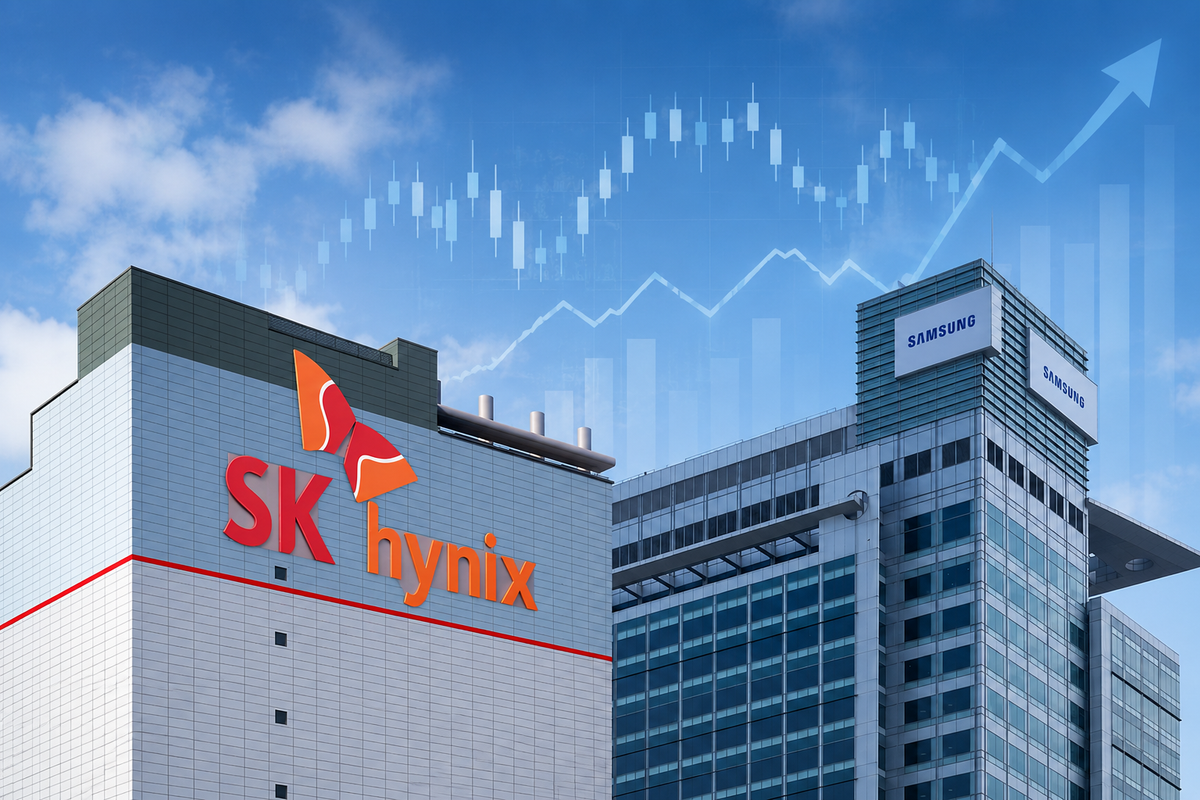
On the final trading day of July, South Korea's benchmark KOSPI index posted its largest single-day gain on record. Samsung Electronics surged 27%, and SK Hynix hit its daily price limit for the first time in 17 years. The question gripping the market is whether this marks a genuine turning point — or merely a dead-cat bounce.
What happened
On July 31st, the KOSPI soared 993.83 points, or 17.91%, to close at 6,595.45 — the index's biggest one-day percentage gain in history. The moves in the two largest stocks by market capitalisation were particularly dramatic. Samsung Electronics jumped roughly 25% at the open, triggering a two-minute trading halt under Korea's static circuit-breaker mechanism, before closing up 26.81% at 262,500 won — its biggest single-day gain since listing. SK Hynix came within a whisker of its daily limit during the session, pulled back, then surged again in the afternoon to close up 29.95% at 1,718,000 won — at the full daily ceiling. It was the first time SK Hynix had hit the limit since South Korea widened its daily price band from ±15% to ±30% in June 2015. SK Square, SK Hynix's largest shareholder, also closed at its daily limit. The rally clawed back all of Samsung's losses over the previous three trading sessions (which had totalled 19.34%), and recovered 94.6% of SK Hynix's recent decline. Even so, both stocks remain well below their June peaks — Samsung by 27.59% and SK Hynix by 41.14%.
The immediate trigger came from America. On July 30th, Microsoft reported results that beat market expectations, partly allaying doubts about the sustainability of AI investment. Overnight on Wall Street, memory and storage companies rallied sharply — Micron rose 18.36%, SanDisk 25.99%, and Western Digital 15.37% — lifting the Philadelphia Semiconductor Index by 8.19%. Foreign investors net-bought 7 trillion won (roughly $5.1 billion) of Korean equities in the KOSPI cash market alone on the day.
The leverage unwind that made it possible
Understanding this rebound requires understanding leverage. JP Morgan, in a note published on July 31st, assessed that the forced liquidation of KOSPI leveraged exchange-traded funds had been completed, and that hedge-fund deleveraging was approximately 90% done. In the United States, hedge funds with heavy exposure to AI hardware — including semiconductors — had been unwinding positions. In Korea, a wave of forced selling had swept through single-stock leveraged ETFs, margin accounts, and stock-collateralised loans during the preceding plunge. The government added to the positive mood by announcing further regulatory measures targeting leveraged products, raising hopes that future market volatility would moderate. Given that much of the recent sell-off reflected a supply-and-demand shock caused by leverage rather than any deterioration in fundamentals, signals that this overhang is clearing are unambiguously constructive.
Divided opinions
Yet the bulls and bears remain sharply divided.
The optimistic case rests on several pillars. Excessive leverage simultaneously distorted flows in both the American and Korean markets, amplifying the decline as the two fed on each other; with that selling pressure now largely absorbed, conditions for a sustained recovery are in place. On valuation, Yuanta Securities notes that the KOSPI's forward price-to-earnings ratio has fallen to levels last seen during the global financial crisis, and that on a relative valuation basis — adjusting for return on equity — the index sits in a zone of extreme undervaluation. What collapsed in July, the argument goes, was not semiconductor earnings but an over-leveraged positioning structure built on top of them. The fundamental earnings trajectory of the two semiconductor giants remains intact. Both Samsung and SK Hynix have recently signed long-term supply agreements (LTAs) with global technology majors, boosting earnings visibility. SK Hynix has reportedly secured memory supply contracts worth $750 billion over five years, while Samsung has struck a five-year framework agreement with Broadcom covering memory and foundry supply worth approximately $200 billion, and is pursuing a strategy of filling 60–70% of its total production capacity with multi-year contracts. Even as sentiment soured under the weight of forced selling, the underlying business fundamentals, bulls argue, never wavered.
The bearish case interprets the rebound as a purely technical rally off an oversold market — a classic dead-cat bounce. Doubts about the sustainability of capital expenditure by hyperscalers have been eased somewhat but not extinguished; suppliers of memory chips and GPUs remain exposed to that uncertainty. The interest-rate backdrop also deserves attention. The rebound came, perhaps ironically, on the very day after the US Federal Reserve delivered a hawkish hold. The Fed kept rates unchanged for the fifth consecutive meeting on July 30th (Korean time), but three of the twelve voting members cast ballots for a 0.25 percentage-point increase — a marked shift from the unanimous hold of a month earlier. Rate futures briefly priced in a greater-than-50% probability of a September hike following the announcement. Markets chose to focus on the semiconductor tailwinds that day, but the rate risk has not disappeared. The classic hallmarks of a dead-cat bounce — a brief spike in volumes that quickly fades, a rebound driven largely by short-covering rather than genuine buying, and persistent fundamental uncertainty — have not yet been ruled out. The rally has so far been concentrated among large-cap semiconductor names and foreign bargain-hunters; broader participation remains unconfirmed. With the market's credibility shaken by violent swings in both directions, a W-shaped, range-bound grind — where fresh selling materialises each time the index approaches certain levels — is a plausible outcome.
Strategy for the weeks ahead
There is a reasonable case that Korean equities are undervalued relative to most developed markets. The KOSPI fell more than 22% in July (including the July 31st rebound), the steepest monthly decline among major global indices. If that perception of overshooting holds, there is room for further gains even if the current rally ultimately proves to be a bear-market bounce — some of history's sharpest one-day rises have occurred during broader downtrends.
The fundamentals of Korea's semiconductor champions remain solid. Valuations have entered an attractive range, and even on a forward price-to-book basis — a more stable measure than the volatile forward PER — the stocks are not stretched. Maintaining meaningful exposure to semiconductor names as the core of any Korea-oriented portfolio therefore remains sound.
That said, the extreme concentration of capital in semiconductor stocks that characterised the first half of the year is unlikely to be repeated. Investor attention may broaden into sectors that were neglected earlier. Power-grid equipment makers stand out: they have emerged alongside semiconductors as one of the principal bottlenecks in the AI buildout. Shipbuilders also merit attention: South Korea's yards are riding a strong cycle in both orders and earnings. Materials, components, and equipment suppliers to the semiconductor industry — a category Koreans refer to as *sobujang* — are another candidate. Equipment stocks within this group rallied strongly before the sell-off, then gave back much of those gains; if the major chipmakers proceed with capacity expansions underpinned by their long-term contracts, history suggests that sobujang stocks tend to outperform during such cycles. The LTA momentum is reportedly spreading beyond the chip companies themselves to their supplier ecosystems.
The KOSDAQ, South Korea's second exchange focused on smaller growth companies (broadly analogous to a domestic Nasdaq), also warrants a look. The performance gap between the KOSPI and KOSDAQ widened to an extreme in the first half, and both indices then fell in tandem. Should the concentration of flows in large-caps ease, and if regulatory reforms on leveraged products and government support for the KOSDAQ take hold, a normalisation of the KOSDAQ's excess decline is plausible — though analysts advise selecting stocks that simultaneously offer attractive valuations, upward earnings revisions, and policy tailwinds, rather than treating any such move as a broad-based boom.
Stability in the won-dollar exchange rate is a further condition to watch. Currency volatility acts as a deterrent to foreign inflows; a calmer exchange rate would remove one headwind to a sustained recovery.
What to watch: Whether trading volumes hold at July 31st levels, confirming genuine buying conviction, or fade — exposing the rally's technical limits. Whether upcoming results from US technology majors and their capital-expenditure guidance are strong enough to sustain the relief rally. And the direction of the Fed's September decision, which — after three dissenting votes for a hike — remains very much a live variable. Taken together, these will determine whether July 31st marks the beginning of a trend reversal or merely a brief, violent interruption in a broader decline.
Bull vs Bear: The case at a glance
Trend-reversal case | Dead-cat-bounce case
Core argument | Leverage unwind largely complete (JP Morgan: ETF liquidations done, hedge funds 90% deleveraged) | Rally concentrated in foreign buying and large-cap semiconductor names
Valuation | Forward PER and ROE-adjusted multiples at extreme lows | Cheap valuations alone will not hold if fresh negative catalysts emerge
Fundamentals | LTAs boost earnings visibility and predictability | Doubts over AI capex sustainability not fully resolved
Interest rates | Semiconductor tailwinds outweighed hawkish hold on the day | Three Fed members voted for a hike; September increase still ~50% priced in
Warning signals | — | Volume sustainability unconfirmed; W-shaped range-bound trading a risk