After *Yeezus*, Kanye West went quiet. He had scaled the twin peaks of maximalism — *My Beautiful Dark Twisted Fantasy*'s operatic excess — and minimalism — *Yeezus*'s abrasive austerity — and found himself mired in protracted feuds with longtime collaborators and a personal life that kept pulling focus. He had become an artist whose name appeared more reliably on the front pages of gossip outlets than on music platforms.
The album that eventually emerged from this period passed through several working titles — *So Help Me God*, *SWISH*, *Waves* — before arriving in the world through an act of deliberate imperfection. West released an unfinished version to streaming platforms first, then continued to revise the mix, the mastering, the track sequencing, and individual musical elements long after the official release date. The method was the message.
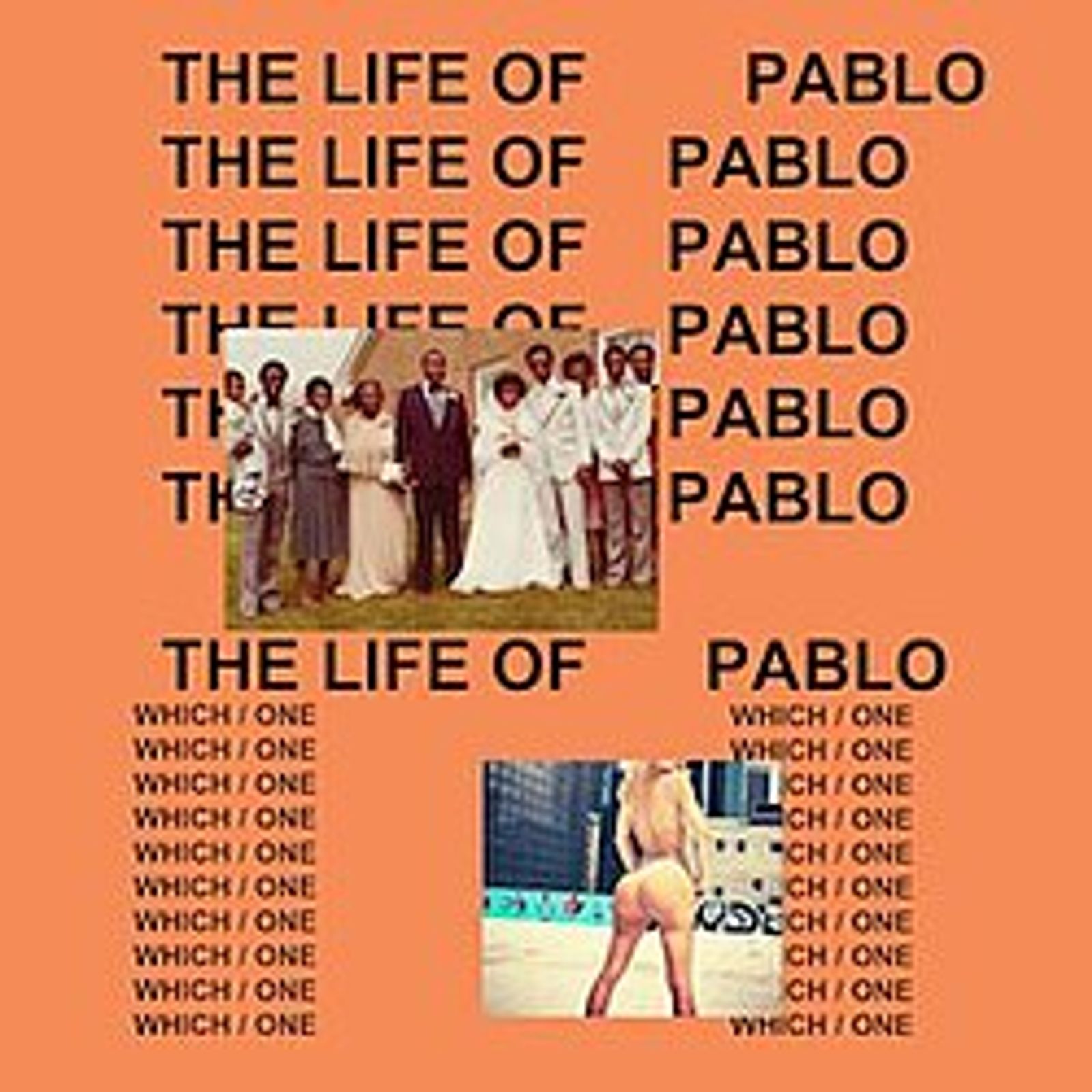
That method reveals something about the spirit in which the album was made. Setting aside the maximalism of *MBDTF* and the severity of *Yeezus*, West chose a different weapon: unmediated feeling. His genius for sampling — moving fluently between gospel, electronic music, and deliberately dissonant harmonics — transmits every emotional register with persuasive force. The album's cover art, which juxtaposes an explicit image of the female body with a photograph of a happy family, functions as a visual manifesto: like the music itself, it dissolves the boundary between sound and narrative in order to render life as it actually is.
The album opens with "Ultra Light Beam" and flows organically into the gospel sample that anchors "Father Stretch My Hands Pt. 1". A song of praise to a higher power, it is complicated by the presence of Metro Boomin — then emerging as one of Atlanta's defining producers — whose drums drive the track alongside an explicit verse and a collaboration with Kid Cudi, a long-estranged friend. The transition to Pt. 2, which samples newcomer Desiigner's "Panda" to generate fresh momentum through contrast, is a reminder of why West remains one of the most influential figures in contemporary music: his ear for new talent is as sharp as his instinct for juxtaposition.
The album's intricate yet somehow coherent architecture carries through to "Famous", where Rihanna's featured vocal casts a note of hollowness over a track propelled by Swizz Beatz's exuberant ad-libs, West's solipsistic rapping, and a sample of Sister Nancy's "Bam Bam". The emotional turbulence is relentless.
Individual tracks cut like a blade. For some listeners, the album may feel incoherent. But West uses his honesty and his exceptional ear for texture to bind raw, ambivalent feeling into a single coherent work. "Feedback" showcases sharp, unguarded rapping; "Low Lights" and "Highlights" make no attempt to conceal the gospel influence that runs through the record, while their featured artists preserve hip-hop's vitality.
"I Love Kanye" strips everything away to arrive at the album's most nakedly honest moment. It gives full rein to West's narcissism and his bipolarity, and holds nothing back — neither the mockery directed at his public image nor, beneath it, the affection.
"Waves", lifted by Chris Brown's contribution and Mike Dean's masterful production, raises the album's emotional temperature; "FML" brings it back down into grief, opening what feels like a second act. The Weeknd, the first guest of this new movement, intensifies the mood. The song's closing breakdown gives physical form to emotional collapse: a sample from Section 25's "Hit" generates deliberate dissonance, and the fractured Auto-Tune texture recalls the sound West himself invented on *808s & Heartbreak*, deployed here with perfect precision.
"Wolves" is a song that has changed shape through multiple iterations. Rather than settling on what might have seemed a finished form, West made the bold choice to place Sia and Vic Mensa on the same track — in place of Frank Ocean's vocal — and then to detach the Frank Ocean outro into a separate track, "Frank's Track", positioned immediately afterwards. Rather than refining towards completion, he shares with the listener the raw material of creation, as if to say: *this* is the moment that moved me most.
"30 Hours" and "No More Parties in LA" deliver some of the album's most intense rapping — about fractured relationships, the hollowness of the entertainment industry, and the forces that have made West who he is. Over a Madlib beat, trading verses with Kendrick Lamar, the album reaches its most powerful statement. It moves beyond self-justification into something emptier and more honest; the listener is made a confidant in the cost of spectacular success.
The run from "Facts" to "Fade" is West's extended love letter to soul samples and house music. The closing of "Fade", which draws on Mr. Fingers' "Mystery of Love" to connect to the Chicago house tradition West grew up with, is placed immediately after the album's most ferocious rapping — a sequencing decision that speaks once more to his instincts as a curator.
The album closes with "Saint Pablo", Sampha's voice carrying the final words. The longing for salvation, the self still wavering — West refuses to resolve them. He lets the curtain fall without tying anything up.
Strip away the performance and the human face is, by nature, complicated. *The Life of Pablo* does not tidy that complication away. It holds it up, unretouched, and asks you to look.
Rating: ★★★★☆ (4.0)
In a word: "Life is a collage no single picture can contain — an unguarded mirror of emotion, and proof that incompleteness can be its own kind of perfection."