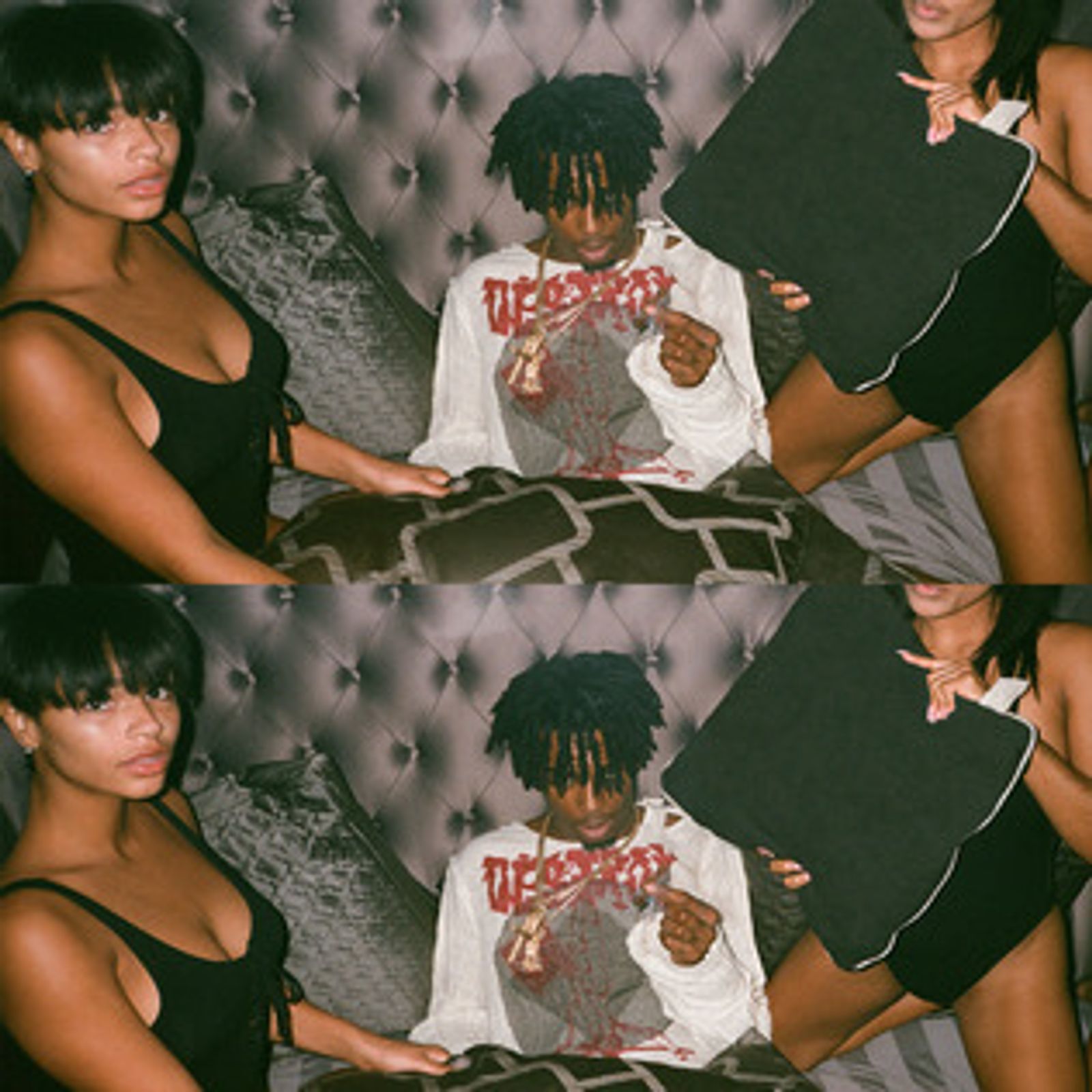
**Playboi Carti — *Playboi Carti* (2017, AWGE / Interscope)** ★★★★☆ (4.5/5.0)
For much of its history, hip-hop has measured greatness by craftsmanship: how precisely an artist constructs their world, and how cleverly they subvert it. Then along came a man who snapped the measuring stick in half. Released in 2017 under AWGE and Interscope, *Playboi Carti* discards order entirely — and in the space left behind, writes a new grammar from pure instinct.
From the opening track, *Location*, Carti makes no effort to conceal his narcissism. What might read as a catalogue of guns, tattoos, jewels and wealth is redeemed by producer Harry Fraud, who warps Allan Holdsworth's *Endomorph* into something ethereal and disorienting. The track carries the rough, underground texture of Carti's earlier work with Atlanta's avant-garde Awful Records collective — and rather than sanding it smooth for mainstream consumption, he makes it entirely his own.
Then comes *Magnolia*, the moment a new generation of trap music found its manifesto. Over Pi'erre Bourne's skeletal beat, Carti tosses out syllables that barely constitute words. Narrative gives way to feeling; feeling gives way to instinct. The measure of a star is the ability to convince an audience that something new and strange is worth caring about. Carti passed that test on his debut.
The record's euphoria deepens on *Lookin* and *wokeuplikethis\**, where Carti links up with Lil Uzi Vert. Their rapping ceases to function as language and becomes pure instrument, filling every gap in the beat. The words bypass the ear and land directly in the brain — an almost physical jolt of sonic pleasure.
But what elevates this from a collection of hits to a coherent work is what happens in between. Tracks like *Let It Go* and *Half & Half* arrive at precisely the right moments to shift the mood, yet Carti never loses his own thread. His rapping grows simultaneously more nonsensical and more assured — and the paradox of that disordered discipline is what gives the album its strange, addictive logic.
*New Choppa* is a symbolic centrepiece. It pairs Carti with A$AP Rocky — the executive producer of this album and, in many ways, the patron saint who helped lift Carti from underground cult figure to genuine icon — and the collaboration raises the album's ambitions noticeably.
The stretch from *Other Shit* to *Yah Mean* is Carti's uninterrupted showcase. Even on tracks where Uzi and Rocky feature, Carti never cedes the host's seat. Across a consistent tempo, he alternates long and short cadences with an instinctive precision that — however chaotic it sounds on the surface — reveals a clearly defined aesthetic vision.
The album's finest moment arrives at track 13: *Flex*. Without abandoning his masculine swagger, Carti allows something softer through — a glimpse of feeling about love and the world, expressed entirely on his own terms. As befits his first release under AWGE, Rocky's influence is felt most sharply in the production touches: a pitch-shifted bridge, a mid-track beat switch, and a melodic arrangement that stitches it all together seamlessly. Over this, vocalist Leven Kali emerges as the record's most perfectly placed guest.
The album closes with *Kelly K* and *Had 2*, Carti planting his flag on the "plug" sub-genre of trap — a sound shaped significantly by the SoundCloud era he helped define — as if to remind listeners of how long he has been pointing in this direction.
Bold artistic experiments invariably attract criticism before they earn praise, and Carti's catalogue has always followed that pattern: the hostility comes first; the appreciation takes time. That arc is the particular burden of artists who make the era rather than simply inhabit it. He bore it, and prevailed. What was once dismissed as pure negation has since been vindicated as synthesis.
Returning to this album now produces a peculiar joy — not unlike watching footage of Michael Jordan's rookie season, knowing everything that follows.
*"A masterwork of disordered order — the perfect antithesis in trap music's ongoing thesis, antithesis and synthesis."*