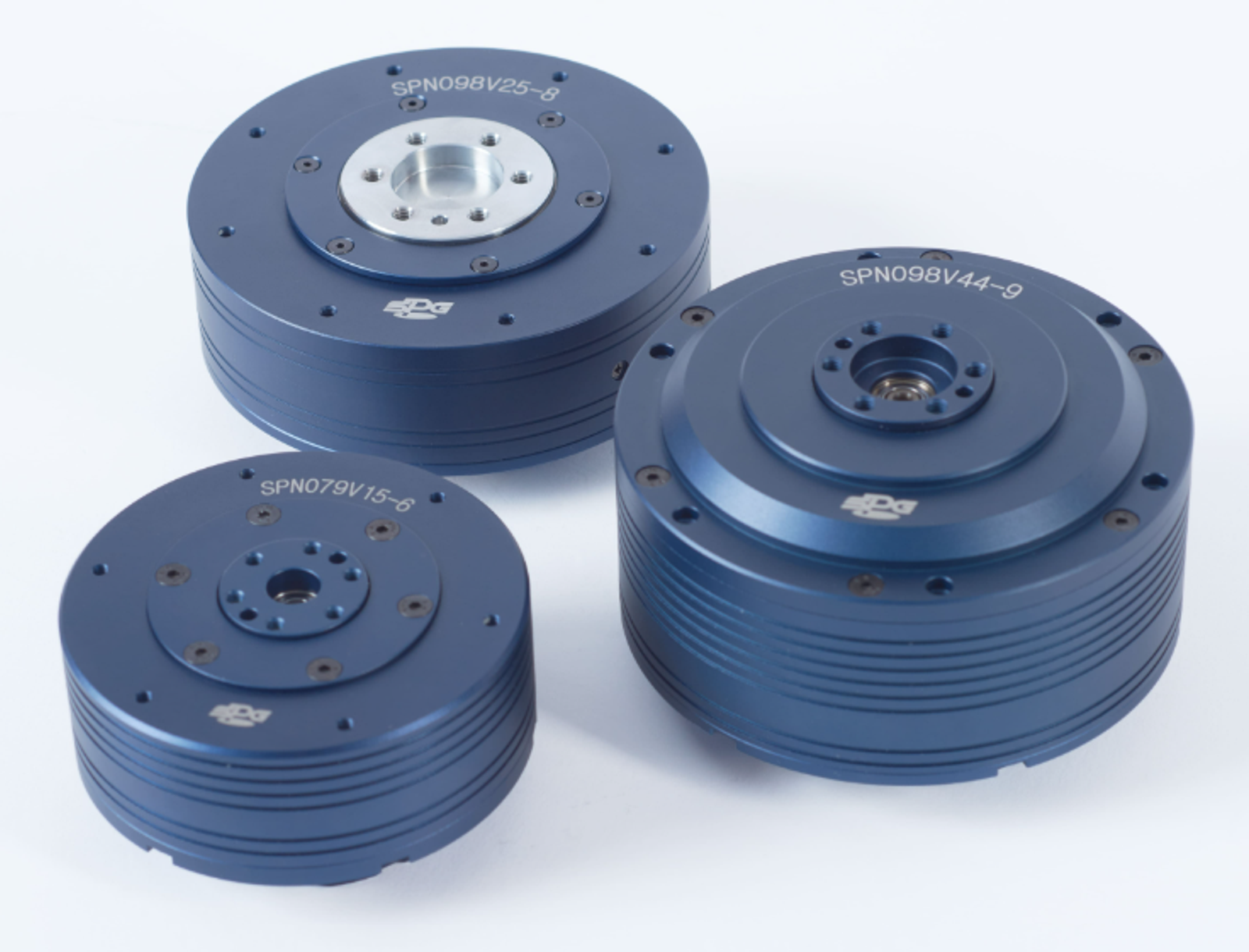
Mirae Asset Securities initiated coverage of SPG (KOSPI: 058610) on 21st August with a "Buy" recommendation and a target price of ₩129,000, implying upside of 27.1% from the closing price of ₩101,500 on 19th August.
The target price was derived by applying a price-to-sales (P/S) multiple of 7.3x — the average for global peers in precision reducers and motors — to SPG's projected sales per share of ₩17,608 for 2027. Mirae Asset forecasts that by 2028 SPG will generate revenues of ₩434.6bn and operating profit of ₩25.1bn, equivalent to an operating margin of 5.8%.
The only Korean maker of all three reducer types
SPG is the sole South Korean company capable of mass-producing all three main categories of precision reducer in-house: planetary, harmonic, and cycloidal. Precision reducers differ from ordinary industrial reducers in that they minimise backlash — the play between mechanical components — enabling the precise positional control and high repeatability that robotic applications demand. A standard industrial reducer carries backlash of roughly 15 arc-minutes; a harmonic reducer can bring that figure down to around 1 arc-minute.
SPG's precision-reducer business has grown at a compound annual rate of 37% over the past five years. Revenue from the segment rose from ₩4bn in 2021 to ₩14bn in 2025. That figure still represents only 3–4% of group sales (approximately ₩341.7bn in 2025), but Mirae Asset expects the share to exceed 20% by 2028.
Rainbow Robotics: a pivotal customer
SPG's key client is Rainbow Robotics, a leading South Korean humanoid and collaborative-robot maker. Rainbow Robotics previously sourced its reducers from Japanese and Chinese suppliers — including Harmonic Drive, Nidec Shimpo, and Leader Drive — but has reportedly switched its entire collaborative-robot reducer supply to SPG. The relationship is also deepening: SPG's reducers are used 22 per unit in Rainbow Robotics's mobile dual-arm robot (the RBY1) and 12 per unit in its quadruped robot, more than three times the number fitted in a single collaborative robot. Revenue from Rainbow Robotics rose from ₩1.8bn in 2024 to ₩4.4bn in 2025; Mirae Asset projects it will reach the low ₩10bn range in 2026.
A new actuator enters the picture
SPG is also developing an actuator based on Quasi-Direct Drive (QDD) technology, which it calls the SDD (SPG Direct Drive), with mass production scheduled to begin in September this year. The company says the SDD is roughly 10% lighter than comparable Chinese products, 20% more durable, and more than twice as precise. Crucially, it has addressed a persistent weakness of QDD designs — overheating. After 400 seconds of continuous operation, leading Chinese rivals reach temperatures of around 97°C; the SDD reportedly stays at 67°C, enabling ten hours of sustained use. Initial production targets 5,000 units: 1,000 destined for the Korea Institute of Machinery and Materials, and 4,000 to be distributed through LG Science Park.
Trade-war tailwinds in the core business
SPG's mainstay fan-motor and geared-motor operations are also benefiting from the US-China trade dispute. As supply chains are restructured and demand for non-Chinese components rises, global customers including Coca-Cola, Stryker, and Neptune have adopted SPG products. The company is said to have secured more than ten new customers since 2024, each expected to contribute annual revenue of ₩2bn–₩5bn.
A recovery delayed
Group-level results peaked in 2022 at revenues of ₩440.5bn and operating profit of ₩25.5bn, before declining for three consecutive years as interest rates rose and capital expenditure slowed. In 2025, revenues came in at ₩341.7bn and operating profit at ₩17.9bn. Mirae Asset regards 2026 as the trough year, forecasting revenues of ₩350.2bn (up 2.5% year-on-year) but a further dip in operating profit to ₩16.2bn (down 9.5%), reflecting residual weakness in sales to Chinese white-goods giant Haier.
Risks worth watching
The investment case carries meaningful risks. At a P/S multiple of 5.8x on 2027 estimates, the shares already trade at a premium to the 4.6x multiple of a year ago, suggesting that considerable optimism about the humanoid-robot reducer business is baked into the price. Rainbow Robotics has yet to enter full-scale mass production, and any delays in orders or manufacturing ramp-ups could expose the valuation. Moreover, with precision reducers still accounting for only 4% of group revenues, fluctuations in the core business are likely to have a greater near-term impact on earnings — and the share price — than robotics-related developments.
SPG's shares have surged more than 330% over the past twelve months. The 52-week high stands at ₩158,100 and the low at ₩23,150 — an extraordinarily wide range. The company's market capitalisation currently stands at approximately ₩2.25tn. The rally reflects genuine excitement about the robotics industry, but investors should bear in mind that if the gap between share-price expectations and actual earnings does not close, the scope for a sharp correction is considerable.