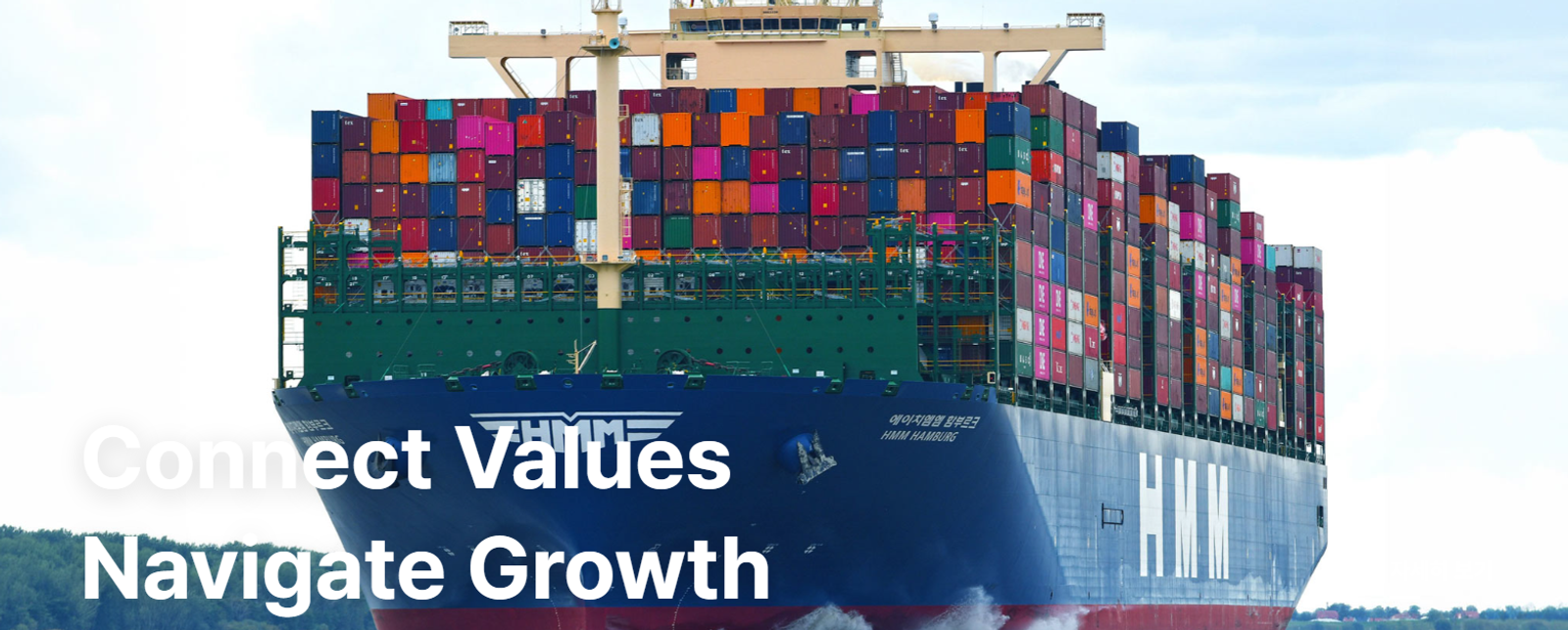
Mirae Asset Securities raised its target price for HMM (ticker: 011200), South Korea's largest container shipping line, from 24,000 won to 26,000 won on 13th August, reaffirming a buy recommendation. The revision reflects better-than-expected second-quarter revenues and continued upward momentum in freight rates.
Second quarter: revenues beat, profits pinched by costs
HMM posted second-quarter revenues of 3.402 trillion won, up 29.7% year on year. Operating profit rose 52% over the same period to 354.1 billion won — a solid headline figure, but modestly short of the market consensus of 396.2 billion won. The gap illustrates a recurring tension in the shipping industry: rates rise, but so do costs.
In the container division, revenues reached 2.803 trillion won, up 23.4% from the previous quarter, yet operating profit came to only 198.6 billion won, implying a thin operating margin of 7.1%. The Shanghai Containerised Freight Index (SCFI) averaged 2,337 points over the quarter, but HMM's realised rate improvements lagged the benchmark. Cargo-handling fees and charter costs rose in tandem, capping profit growth. Selling, general and administrative expenses surged 45.9% year on year to 174.4 billion won, partly owing to a 20 billion won charge for performance bonuses and an employee welfare fund.
The bulk shipping division provided welcome relief, delivering operating profit of 156.4 billion won — up 88.4% quarter on quarter and carrying a 28.0% operating margin. Rising Baltic Dry Index (BDI) readings, a strong market for very large crude carriers (VLCCs), and fleet expansion all contributed.
Third quarter: rates climb further, but new costs loom
Freight conditions have tightened further into the third quarter. As of 7th August, the SCFI stood at an average of 3,190 points, some 37% above the second-quarter average. Several forces are converging to sustain the rally: front-loading of shipments to circumvent tariffs, peak-season demand, congestion at ports in Panama, China and Europe, the prolonged Middle East crisis, and low water levels on the Rhine.
Additional costs are, however, on the way. Fuel surcharges are already in place, and Panama Canal surcharges are scheduled to take effect from September, meaning that higher revenues will again be partially offset by rising expenses.
Oversupply remains the long-term concern
The structural risk of excess capacity has not gone away. The critical variable for the freight rate outlook is whether the capacity-absorption effect created by vessels rerouting around the Suez Canal will unwind. Major carriers are likely to maintain their diversions around the Red Sea and the Middle East on security grounds, which will keep effective supply constrained in the near term. Even so, the broader market consensus leans towards an eventual supply surplus, and a more pronounced weakening of rates cannot be ruled out.
Revised forecasts and valuation
Mirae Asset has revised its full-year 2026 revenue forecast for HMM upward by 8%, from 12.294 trillion won to 13.263 trillion won. Its operating profit estimate has been nudged up from 1.198 trillion won to 1.268 trillion won — a more modest upgrade, reflecting the drag from higher operating costs.
The new 26,000 won target price is derived by applying a price-to-book ratio of 0.8 times to projected end-2026 book value. Against the 13th August closing price of 21,050 won, this implies upside of 23.5%. Mirae Asset argues that HMM's substantial cash holdings, its expanding bulk fleet, and the competitive positioning outlined in its long-term 2030 strategy — which envisages 29.1 trillion won of investment — provide a floor for the share price. The brokerage adds that how HMM deploys its surplus cash, including whether it expands shareholder returns, will be a key determinant of any re-rating.
Risks to watch
Investors should treat this assessment with appropriate caution: it represents the view of a single brokerage. Container shipping is notoriously volatile, and the spread between boom and bust can be extreme. HMM's own history is instructive: its operating margin collapsed from 48% in 2022 to 13.4% in 2025. The projected margin of 9.6% for 2026 is consistent with a more normalised industry environment, not a cyclical peak.
The key variables to monitor are whether current freight rates prove durable, how quickly additional costs materialise after September, and when — or whether — the Suez Canal route returns to full use. For the time being, the tug-of-war between rising rates and rising costs will determine which direction HMM's shares ultimately travel.