In an industry report published on the 18th, SK Securities highlighted that order backlogs at South Korea's leading semiconductor equipment companies reached record levels in the first and second quarters of this year, and identified this trend as the primary trigger for share-price gains in the second half.
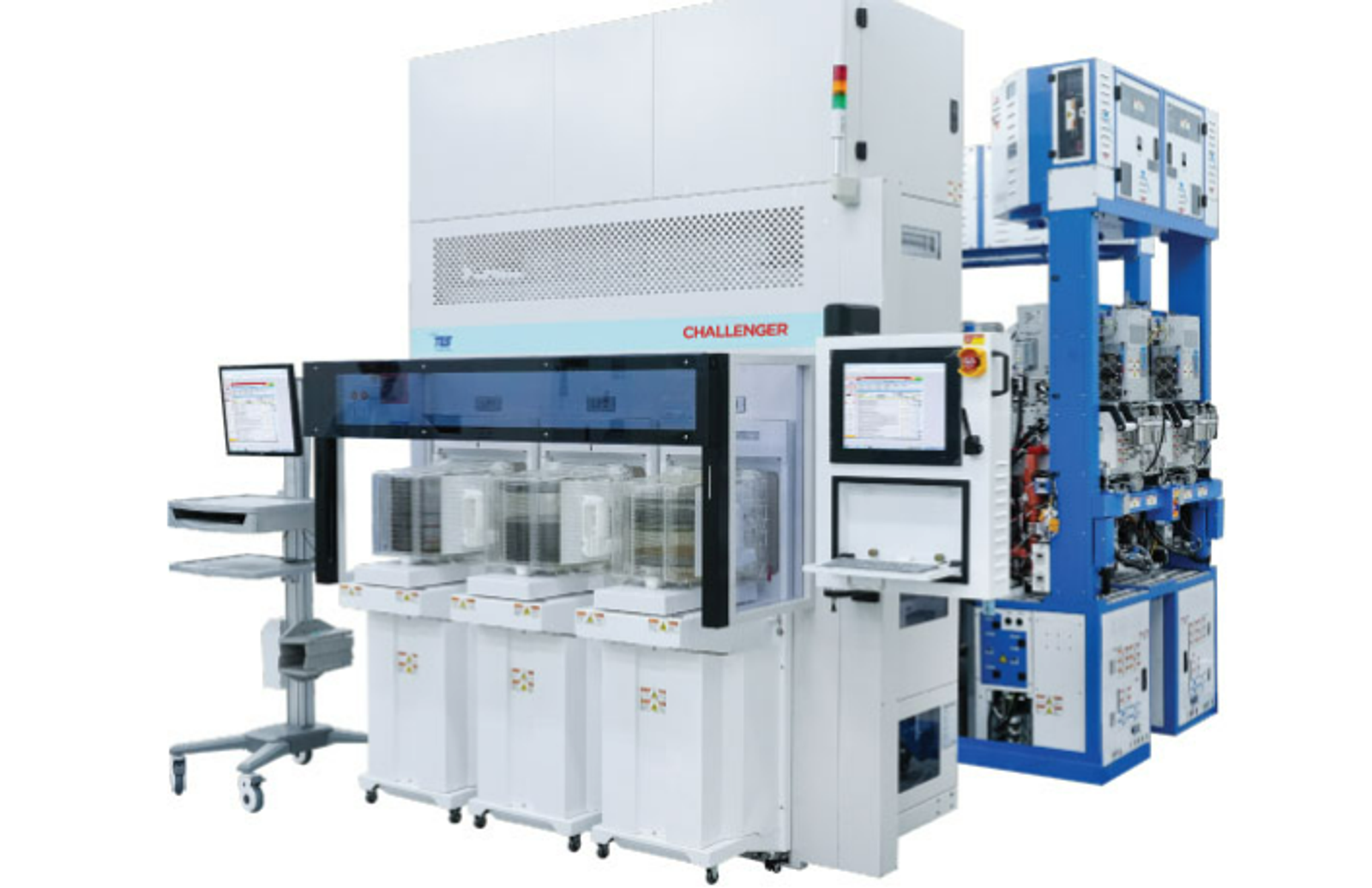
The numbers are striking. Tes (TES), a maker of front-end semiconductor equipment, saw its order backlog surge from 41.2bn won in the fourth quarter of last year to 145.5bn won in the first quarter and 206.9bn won in the second. Wonik IPS expanded from 298.2bn won to 400.4bn won and then 634.6bn won over the same period. Eugene Technology rose from 95.6bn to 126.6bn and then 153.3bn won; Unisem from 34.1bn to 49.2bn and then 111.2bn won; and Park Systems from 63.6bn to 87.1bn and then 112.5bn won.
This acceleration becomes even more significant when set against previous semiconductor upcycles. Strong positive correlations between order backlogs and share prices were observed during the memory boom of 2016–18 and again in the 2020–22 cycle. Current backlog levels already exceed the peaks of both those periods, and SK Securities expects the upward trend to persist at least through the fourth quarter of 2027.
The driving force behind the surge is an accelerating expansion of DRAM capacity at Samsung Electronics and SK Hynix. Samsung is on course to complete equipment installation for phases three and four of its Pyeongtaek P4 facility in the first and second halves of this year respectively, with its P5 plant targeted for completion in May or June of next year. DRAM investment this year is estimated at 90,000–100,000 wafer starts per month (wspm), rising to 150,000 wspm in 2026. SK Hynix, meanwhile, aims to complete the setup of most of its 90,000-wspm M15X capacity within the year, with its Yongin Y1 fab — due to open in February next year — expected to begin ramping up at 150,000 wspm thereafter.
The scale of these expansions reflects a structural shift driven by high-bandwidth memory (HBM), the specialised chips that sit inside AI accelerators. Producing HBM consumes three to three-and-a-half times as much wafer capacity as standard DRAM. As HBM's share of total DRAM capacity rises to an estimated 31% in 2026 and 35% in 2027, SK Securities calculates that this alone will require capacity additions equivalent to 21% and 25% respectively above baseline needs. The brokerage argues that a 150,000-wspm expansion should now be regarded as the new normal.
The global outlook for semiconductor equipment is equally encouraging. Worldwide wafer fabrication equipment (WFE) spending is forecast to reach $150bn in 2026 and $190bn in 2027 — upgrades of $5bn and $15bn respectively from previous estimates. To put the current cycle in historical perspective: cumulative WFE spending totalled $156bn during 2016–18, $269bn during 2020–22, and is projected to reach $465bn for 2025–27, dwarfing its predecessors.
SK Securities notes a timing gap between when rising backlogs translate into earnings for equipment makers versus components and materials suppliers. Equipment companies should begin seeing a results rally from the second half of this year, while materials and components firms — whose earnings cycle typically lags by six to nine months — are expected to see meaningful improvement from the first half of next year. However, share prices tend to move ahead of earnings, meaning momentum could spread rapidly across the broader supply-chain sector.
The brokerage's top picks reflect this sequencing. In front-end equipment, it favours Tes, which stands to benefit from a resumption of new NAND flash investment and from the growing contribution of new tools such as BSD and Tetra. In back-end equipment, it prefers Park Systems, whose orders from China came in at 141.3bn won in the first half of this year — a faster recovery than expected. In materials and components, Comico is the pick of choice, on the grounds that utilisation rates are rising at its domestic and overseas operations, and that its subsidiary Mico Ceramics is expanding supplies to Chinese customers.
On valuation, Korean semiconductor equipment stocks trade at an average of 30 times forecast 2026 earnings — a meaningful discount to the 41 times average for their global peers. Korean materials and components companies trade at 20 times versus 24 times for overseas counterparts, a gap SK Securities cites as an additional argument for investing in the sector.
That said, the brokerage acknowledges several risks that could temper this optimistic outlook. Capital expenditure at the four largest cloud-service providers — Amazon, Google, Microsoft and Meta — is growing faster than operating cash flow, and has pushed Amazon and Google into free-cash-flow deficits in some quarters. Should doubts grow about the sustainability of that spending, memory chipmakers' expansion plans could be revised. More immediately, if construction of clean-room facilities at Samsung's Pyeongtaek and SK Hynix's Yongin sites falls behind schedule, equipment orders could be delayed accordingly.
There is also a near-term technical overhang in markets. Between May and July, retail investor flows in South Korea concentrated heavily in leveraged exchange-traded funds tracking Samsung Electronics and SK Hynix directly, pulling money away from broader technology ETFs that include supply-chain names. The SOL AI Semiconductor TOP2 Plus ETF saw its net assets fall by 2 trillion won, or 38%, over the past month; the TIGER Semiconductor TOP10 and HANARO Fn K-Semiconductor ETFs shed 1.6 trillion won and 1.5 trillion won respectively. Until this distortion fully unwinds, it may act as a brake on any recovery in supply-chain stocks — a factor investors would do well to keep in mind.