The puzzle: rising profits, falling shares
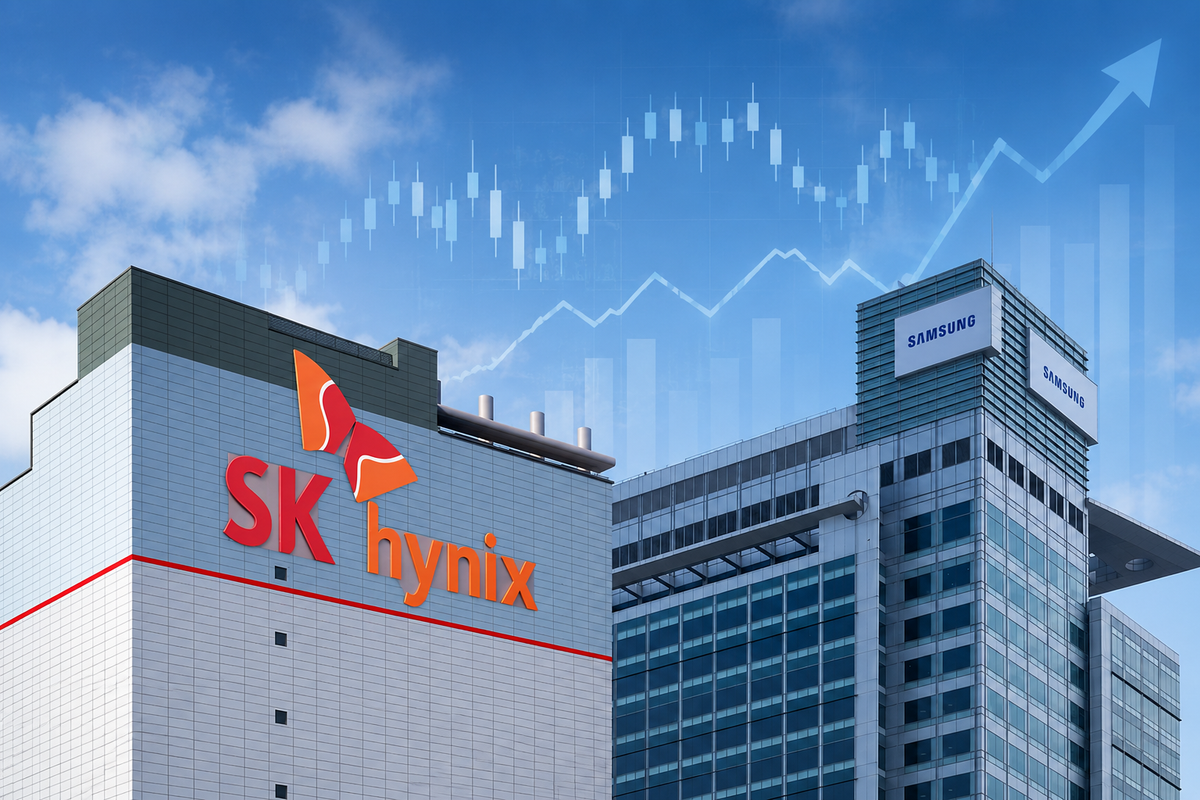
The most perplexing feature of South Korea's two dominant chipmakers right now is this: earnings forecasts keep improving, yet share prices refuse to follow. Analyst consensus for annual operating profit stands at around 39.2 trillion won for Samsung Electronics and 26.7 trillion won for SK Hynix—up 11.4% and 4.2% respectively from estimates just three months earlier. Yet as of September 11th, Samsung's shares sat at 269,000 won, some 28.2% below their 52-week high of 374,500 won, while SK Hynix traded at 1,812,000 won, fully 39.3% off its peak of 2,987,000 won. Price targets from brokerages remain roughly 90% above actual market prices—a gap that has persisted throughout the summer. Earnings expectations and share prices have been moving in opposite directions for months.
Even within the brokerage community, views are sharply divided. On August 31st, LS Securities raised its target price for Samsung to 450,000 won from 400,000 won—while simultaneously cutting its target for SK Hynix to 2,400,000 won from 3,300,000 won. The reasoning was precisely symmetrical. Samsung has emerged as a formidable challenger after demonstrating improved production yields for its HBM4 chips—the share of HBM4 in Samsung's total HBM shipments surged from around 5% in the first quarter to roughly 35% in the second. Conversely, SK Hynix, which had enjoyed something close to a monopoly in the high-bandwidth memory market, is now entering a phase of margin normalisation as Samsung moves in earnest into its territory. LS Securities cut its forecast for SK Hynix's HBM operating margin in 2027 from around 80% to 60%, arguing that excessively high margins would squeeze customers such as Nvidia and ultimately constrain demand for standard DRAM as well. The market structure, in other words, is shifting from monopoly to competition.
Three simultaneous fronts
To make sense of this confusion, it helps to recognise that both companies are fighting three distinct battles at once.
*The first is the internal front: competition between Samsung and SK Hynix.* According to market research firm Counterpoint Research, Samsung held a 39% share of DRAM revenue in the second quarter of 2026, ahead of SK Hynix at 26% and Micron at 25%—a clear lead in overall market terms. Yet in HBM, the segment that commands premium pricing and the greatest strategic attention, SK Hynix has long been regarded as the superior player. That perception is now being tested, as Samsung's rapidly improving HBM4 yields challenge SK Hynix's dominance. The situation might be described as one in which the volume numbers favour Samsung, while the market's belief in SK Hynix's HBM premium has yet to be fully dismantled.
*The second is the external front: China's challenge.* ChangXin Memory Technologies (CXMT), China's leading memory chipmaker, recently completed a listing on China's STAR Market (the country's technology-focused exchange modelled on Nasdaq), instantly becoming the largest company by market capitalisation on the mainland bourse. Armed with fresh capital, CXMT plans to begin mass production of sixth-generation low-power DRAM (LPDDR6) in the second half of this year, and reports suggest that its HBM3 prototype has entered yield-verification testing. Some analysts worry that CXMT could leverage control over both ends of its supply chain to close a two-to-three-year technology gap with Korean rivals faster than expected. Others are more sanguine, pointing out that Chinese chipmakers still rely heavily on older deep-ultraviolet (DUV) lithography equipment from ASML and others, and that CXMT's capacity expansion is unlikely to compete directly with the Korean firms' core customers. There is also an intriguing counterargument: KB Securities suggested that China's push for semiconductor self-sufficiency could actually increase demand for Samsung's memory chips, since Chinese AI accelerators are less computationally efficient than Nvidia's GPUs and therefore require more chips—and more memory—to achieve the same processing output.
*The third is the future front: the next-generation technology race.* At the FMS (Future of Memory and Storage) conference held in Santa Clara in early August 2026, Samsung became the first company in the industry to unveil mock-ups of its next-generation three-dimensional memory architectures, zHBM and zNAND-O—territory that neither SK Hynix nor Chinese rivals have yet entered. This looks like a deliberate signal that Samsung intends to compete not merely for today's market share, but to reshape the competitive landscape an entire product generation ahead.
Nomura versus domestic brokerages: the valuation gap as a variable in itself
The divergence in how analysts read these three fronts is nowhere more striking than in the contrast between domestic Korean brokerages and foreign investment banks. Korean analysts tend to be sensitive to near-term risks—NAND price declines, Chinese equipment localisation, HBM margin compression—and have frequently revised their targets in response to each new data point. Nomura Securities, by contrast, has pushed a far more aggressive structural rerating thesis. In May, the Japanese bank raised its target prices for Samsung and SK Hynix to 590,000 won and 4,000,000 won respectively; in June it lifted them further to 670,000 won and 4,700,000 won, and has held those levels ever since. These targets are some 50–80% above the domestic consensus range (370,000–450,000 won for Samsung; 2,400,000–3,310,000 won for SK Hynix).
Nomura's thesis rests on a straightforward premise: both companies' forward price-to-earnings ratios for 2027 stand at roughly three times earnings, which Nomura argues is far too low for businesses that should no longer be valued as cyclical commodity producers but rather as structural growth companies comparable to TSMC, which trades at around 20 times earnings. Underpinning this view is a striking supply-demand scenario in which AI-driven memory demand—shifting from the training phase to inference—could multiply several thousandfold over the next five years, while supply is expected to grow only five-to-sixfold.
Whether Nomura is right remains to be seen. What is notable, however, is that it has not once wavered from its bullish stance since May—a striking contrast to the frequent target revisions among Korean peers. Whether this reflects a genuinely longer-horizon structural perspective, or simply an institutional reluctance to walk back a bold call, is a question that only time can answer.
The won's double-edged appreciation
A further complication has entered the picture: the Korean won. Having reached 1,559 won to the dollar in May, the currency strengthened sharply to 1,345.9 won by September 11th—a move of roughly 200 won, or 12.8%, in two months. For two companies that earn the overwhelming majority of their revenues in dollars, this is a direct headwind: dollar-denominated sales translate into fewer won when converted. Citigroup, factoring in the exchange-rate shift, cut its third-quarter operating profit forecast for Samsung by 10%, from 115.5 trillion won to 104.1 trillion won, and trimmed its SK Hynix estimate by 3%, from 76.7 trillion won to 74.0 trillion won, also lowering its SK Hynix price target from 3,100,000 won to 3,000,000 won. In aggregate, the two companies' combined third-quarter consensus operating profit has shrunk by around 11 trillion won in two months, with the annual figure falling by some 21 trillion won. Notably, Samsung—with its greater exposure to dollar revenues—absorbed a larger proportional downgrade than SK Hynix.
Yet the currency move need not be read as purely negative. Hwang Su-wook, an analyst at Meritz Securities, argued that while won appreciation creates short-term pressure on earnings estimates, the medium-term effect of drawing foreign capital back into Korean equities could provide a broader tailwind to the market. He also suggested that much of the earnings-estimate drag would be absorbed during the third-quarter earnings preview season in late September and early October. In other words, a stronger won is a near-term headache for profits but could be a medium-term catalyst for inflows.
This connects, almost paradoxically, to Nomura's structural bull case. If foreign investors—drawn partly by currency dynamics—do increase their exposure to Korean chipmakers, that flow of capital would itself constitute one plausible path by which Nomura's aggressive price targets begin to look less implausible. Meanwhile, memory prices have continued to rise on the back of AI server demand, providing a partial offset to the currency headwind.
The decisive variable: who is buying and who is selling
With three competitive fronts, a transatlantic valuation dispute, and currency volatility all in play simultaneously, the market's most immediate focus has shifted to flows. In August, foreign investors net sold SK Hynix shares worth 7.06 trillion won and Samsung shares (including preferred shares) worth roughly 2.3 trillion won. Domestic retail investors moved in the opposite direction, buying approximately 2.64 trillion won of SK Hynix and 2.29 trillion won of Samsung over the same period.
Against this backdrop, both companies have announced substantial shareholder returns: SK Hynix unveiled a 40 trillion won share buyback and cancellation programme, while Samsung announced returns of between 90 trillion and 110 trillion won. How effectively these buybacks absorb the overhang of foreign selling will be among the key determinants of share-price direction in September.
The answers to the larger questions—which company prevails on which front, whether Nomura's structural thesis or the domestic consensus proves more accurate, and when won appreciation begins to register as a positive for foreign inflows rather than a negative for earnings—are most likely to reveal themselves first through the lens of these supply-and-demand dynamics.
What to watch: How much of the currency-driven earnings drag is digested during the third-quarter preview season in late September and early October; when CXMT achieves genuine HBM mass production; and whether the two companies' buyback programmes can continue to absorb foreign selling at anything like August's pace. The answers to these three questions will determine which side of the current analytical divide the weight of evidence shifts towards.