Company Overview
Samsung Biologics was founded in 2011 when the Samsung group moved into contract development and manufacturing (CDMO) for biopharmaceuticals, and listed on the Korea Stock Exchange (KOSPI) in 2016. Operating from a sprawling campus in Songdo, Incheon, the company has assembled one of the largest biologics manufacturing capacities of any single site in the world, establishing itself as a major force in the global CDMO market. For years it also housed Samsung Bioepis, a subsidiary focused on developing and commercialising antibody biosimilars. In 2025, Samsung Bioepis was spun off through a share split, leaving Samsung Biologics as a pure-play CDMO.
The company has at times ranked among the four largest firms by market capitalisation on the KOSPI. Yet on the question of shareholder returns, it stands out — unfavourably — as the most laggard among South Korea's large pharmaceutical and biotechnology companies. It has not paid a single dividend since listing, and no formal share buy-back or cancellation programme has ever been announced. On the key metrics of the Korea Value-up Programme — a government-backed initiative launched in 2024 to address the chronic undervaluation of Korean equities — Samsung Biologics has consistently scored poorly. It has twice been excluded from the Korea Value-up Index, making the cost of its inaction increasingly tangible.
Business and Financial Performance
*CDMO Model and Capacity Expansion*
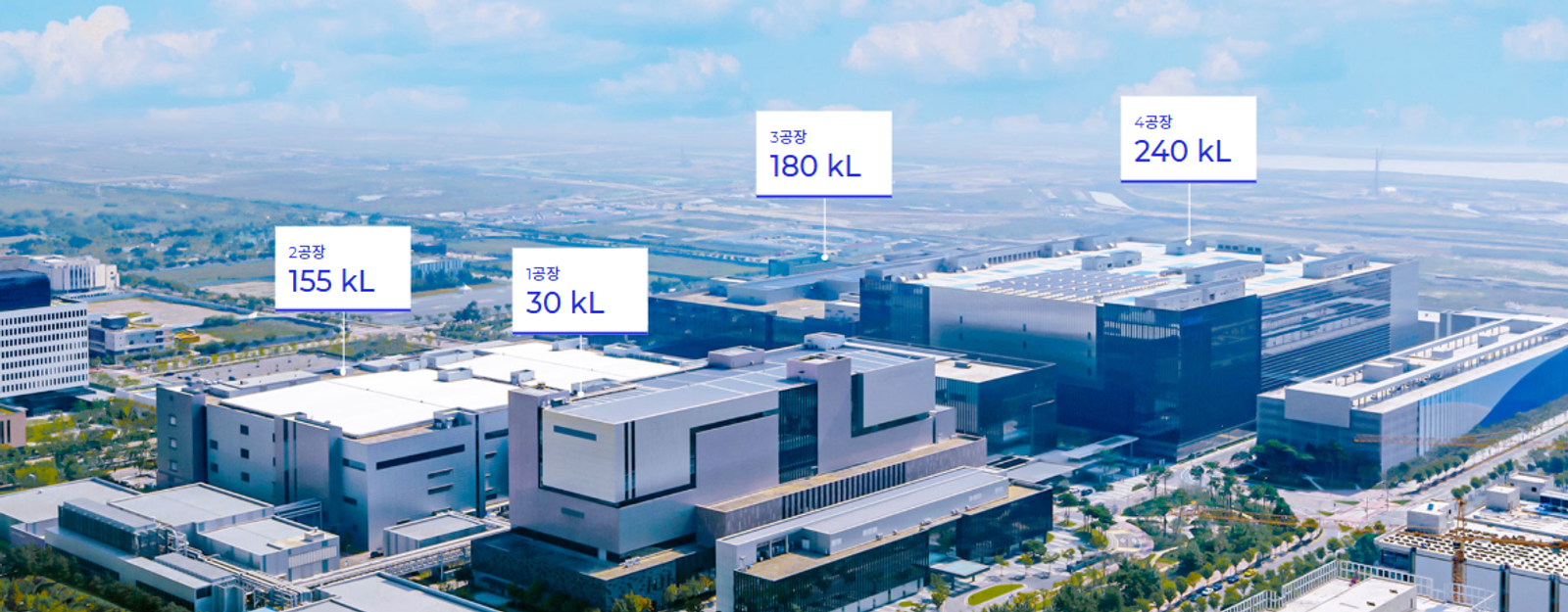
The company's core competitive advantage lies in the large-scale biologics manufacturing infrastructure concentrated at its Songdo campus. By end-2023, the combined capacity of its first four production plants reached 604,000 litres, believed to be the largest at any single site in the world. A fifth plant, adding 180,000 litres, came on stream in 2025, and a sixth is reportedly under construction. Revenue is underpinned by large, long-term contracts with global pharmaceutical companies, and the order backlog has grown steadily.
*Financial Results by Year*
Year | Revenue (bn won) | Operating Profit (bn won) | Operating Margin (%) | Net Profit (bn won) | Shareholder Returns
2020 | 1,164.8 | 291.2 | 25.0 | 212.9 | None
2021 | 1,561.3 | 545.5 | 35.0 | 510.7 | None
2022 | 3,045.6 | 906.9 | 29.8 | 810.7 | None
2023 | 3,694.9 | 1,113.7 | 30.1 | 981.6 | None
2024 | ~4,200 (est.) | ~1,200 (est.) | ~28–30 | TBC | None
*Note: 2024 figures are estimates based on published preliminary results and may change depending on accounting treatment applied before and after the corporate split.*
Operating margins have remained stable at around 30%, a reflection of the high-value-added nature of CDMO work, in which large contracts are long-dated and typically involve advance payments. By end-2023, the company's combined cash and liquid financial assets were estimated at approximately 6 trillion won. The failure to recycle any of this substantial cash pile into shareholder returns has become the central grievance of retail investors and institutional shareholders alike.
*Corporate Spin-off and Restructuring*
In November 2025, Samsung Biologics completed the separation of Samsung Bioepis through a proportional share split, establishing it as an independently listed entity under the name Samsung Epis Holdings. This left Samsung Biologics with a clean identity as a pure-play CDMO. Samsung Epis Holdings announced its own strategic agenda focused on advancing its biosimilar pipeline and securing options in novel drugs, along with a separate discussion around its own value-enhancement plans.
Value-up Timeline
*2024 — Korea Value-up Programme Launches; Samsung Biologics Sits It Out*
From early 2024, South Korea's exchange operator and financial regulators pushed the Korea Value-up Programme, encouraging companies to voluntarily disclose plans to improve return on equity (ROE), price-to-book ratios (PBR), and dividend yields — all metrics associated with the persistent "Korea discount" that depresses Korean equity valuations relative to international peers. Major listed companies including Samsung Electronics and KB Financial Group published value-up plans in response. Samsung Biologics published nothing. Chief executive John Rim was reported to have maintained that capital expenditure and business expansion remained the priority.
*Late 2024 — Excluded from the Korea Value-up Index*
When the Korea Exchange announced the constituents of its new Korea Value-up Index in September 2024, Samsung Biologics was not among them. Analysts attributed its exclusion primarily to its complete absence of shareholder returns, its negligible dividend yield, and its failure to present any medium-term improvement plan. The fact that other companies within the same biotechnology sector were included threw Samsung Biologics' outlier status into sharp relief.
*March 2025 — No Dividend for the Ninth Consecutive Year*
At the annual general meeting in March 2025, shareholders were told there would be no dividend for the 2024 financial year — the ninth year in succession since listing. Mr Rim indicated that shareholder returns would be "considered once the capital expenditure cycle is complete," but offered no specific timetable or figures, prompting sharp criticism from retail investors. The contrast with Celltrion, a Korean biosimilar rival that around the same time surpassed 700 billion won in total annual shareholder returns, was widely noted.
*November 2025 — Spin-off Complete; Hopes of a Fresh Start on Value-up*
The formal completion of the Samsung Bioepis separation prompted some analysts to argue that simplifying a complex corporate structure could, over time, improve conditions for shareholder returns. However, with no accompanying announcement on dividends or buy-backs, opinion was divided over whether the restructuring would translate into genuine value creation for shareholders, or merely amount to a tidier version of the same problem.
*March 2026 — No Dividend for the Tenth Year*
The annual general meeting of March 2026 brought another nil distribution for the 2025 financial year. The phrase "three years from now" reportedly recurred in the company's investor communications as the expected horizon for revisiting dividends. Sitting on roughly 6 trillion won in cash — more than eight times Celltrion's annual shareholder return — while deferring any distribution prompted furious commentary in online investor communities and some institutional research notes, with one widely circulated phrase accusing the company of treating its shareholders "like an ATM." Samsung Biologics offered no formal response to the gathering debate over mandatory treasury share cancellation prompted by proposed reforms to South Korea's Commercial Act.
*June 2026 — Excluded Again from Value-up Index Rebalancing*
Samsung Biologics was again left out when the Korea Value-up Index underwent its scheduled rebalancing in June 2026. Governance-focused analysts noted that the company's value-up gap remained intact, and forecasts suggested that dividend resumption was at least three years away.
Challenges and Assessment
*What Needs to Change*
Market specialists are broadly agreed that for Samsung Biologics to be taken seriously as a participant in South Korea's value-up agenda, it must first publish a credible, time-bound shareholder return roadmap. The current formula of "we will consider it when the investment cycle is complete" is widely regarded as too vague to inspire investor confidence.
More specifically, observers argue that the board should formally adopt and disclose a capital allocation policy setting out how free cash flow will be distributed once construction of the fifth and sixth plants is finished. The completion of the corporate spin-off, by simplifying the group structure, provides a natural opportunity to establish such a policy in parallel. Changes to the regulatory environment — including proposals to mandate treasury share cancellation and strengthen directors' fiduciary duties to shareholders under a reformed Commercial Act — add urgency to the case for acting proactively rather than waiting to be compelled.
*Verdict*
As a business, Samsung Biologics commands genuine respect. Its manufacturing scale, its order book and its ability to win and retain global pharmaceutical clients leave its medium-to-long-term growth story essentially intact.
The verdict on governance is harsher. Approaching a decade of listing without a single dividend payment, and with 6 trillion won in cash on the balance sheet and no concrete return schedule in sight, the company stands in direct contradiction to the principles the Korea Value-up Programme was designed to promote. Even granting the legitimacy of heavy investment in a capital-intensive industry, a minimum standard of shareholder communication and policy transparency is expected. By that measure, Samsung Biologics' value-up scorecard remains, for now, distinctly incomplete.
Key Controversies
*The 6-Trillion-Won Paradox*
The cash pile is the centrepiece of every shareholder grievance. With combined cash and short-term financial assets estimated at roughly 6 trillion won as of 2025–26 — a sum exceeding eight times Celltrion's annual shareholder distributions — the argument that the company lacks the means to return capital simply does not hold. The frustration is that neither dividends nor buy-backs have been forthcoming despite this abundance of liquidity.
*What Exclusion from the Value-up Index Actually Means*
The Korea Value-up Index is not merely a reputational yardstick; it drives mechanical inflows of passive investment capital. Repeated exclusion therefore carries real financial consequences: higher implied cost of capital and weaker demand from foreign institutional investors. The divergence between Samsung Biologics and its sector peers that have secured index inclusion is increasingly cited as a live demonstration of the direct link between return policy and market valuation.
*John Rim and the Retail Investor Divide*
Mr Rim has earned broad credit for the company's commercial success — aggressive contract wins and a relentless build-out of manufacturing capacity. On shareholder returns, however, his consistent caution has generated a deepening rift with retail investors. Annual general meetings have seen the same question asked repeatedly; the answer has consistently been "we will consider it in due course." Some observers speculate — without any confirmation from the company — that the ownership structure of the Samsung group and variables related to inheritance and wealth transfer within the founding family may exert an indirect influence on dividend policy.
*Regulatory Change and the Absence of a Response*
As reform of South Korea's Commercial Act has accelerated through 2026, bringing with it proposals to mandate treasury share cancellation and reinforce directors' duties to act in the interests of all shareholders, Samsung Biologics has conspicuously refrained from commenting. Across the pharmaceutical and biotechnology sector more broadly, treasury share holdings are shrinking and cancellations are rising. Pessimists argue that, without regulatory compulsion, voluntary improvement from Samsung Biologics is unlikely.
Key Statistics at a Glance
Year | Operating Profit (bn won) | Dividend (bn won) | Buy-back/Cancellation | PBR (year-end, x) | ROE (%)
2020 | 291.2 | 0 | None | ~8–10 | ~5–6
2021 | 545.5 | 0 | None | ~10–12 | ~9–11
2022 | 906.9 | 0 | None | ~6–8 | ~12–14
2023 | 1,113.7 | 0 | None | ~5–7 | ~12–13
2024 | ~1,200 (est.) | 0 | None | ~4–6 (est.) | ~11–13 (est.)
2025 | TBC | 0 | None | TBC | TBC
Cumulative shareholder returns since listing: zero Estimated cash and liquid assets (2025–26): ~6 trillion won Korea Value-up Index inclusion: excluded (2024 launch and 2026 rebalancing)