Introduction
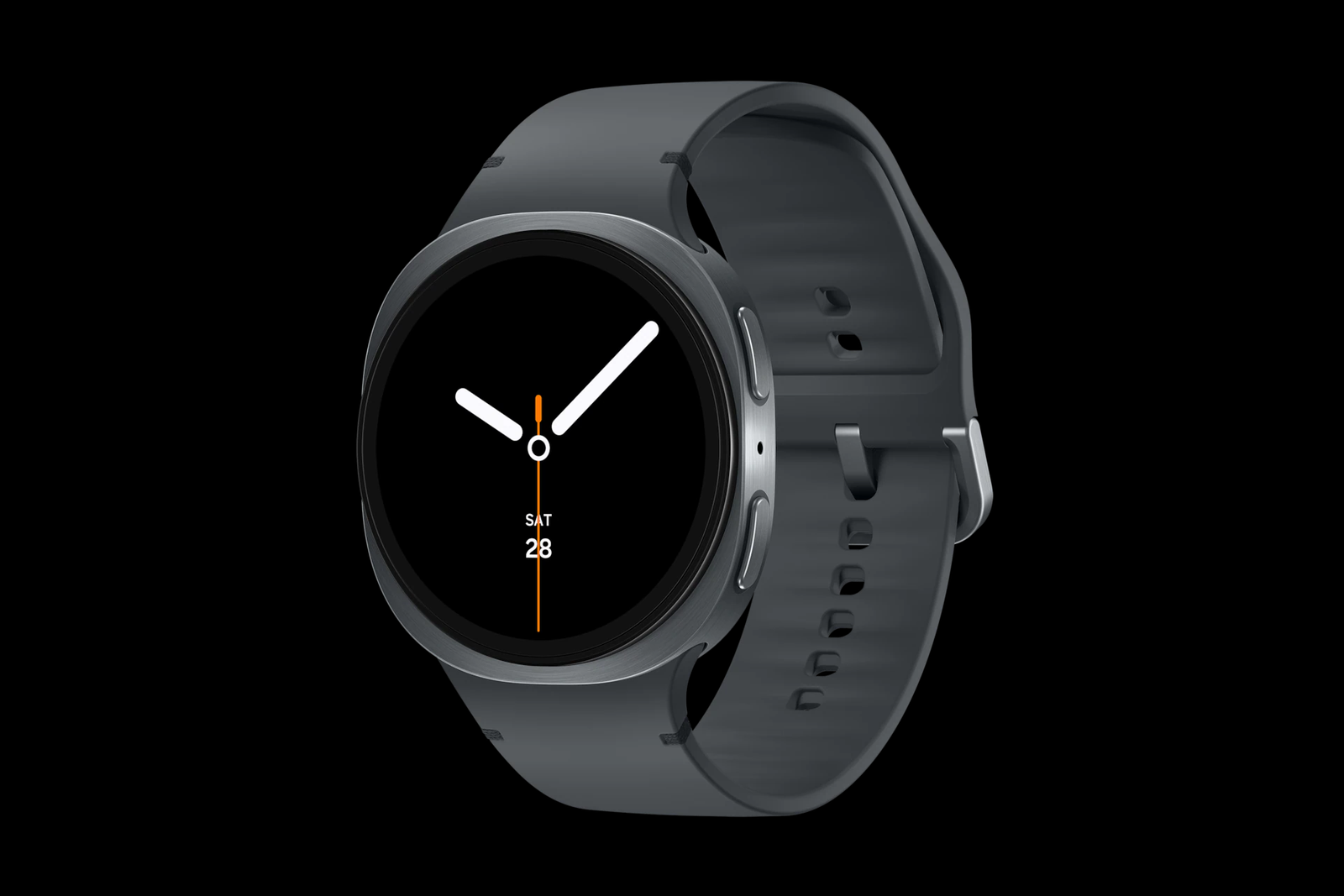
The Galaxy Watch 8 is a smartwatch unveiled by Samsung at its "Galaxy Unpacked 2025" event in New York on 9th July 2025 and officially launched on 25th July. It comes in two variants: the standard Galaxy Watch 8, optimised for everyday health monitoring with a slim, minimal design, and the Galaxy Watch 8 Classic, which adds a rotating bezel and a quick-access button to evoke the feel of a traditional analogue timepiece. Colour options are Silver and Graphite for the Watch 8, and Black and White for the Classic. Size options are 40mm and 44mm for the Watch 8, while the Classic is available only in a single 46mm case.
Specifications
The Watch 8 retains the same Exynos W1000 processor found in its predecessor, the Galaxy Watch 7. What has changed is the display's peak brightness, which rises from 2,000 to 3,000 nits, and the battery capacity, which grows modestly — from 300mAh to 325mAh in the 40mm model and from 425mAh to 435mAh in the 44mm. This is, in essence, a minor upgrade: a careful polish of existing hardware rather than a generational leap.
On the design front, Samsung bills the Watch 8 as the thinnest model in the Galaxy Watch series to date, with a cushion-edged silhouette that flows naturally from the display to the slim case body. Compatibility requires an Android 12 or later smartphone with at least 1.5GB of RAM and 16GB of storage, along with Google Mobile Services (GMS) certification. Devices that lack GMS certification — including iPhones, as well as handsets from LG, Huawei, and ZTE — cannot be paired with the watch. Tablet connectivity is also unsupported.
At launch in August 2025, prices started at 419,000 won (approximately $305) for the 40mm Bluetooth Watch 8 and reached 489,500 won for the 44mm LTE model. The Classic was priced at 569,000 won for the Bluetooth version and 599,500 won for the LTE variant. Compared with the previous generation, prices rose by 70,000 won for the Watch 8 and by 100,000–110,000 won for the Classic. Market prices have since softened: by November of the same year, the 40mm Bluetooth Watch 8 was available for around 373,500 won, a reduction of roughly 10%.
Strengths and Limitations
The Watch 8's clearest strength lies in the depth and coherence of its health-monitoring capabilities. The Verge noted that the device "helps users become healthier through immediate feedback," while PhoneArena highlighted the on-board Gemini AI assistant's ability to handle lengthy and complex queries with ease. Features such as a real-time running coach reflect a health platform designed for practical, everyday use rather than mere novelty.
The limitations are equally apparent. Carrying over the same processor as the previous generation gives the Watch 8 the feel of a refined iteration rather than a true successor. The price increase relative to its predecessor will sting for cost-conscious buyers. The watch's closed ecosystem — which excludes any device lacking GMS certification, most notably iPhones — also means it is, from the outset, a product exclusively for Android users.
Verdict
The Galaxy Watch 8 is a model that prioritises refinement over reinvention. Samsung has nudged up display brightness and battery capacity, trimmed the chassis, and sharpened its AI-driven health features. The unchanged processor is a genuine shortcoming, but as an everyday health-tracking device, the Watch 8 has earned broadly positive reviews from the market.
★★★★☆ (4.0/5.0)
In one line "No dramatic leap forward — but as a health coach on your wrist, it was already more than good enough."