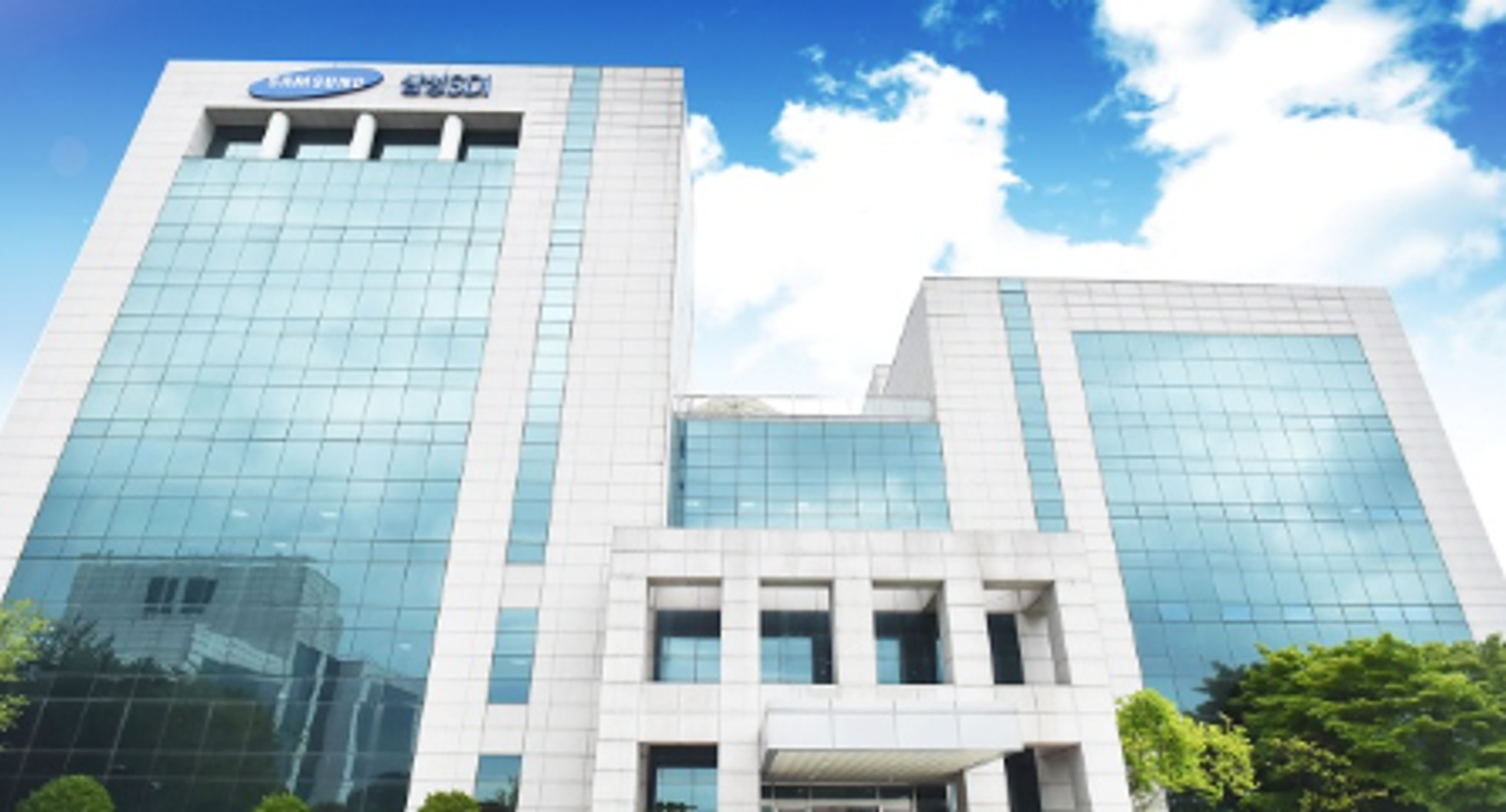
iM Securities has trimmed its target price for Samsung SDI (KRX: 006400) from KRW 700,000 to KRW 590,000, while maintaining a buy recommendation. The adjustment reflects a broad valuation reset across the global rechargeable battery sector rather than any deterioration specific to the company.
A beat built on a windfall
Samsung SDI reported its second-quarter 2026 results on 30 July. Revenue came in at KRW 3.769 trillion, up 19% year on year and 5% quarter on quarter. Operating profit reached KRW 204 billion, a return to the black from both a year earlier and the preceding quarter. Both figures comfortably exceeded market consensus, which had forecast revenue of KRW 3.7 trillion and an operating loss of KRW 27.3 billion.
The headline numbers, however, require some unpacking. Roughly KRW 190 billion of the operating profit came from a one-off refund related to a legal ruling against American reciprocal tariffs. Strip that out, and the underlying operating result was a modest profit — still a positive sign, but a more modest one.
Mixed signals across business lines
Performance varied considerably by division. The energy storage systems (ESS) business is benefiting from rising demand for renewable energy infrastructure and artificial-intelligence data centres, yet second-quarter ESS revenue fell roughly 10% quarter on quarter. The culprit was a scheduling delay: deliveries under a domestic centralised contract-market project, secured last year, slipped into the third quarter.
The automotive battery division fared somewhat better. Samsung SDI redirected supply originally destined for Stellantis's European operations to its American SPE plant, boosting sequential revenue. The American advanced manufacturing production credit (AMPC) — a subsidy under the Inflation Reduction Act — also helped narrow losses. Even so, shipments to BMW and Volkswagen continued to decline as the company ceded market share at both customers.
The small-format battery business posted a sequential revenue increase of around 10%, driven by demand for power-tool batteries and battery backup units (BBUs) for AI data centres. Nevertheless, the division remained loss-making, weighed down by low-margin orders won during an earlier period of oversupply.
Third quarter: a step forward, then back
iM Securities projects third-quarter revenue of KRW 4.078 trillion — up 34% year on year and 8% quarter on quarter — with operating profit of KRW 110 billion. That would represent a 46% sequential decline in operating profit, simply because the KRW 190 billion tariff refund will not recur. Excluding that one-off, underlying profitability is expected to improve.
ESS is the main engine of recovery. Deliveries deferred from the second quarter are now expected to flow through in the third, lifting ESS revenue by roughly 35% quarter on quarter. A further acceleration is anticipated in the fourth quarter, when Samsung SDI's American lithium iron phosphate (LFP) production line is due to come fully on stream. Higher capacity utilisation should reduce fixed-cost burdens, and an expanded AMPC benefit should accelerate the improvement in margins.
Valuation: deep discount, but not without cause
The target-price reduction reflects a sector-wide re-rating rather than company-specific setbacks. iM Securities derived its new target using a sum-of-the-parts (SOTP) methodology, applying a peer-group EV/EBITDA multiple of 8.2 times to projected 2028 EBITDA. The peer group comprises CATL, LG Energy Solution, SK Innovation, BYD, and Panasonic.
The market has already done much of the painful work. Samsung SDI's shares closed at KRW 358,500 on 30 July — roughly 50% below their May peak of KRW 712,000. The implied upside to iM Securities' target price is 64.6%. At current levels, the stock trades at 12.6 times projected 2028 earnings, a far cry from the stretched multiples of earlier years.
Risks that remain
Investors should not mistake cheapness for safety. The loss of market share at BMW and Volkswagen means any meaningful recovery in the automotive battery division may be slow. The small-format battery business still needs time to restore profitability. ESS revenues, as the second-quarter scheduling slip illustrated, are prone to timing volatility. And the AMPC, a critical support for the economics of American production, remains a political variable in an uncertain policy environment.
A sector searching for a floor
Samsung SDI's predicament is shared across the industry. Chronic oversupply and slowing electric-vehicle demand have pushed the entire battery sector into a prolonged downturn. Whether Samsung SDI can differentiate itself through its pivot to ESS and its expansion of American local production will be the central question for the stock.
iM Securities argues that selective overweighting of battery-cell makers with visible earnings recovery and clear exposure to American policy incentives remains the appropriate strategy at this stage of the cycle.
The longer road back
On an annual basis, the scale of the challenge is stark. Samsung SDI recorded an operating loss of KRW 1.998 trillion in 2025. iM Securities forecasts a staged recovery: operating profit of KRW 396 billion in 2026, KRW 1.756 trillion in 2027, and KRW 2.774 trillion in 2028. ESS revenue is projected to nearly quadruple, from KRW 2.896 trillion in 2025 to KRW 11.542 trillion in 2028.
Those projections rest on a critical assumption: that the expansion of American manufacturing capacity — including a joint-venture production line with General Motors scheduled to begin operations in 2028 — proceeds on time and on budget. Should that timetable slip, the recovery trajectory would need to be reassessed.