*This is the fifth instalment in our Ramen Wars series, which examines the stories behind South Korea's most iconic instant noodles—their origins, brand histories, competitive battles, and an honest assessment of how they actually taste. Rating: ★★★⯨☆ (3.5/5.0)*
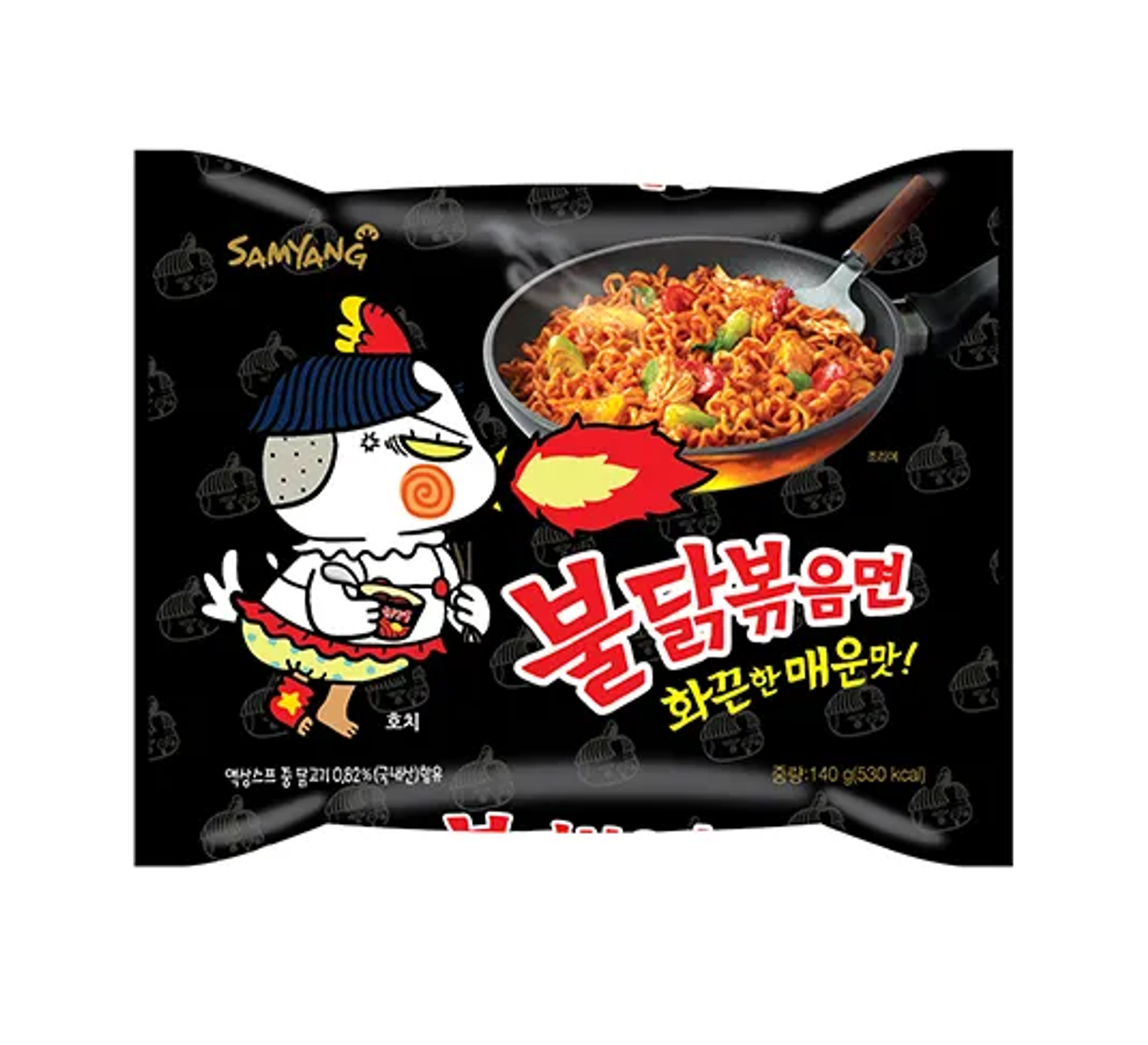
On 13th April 2012, Samyang Foods launched a new instant noodle. First-month sales came to roughly 700m–800m won (about $540,000–$615,000 at today's rates). Nobody thought this product would rewrite Korean food history. Fourteen years later, in June 2026, cumulative sales of the Buldak noodle range crossed 10 billion packets—equivalent to 63 sold every second, around the clock, across the entire world.
The Origin Story
Buldak Bokkeummyeon—literally "fire chicken stir-fried noodles"—was born in a Myeongdong alleyway. In 2011, Kim Jung-soo, who was then married into the founding family of Samyang Foods and now serves as its chairwoman, was walking through the bustling Seoul neighbourhood when she noticed something peculiar: people drenched in sweat, visibly suffering, yet utterly incapable of putting down their plates of buldak (spicy grilled chicken) and spicy chicken feet. The contradiction on their faces—agony and compulsion in equal measure—sparked an idea. Could that intensely Korean brand of fiery heat be captured in a noodle?
A year of research followed. Chillies from around the world were analysed: Korean cheongyang peppers, habaneros, Vietnamese varieties, Tabasco. The development process consumed 1,200 chickens and two tonnes of chilli sauce. The product that emerged in April 2012 was met, initially, with scepticism at home. "Too spicy," critics said.
The reversal came from abroad in 2016. A British YouTuber running the popular channel "Korean Englishman" posted a video of himself eating Buldak noodles. The spectacle of a foreigner writhing in chilli-induced distress proved irresistible. The video spread. YouTubers and TikTokers worldwide replicated the challenge. The "Buldak Challenge" became a global trend. The sensation of unbearable heat that one cannot bring oneself to stop—precisely the paradox Kim had observed in Myeongdong—turned out to be perfectly engineered for the attention economy. Capsaicin triggers dopamine and endorphin release as the brain attempts to counter pain; that neurochemical reward creates the craving to repeat the experience, and the urge to share that moment online did the rest.
The celebrities followed. In 2022, BTS member Jimin ate Carbo Buldak noodles—a carbonara-flavoured variant—during a live broadcast. In 2024, American rapper Cardi B posted a TikTok video of herself eating the same product; it accumulated 32 million views within a month. A video of an American girl named Adaline Sophia moved to tears upon receiving Carbo Buldak noodles as a birthday present surpassed 100 million views. The noodle had ceased to be merely food. "Buldak" had become a proper noun in dozens of languages.
The numbers are remarkable. Samyang Foods' overseas revenue grew from 93bn won in 2016 to 1.8838 trillion won in 2025—a twentyfold increase. The share of revenue derived from exports rose from 26% to 80%. Samyang alone now accounts for more than 60% of all South Korean instant noodle exports. The company's share price surged from 28,200 won before Buldak's launch to 1.23m won by end-2025, a gain of 4,365%. Its market capitalisation broke through 10 trillion won in June 2025—a first for the Korean food industry—briefly valuing it at more than four times its arch-rival Nongshim (maker of Shin Ramyun). This is the same Samyang Foods that was nearly destroyed in the late 1980s by a scandal over the alleged use of industrial tallow in its products. One noodle resurrected the entire company.
Even a regulatory setback became, perversely, a branding triumph. In 2024, Denmark's food safety authority recalled several Buldak products, citing capsaicin levels so high they posed a risk of "acute poisoning". Samyang responded by throwing a "Buldak Spicy Ferry Party" in Copenhagen to mark the eventual lifting of the recall—celebrating its own dangerous heat in the very country that had tried to ban it.
Tasting Notes
Buldak Bokkeummyeon is, unambiguously, very spicy. It registers 4,404 Scoville Heat Units—approximately 1.6 times hotter than Nongshim's Shin Ramyun, which sits at 2,700 SHU. First-time eaters may find it genuinely punishing. But that is the point. The heat is not accidental; it is engineered to produce pleasure through pain. Capsaicin stimulates the brain's pain receptors, which respond by releasing dopamine and endorphins. The resulting euphoria is precisely what compels people to return.
The noodles themselves are thick and chewy. The liquid sauce balances chicken flavour with chilli heat reasonably well. The preparation—rinsing the noodles, then stir-frying them with the sauce rather than serving in broth—looks complicated but becomes straightforward with practice. Adding a fried egg or a slice of cheese tempers the heat and adds richness; this versatility has spawned countless recipes and contributed substantially to the product's longevity.
In an honest assessment, however, the Carbo Buldak variant is the more accomplished product. The addition of a cream powder achieves a balance between heat and savoury richness that makes it accessible to a considerably wider audience. The original is strictly for those who want an unmediated chilli experience. For anyone who does not actively seek out extreme heat, the carbonara version is the better choice.
Verdict
Buldak Bokkeummyeon is not merely a noodle. It is a cultural phenomenon. Without social media, without the global reach of K-pop, without the viral logic of YouTube challenges, it is doubtful this product would have achieved what it has. But the wave could only be ridden because the product itself deserved to ride it. The world is not short of aggressively spicy instant noodles. Only one of them has conquered the global palate.
If Shin Ramyun is the noodle that represents Korea, Buldak is the noodle Korea sent out to represent itself. That distinction explains, as neatly as any financial model, the present gap between Samyang's share price and Nongshim's.
*One-line verdict: "It hurts, and you cannot stop. That sensation conquered the world."*