Company Overview
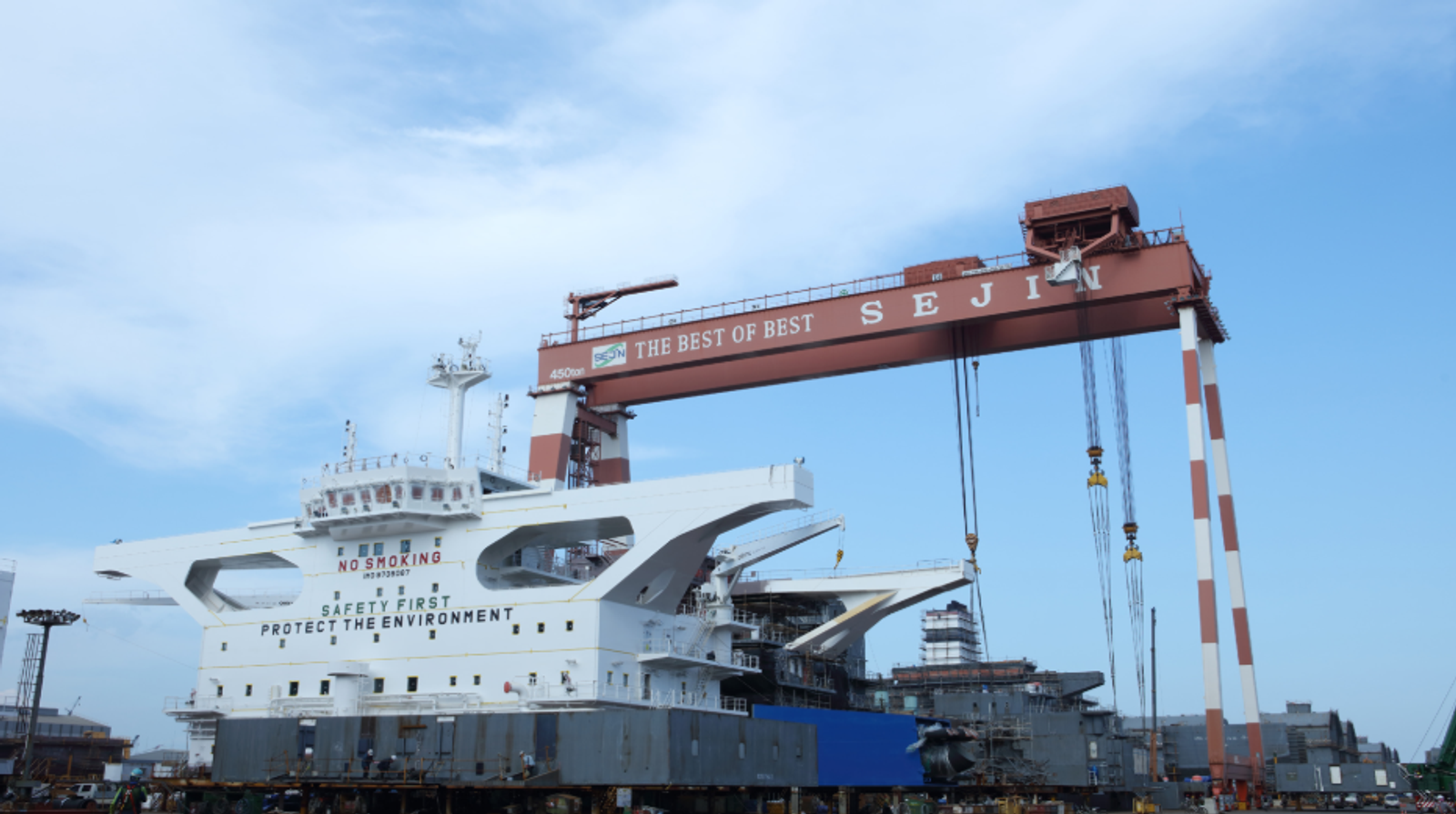
Sejin Heavy Industries (KOSPI: 075580) is South Korea's leading specialist in the manufacture of structural blocks for shipbuilding — the large prefabricated hull sections that major shipyards assemble into completed vessels. The company supplies these components to the country's biggest shipbuilders, including HD Hyundai Heavy Industries, HD Hyundai Samho, and Hanwha Ocean, making it a first-tier supplier at the heart of the domestic industry. With large-scale production facilities in Ulsan and Yeongam, Sejin holds a commanding position in the outsourced shipbuilding-block market.
Its fortunes are tightly bound to the shipbuilding cycle. The early 2020s brought a sharp downturn, but a global surge in orders for LNG carriers and container ships since 2022 has put the company firmly on a recovery path.
In the context of Korea's corporate value-up programme — a government-backed initiative to improve shareholder returns and capital efficiency among listed companies — Sejin has not been directly included in the Korea Value-up Index. Nevertheless, the broader re-rating of the Korean shipbuilding sector, a significant asset sale, and the arrival of new leadership have gradually brought questions of shareholder returns and governance to the surface. Sejin's value-up story is best understood through three lenses: asset disposals, balance-sheet repair, and leadership renewal.
Business and Financial Performance
Business Model: A Single-Product Company
Sejin's entire business revolves around manufacturing structural ship blocks on an outsourced basis for yards that prefer not to produce them in-house. The vast majority of its order book comes from the Big Three Korean shipbuilders — HD Hyundai's yards and Hanwha Ocean. This concentrated, single-product model means the company has virtually no buffer when shipyard clients cut orders; a downturn in contracting flows directly and immediately into its revenues.
After a period of weakness caused by the COVID-19 pandemic and the contraction in global trade in the early 2020s, conditions began to improve materially from 2022 onwards as LNG carrier and container-ship contracting rebounded.
Estimated Financial Trend
Year | Revenue (est., bn KRW) | Operating profit (est.) | Context
2020 | ~300–350 | Loss or marginal profit | COVID-19; industry downturn
2021 | ~300–380 | Modest recovery | Early rebound in orders
2022 | 400+ | Recovery | LNG carrier orders surge
2023 | ~450–500 | Improving | Shipbuilding boom takes hold
2024–25 | Growing | Further improvement est. | Big Three expand volumes
*All figures are estimates based on public disclosures. Final results should be verified against official filings on the Financial Supervisory Service's DART system.*
The Green New Deal and Share-Price Volatility
In September 2020, South Korea's government unveiled a Green New Deal policy package, and Sejin's shares rallied sharply in the days that followed. Investors drew a connection between the company's fabrication capabilities and potential demand for offshore wind structures and eco-friendly vessels. In practice, however, translating that narrative into concrete new revenues took far longer than the market initially assumed.
Key Value-Up Milestones
June 2020 — Land Sale to Korea Zinc: A Balance-Sheet Turning Point
On 30 June 2020, Sejin sold a parcel of land to Korea Zinc — one of the world's largest producers of zinc — for 63.7 billion won. For a company of Sejin's size, this was a material disposal. The timing was deliberate: with the shipbuilding industry mired in one of its deepest downturns, shedding non-core assets to shore up liquidity and strengthen the balance sheet was a rational defensive move. The proceeds were not channelled directly into shareholder returns, but the transaction laid the groundwork for subsequent improvements in financial health.
September 2020 — Green New Deal Momentum: Diversification Hopes Emerge
Following the government's Green New Deal announcement, Sejin attracted market attention on the premise that its structural fabrication expertise could be extended to offshore wind foundations and other green-energy infrastructure. Shares moved higher in the short term. Whether this translated into genuine business diversification remains unclear, but the episode appears to have prompted the company to explore opportunities in clean-energy structures more seriously.
April 2026 — New CEO Kim Jin-jong Takes the Helm: Leadership Renewal
Kim Jin-jong was officially appointed chief executive on 31 March 2026. Shortly after taking office, he stated publicly that his goal was to "consolidate Sejin's position as the number-one shipbuilding-block manufacturer" — a signal that the company intends to deepen its core competency rather than pivot away from it. Markets have interpreted his arrival as a potential catalyst for a more assertive approach to shareholder value, though concrete commitments have yet to materialise.
May 2026 — Korea Value-Up Index Rebalancing: Indirect Benefit
On 28 May 2026, the Korea Exchange conducted its regular rebalancing of the Korea Value-up Index, adding HD Hyundai Heavy Industries and SK Square while removing Hyundai Rotem and Hyosung Heavy Industries, among others. Sejin was neither added nor removed. However, the inclusion of its most important client — HD Hyundai Heavy Industries — is seen as potentially beneficial for Sejin: a re-rating of the Big Three shipbuilders tends to support capital investment and order volumes, which flows through to first-tier suppliers such as Sejin.
Challenges and Assessment
Remaining Challenges
Shareholder returns need definition. Sejin's dividend history has been inconsistent, ebbing and flowing with the shipbuilding cycle. Now that the industry is in a strong upcycle, the company faces pressure to articulate a stable payout policy — whether through a progressive dividend, share buybacks, or cancellations. It also needs to assess whether it can meet the PBR and ROE thresholds required for direct inclusion in the Value-up Index.
Customer concentration is a structural vulnerability. With the bulk of revenues tied to a handful of large shipyards, Sejin has limited bargaining power. If yards press for price cuts or reduce outsourcing volumes, Sejin's ability to protect its margins is constrained. Broadening its client base and exploring adjacent markets are medium-term imperatives.
Governance improvements need to follow leadership change. The appointment of a new CEO creates an opportunity to strengthen board independence and improve communication with shareholders — steps that the market is beginning to demand explicitly.
Green opportunities must be converted into revenues. The prospect of supplying structures for offshore wind farms has been discussed for several years. Turning that possibility into signed contracts will be a critical test of the new management's strategic execution.
Overall Assessment
Sejin Heavy Industries holds a strong market position in a vital niche of the Korean shipbuilding supply chain, yet its value-up journey remains at an early stage. The 2020 asset sale was a sound defensive measure, but the gains were not shared with shareholders in any meaningful way. The next 12 to 24 months — under new leadership, in a buoyant market — represent the most significant window Sejin has had in years to define a credible shareholder-value strategy.
Controversies and Limitations
An opaque history of shareholder returns. Sejin has repeatedly trimmed or suspended dividends during downturns while stopping short of explicit commitments to return capital during good times. For long-term shareholders, this unpredictability is a persistent concern.
Weak bargaining power vis-à-vis clients. The Big Three shipbuilders set the terms. When yards push down unit prices or adjust block-outsourcing ratios, Sejin has limited recourse. This structural disadvantage acts as a ceiling on operating margins.
Failure to meet Value-up Index criteria. Despite the broader uplift to the Korean shipbuilding sector, Sejin did not qualify for direct inclusion in the May 2026 rebalancing, likely because it fell short on metrics such as PBR, ROE, and dividend yield. Institutional investor interest in the stock is, in part, contingent on closing this gap.
The gap between green ambitions and green revenues. The enthusiasm generated by the Green New Deal in 2020 was never fully backed by actual contract wins. The disconnect between narrative and delivery has eroded some of the market's confidence in the company's ability to diversify.
Key Metrics Summary
Year | Dividend (est.) | Buyback activity | Operating profit (est.) | PBR (est.) | Context
2020 | Reduced or nil | Not confirmed | Loss or marginal | Below 1x | COVID; industry trough
2021 | Modest | Not confirmed | Small profit | ~1x | Early recovery
2022 | Modest to moderate | Not confirmed | Improving | ~1x | LNG order surge
2023 | Improving | Not confirmed | Hundreds of bn KRW | ~1x | Boom takes hold
2024 | Improving | Not confirmed | Hundreds of bn KRW | ~1x | Big Three volumes expand
2025 | Continuing | Not confirmed | Growth | Not confirmed | Boom continues
*All figures are estimates based on publicly available information and industry analysis. Definitive figures should be confirmed via DART, the Financial Supervisory Service's electronic disclosure system.*