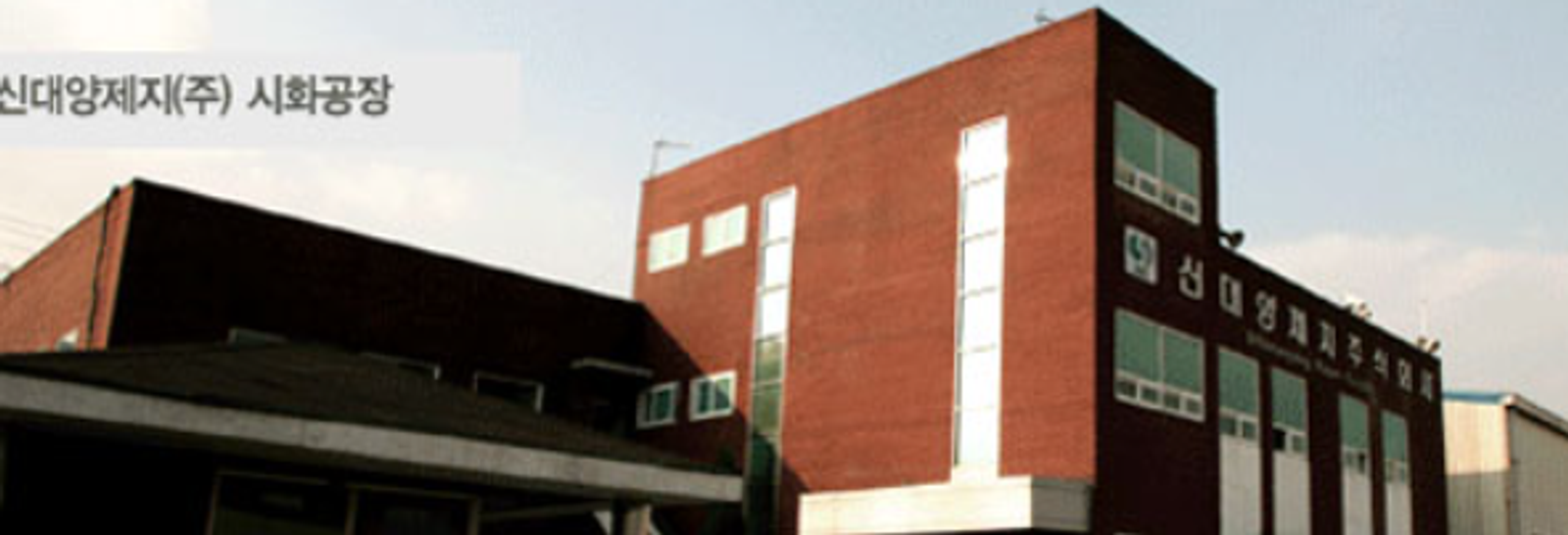
NICE Information Service published a technical analysis report on Shin Daeyang Paper (KOSPI: 016590) on 3rd September, spotlighting the South Korean papermaker's competitive strengths: its ability to produce every grade of containerboard and its vertically integrated supply chain. The headline finding was that the company's operating margin had recovered to 5.6% in the first half of 2026, up from 3.5% for the full year 2025.
A fully integrated paper operation
Founded in 1982, Shin Daeyang Paper produces all major grades of corrugated base paper — kraft linerboard, test linerboard, and corrugating medium — at its Sihwa plant and through its subsidiary Shin Daeyang Paper Banwol. Combined annual production capacity at the two sites stands at 694,260 tonnes, and the utilisation rate reached 99.7% in the first half of 2026. Through a network of affiliates — including Daeyang Paper Industries, Gwangshin Paperboard, Daeyang Paperboard, and Daeyoung Packaging — the group spans the entire value chain from raw base paper through corrugated sheets to finished boxes.
Three years of falling profits, then a turning point
Shin Daeyang Paper peaked in 2023 with revenue of 645.3 billion won and operating profit of 58.5 billion won, representing a margin of 9.1%. Profitability then deteriorated sharply: operating profit fell to 29.2 billion won (a 4.4% margin) in 2024 and to 22.2 billion won (3.5%) in 2025 — a third consecutive annual decline. The causes were a 3.9% year-on-year drop in domestic selling prices per tonne for corrugated base paper and a 4.8% fall in production volumes.
A recovery became apparent in 2026. First-half revenue rose 4.1% year-on-year to 331.0 billion won, and operating profit climbed by 2.3 billion won to 18.5 billion won. Notably, the paperboard division, which had recorded a full-year loss of 7.2 billion won in 2025, swung to a modest profit of 200 million won in the first half of 2026. NICE Information Service estimates full-year 2026 revenue at 671.5 billion won, a 5.0% increase on 2025, with most of the gain attributable to the paperboard division's recovery.
A fortress balance sheet
The company's finances are in robust shape. As of end-June 2026, cash and cash equivalents stood at 196.8 billion won, comfortably exceeding total borrowings and lease liabilities of 101.1 billion won. The debt-to-equity ratio is 29.6% and the equity ratio is 77.2%. Operating cash flow has held steady at roughly 60 billion won per year since 2023, providing a solid financial buffer against industry cycles. The per-share dividend has also risen for three consecutive years: 150 won in 2023, 200 won in 2024, and 225 won in 2025.
Restructuring and expansion
The group has been reshaping its structure. In February, Shin Daeyang Paper spun off the Cheongju plant operations of Daeyang Paperboard into a new entity, Shin Daeyang Paperboard, which was incorporated as a consolidated subsidiary. On 24th August, the company completed an on-market acquisition of Daeyoung Packaging shares worth 4.0 billion won, tightening its grip on the group's packaging operations. One note of caution: Daeyoung Packaging was designated a "listed for administrative issues" stock by the Korea Exchange in August 2026 — a regulatory status that flags potential exchange delisting and warrants close monitoring.
Risks that investors should weigh
The shares closed at 10,370 won on 31st August 2026, some 43% below their 52-week high of 18,150 won. With the 2025 price-to-earnings ratio at 23.2 times, the pace of the margin recovery will be the decisive factor in whether the current valuation is justified. A further uncertainty concerns the Ansan plant of Daeyang Paper Industries, which has been shut since a fire and has yet to resume production; the timing and economics of any reconstruction remain unresolved, casting a shadow over the group's medium-term supply strategy.
A market with structural tailwinds
South Korea's corrugated base paper market was valued at 2.9468 trillion won in 2023 and is forecast to expand at a compound annual growth rate of 4.92%, reaching 3.7468 trillion won by 2028. The corrugated box market is projected to grow from 5.0318 trillion won to 5.9475 trillion won over the same period. The principal drivers are the continued growth of e-commerce and rising demand for sustainable packaging materials. The report's central thesis is that vertically integrated producers — able to pass through raw-material cost changes more quickly across the full value chain — are best placed to capitalise on these trends.
Competitors such as Asia Paper, Sambo Paperboard, and Korea Export Packaging also operate vertically integrated structures linking base paper to corrugated processing, which means the real differentiators are production efficiency, environmental compliance, and customised converting capabilities. No formal broker buy, hold, or sell ratings on Shin Daeyang Paper have been published in the past six months.