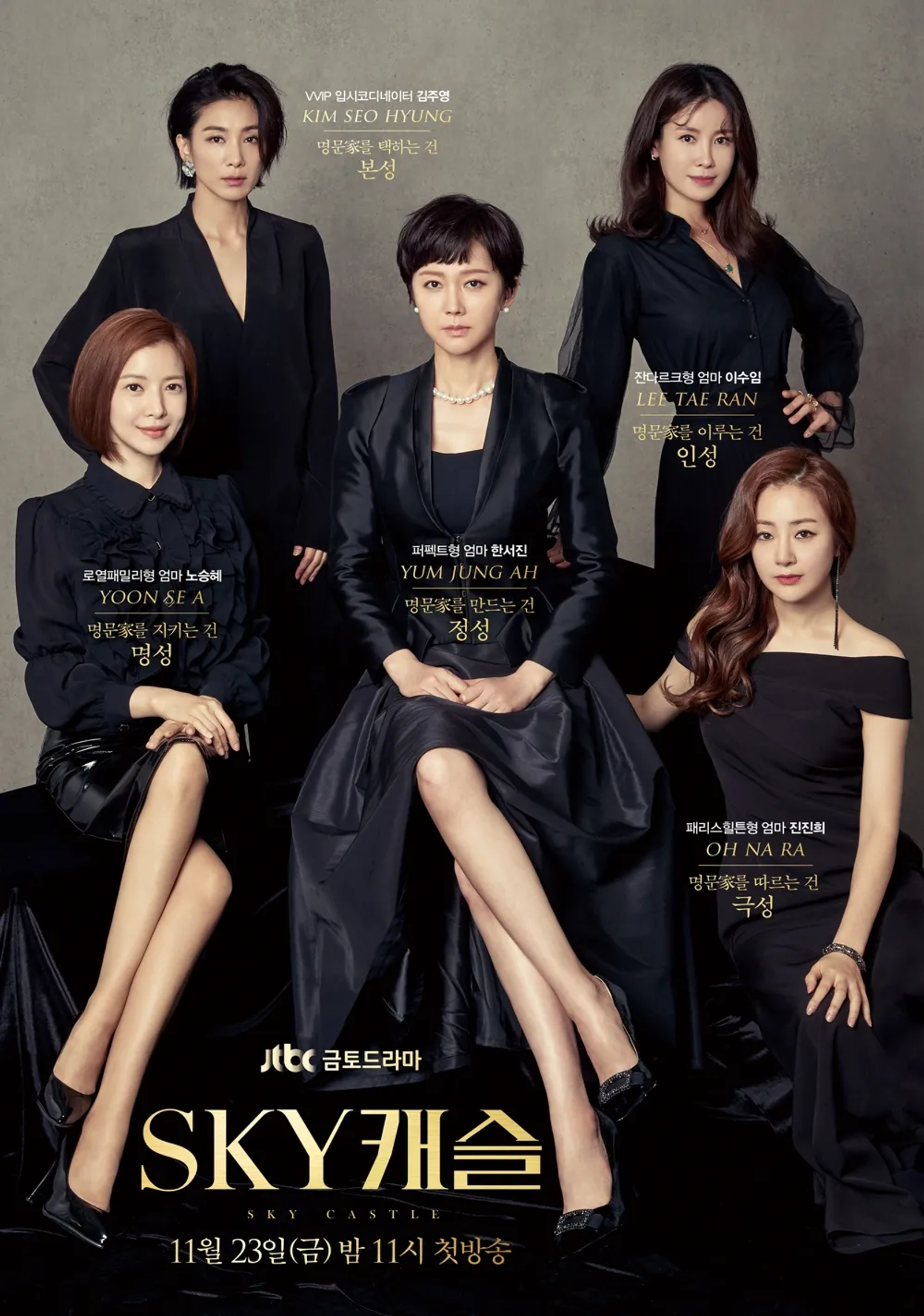
*Editor's note: Behind the Scenes is a series examining the making of hit K-dramas — the production stories, on-set decisions and industry dynamics behind the finished product. The seventh instalment covers JTBC's* SKY Castle.
When SKY Castle first aired on JTBC, a cable and satellite broadcaster, on 23rd November 2018, it drew a nationwide audience share of just 1.7%, according to Nielsen Korea. By the time its final episode was broadcast on 1st February 2019, that figure had risen to 23.8% — a record for any non-terrestrial drama in South Korea. Written by Yoo Hyun-mi and directed by Jo Hyun-tak, the 20-episode series was produced by HB Entertainment and Drama House. It launched without famous faces or a lavish marketing campaign. What follows is an account of how it got made.
Scouting the Cram-School District
Before cameras rolled, director Jo Hyun-tak spent time in Daechi-dong, the Seoul neighbourhood synonymous with South Korea's ferociously competitive private tutoring industry. He watched students — laden with oversized bags and paying for lessons with their parents' credit cards — shuttling between cramming academies, grabbing meals at convenience stores and restaurants that stayed packed well past midnight. "That's just how South Korea works," he told a press briefing afterwards. It was also in Daechi-dong that he first heard that people genuinely sought out the kind of private university-entrance consultant depicted in the show — a role embodied by the character Kim Joo-young.
Rumours circulated that writer Yoo Hyun-mi had drawn directly on her own life, and that two child characters in the series were her real children. Jo dismissed this flatly. While the writer's experience of putting her own children through the university-entrance process provided emotional grounding, he said the dramatic conceits were developed collaboratively between writer and director.
Casting Without Stars
Jo handled casting himself, dispensing with a dedicated casting director. His production team assembled candidates for supporting roles, while child actors went through repeated auditions over days or weeks. Final decisions were made by anonymous vote. Jo credits actress Yeom Jung-ah — who agreed to join the project before the script was finished — with giving the production its foundation.
Kim Seo-hyung, who played the formidable consultant Kim Joo-young, initially intended to decline the role. Her previous project had left her physically exhausted, and working with an unfamiliar director gave her pause. "In the end, I chose to do it, and the choice was mine," she later reflected. The character's backstory, as originally supplied to her, was sketchy — little more than a brief biography — so she filled in the gaps by questioning the director during rehearsals. Rather than adopting the stylised, formal speech patterns that might have made the character sound like a figure from a historical drama, she concentrated on conveying atmosphere. A gesture she devised herself — pressing down on another character's shoulder — was added during this preparatory period and went on to become one of the show's most memorable images. She has noted that performing the role was particularly demanding because she could not know what Kim Joo-young would do next until the following batch of scripts arrived.
A Quiet Start and a 4% Joke
The ratings climbed steadily if unspectacularly at first: from 1.7% in the opening week to 4.4%, then 5.2%, then 7.5%. Jo has said the debut figure was painful, though the pace of production left little time for despondency. His director of photography sent a text message declaring that the only direction left was up. In lighter moments, Jo and writer Yoo traded jokes about how gratifying it would be if the show managed 4%. At one point, a fire at a ratings-research company briefly left the production without any audience data at all.
What did help was the advance state of the scripts. By the time filming began on the first episode, scripts for the first ten episodes were already complete. That lead time allowed the director to think carefully about episode endings and to weigh alternatives during editing. Asked later what had produced the show's most striking dramatic moments, Jo's answer was unequivocal: the writing.
The Sets and the Dead Dragonfly
Production designer Lee Chul-ho built each household to reflect the psychology of the family that inhabited it. The residential exteriors were shot at a townhouse development in Yongin, south of Seoul. The home of Han Seo-jin — a character concealing a shameful past — was filled with ornate cornicing, carpets and decorative balustrades, details chosen to suggest someone desperate to project an image of refinement. The residence of Cha Min-hyuk, a coldly ambitious character, was clad in steel, glass and ceramic, a scheme reportedly so austere that the set dresser remarked it would be genuinely uncomfortable to live in. Kim Joo-young's penthouse exterior was filmed at a hotel suite in Songdo, the purpose-built business district west of Incheon; the home of another character, Ky, was an actual private house. The proportion of studio-set filming was, by Jo's account, roughly double that of a typical Korean drama — a fact that made the eventual dismantling of the sets all the more regrettable to him.
Some directorial choices were made on the spot. Scouting a school location in midwinter, Jo noticed a dead dragonfly lying in a corridor and worked it into a scene. His broader preoccupation throughout the shoot was with the gap between surface and interior — the idea that a smile can deceive but the hands cannot. He paid close attention to characters' backs and gestures as well as their expressions. The scene in which Han Seo-jin falls to her knees before Kim Joo-young is one he singles out as requiring the actress to find genuine maternal feeling rather than performative anguish.
Script Leak and Controversy
Popularity brought difficulties. On 16th January 2019, portions of the scripts for episodes 17 and 18 circulated on online forums. The following day, the production company announced it was formally requesting a police investigation into the leak. Jo learned of the breach while editing episode 17. He rejected suggestions that the leak might have been a publicity stunt, calling it straightforwardly criminal.
The Korea Medical Association issued a statement criticising a storyline in which a surgeon is threatened by a dissatisfied patient. Jo responded that the scene was intended to explore how a character reacts under extreme pressure, not to make a comment about the medical profession, and offered an apology to anyone who had been caused concern. He also expressed disappointment, though with more ambivalence, that some viewers appeared to have watched the show and concluded they should engage a university-entrance consultant of their own — the opposite of the satirical message the production had intended to send.
23.8%, and the Nicknames
The audience kept growing. Episode 18 set what was at that moment a record for any non-terrestrial Korean drama with a 22.3% share; episode 19 reached 23.2%; and the finale pushed the mark to 23.8%. Viewers, as they are wont to do, bestowed nicknames on the cast. Yeom Jung-ah became known by a phrase her character utters in the show; Kim Seo-hyung acquired an affectionate nickname derived from the urgent, distinctive way Han Seo-jin calls her name; and Lee Hyun-jin, whose character had almost no lines, was nicknamed after a single throwaway phrase. Before the finale aired, Kim Seo-hyung was asked how the series would end. "I can't tell you," she said, "because you need to watch to push it to 25%." The show that had started at 1.7% ended, as she had implied it might, just short of that figure.
*In short: a satire of South Korea's university-entrance culture that began at 1.7% was carried to 23.8% by on-the-ground research in Seoul's cram-school district, ten episodes of completed scripts before filming started, and performances built around what faces conceal rather than what they reveal.*