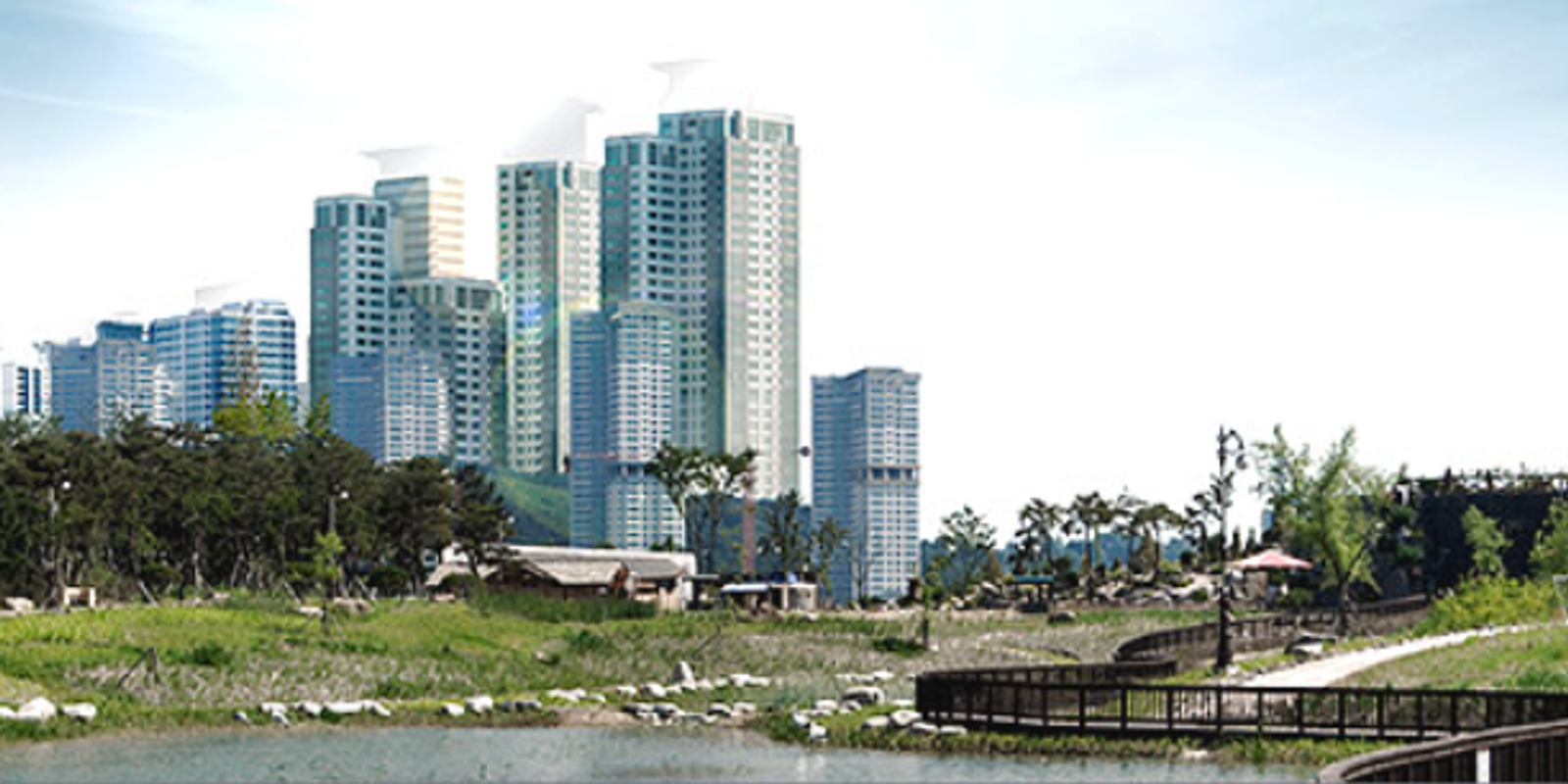
Company Overview
Taeyoung Construction was founded in 1973 and has grown into a mid-sized Korean builder on the strength of its residential brand, "Daesijang" (Desiang), supplying apartment developments across the Seoul metropolitan area and major regional cities. It is a core subsidiary of Taeyoung Group, a conglomerate controlled by TY Holdings that spans construction, broadcasting, and leisure. Listed on the KOSPI — South Korea's main stock exchange — Taeyoung once ranked among the country's top ten contractors by order volume.
Yet any discussion of shareholder value creation at Taeyoung must first pass through an unusual gateway: survival. A crisis in project-finance (PF) lending that erupted at the end of 2023 forced the company to apply for a creditor-led workout programme in January 2024 — the Korean equivalent of a formal debt-restructuring arrangement managed by a consortium of creditor banks. Under that regime, dividends and share buybacks became an afterthought; keeping the company afloat took absolute priority. While South Korea's broader "Value-Up" initiative — a government-backed drive to improve corporate governance and shareholder returns across listed companies — has gathered momentum, Taeyoung has been preoccupied with a far more fundamental challenge. As of 2026, with roughly a year remaining before the workout is scheduled to end, the company is pursuing a twin-track normalisation strategy: expanding public-sector contracts and reshaping its board. Even so, its compliance rate against standard corporate-governance metrics stands at a meagre 47%, underscoring just how much ground remains to be covered.
Business and Financial Performance
Business Structure
Taeyoung's core business is residential construction and property sales. Its Desiang-branded apartments have been its main commercial offering, supplemented by civil engineering, industrial plant construction, and public-works contracts. The group's parent, TY Holdings, holds a stake in SBS, one of South Korea's major terrestrial broadcasters, giving the conglomerate an unusual combination of media and construction assets. This structure means that Taeyoung Construction's financial health has a direct bearing on the group's overall balance sheet.
Before the workout, Taeyoung sustained annual revenues in the multi-trillion Korean won range. The trouble stemmed from PF guarantee exposure that ballooned rapidly between 2021 and 2023: when interest rates rose sharply, those commitments soured in unison, triggering a liquidity crisis.
Financial Performance by Year
Year | Revenue (est.) | Operating Profit (est.) | Key Developments
2021 | ~KRW 3 trillion | Profitable | PF expansion, strong top-line growth
2022 | ~KRW 3 trillion | Sharply lower profit | Rising input costs, interest-rate shock
2023 | ~KRW 2 trillion | Large operating loss | PF defaults accelerate, liquidity crisis
2024 | Workout regime | Restructuring losses | Creditor management, asset disposals
2025 | Recovery sought | Partial improvement (est.) | Public-sector contracts expanded, business restructured
*All figures are estimates based on regulatory filings and press reports; readers should consult the company's annual reports for precise data.*
PF Risk and the Workout
Concerns about Taeyoung's PF exposure began spreading through the market in the second half of 2023. A cooling property market combined with elevated borrowing costs led to a build-up of unsold inventory and repeated delays in converting bridge financing into permanent project loans. In January 2024 the company formally applied for a workout, with the Korea Development Bank — a state-owned policy lender — acting as lead creditor. Effective control of the company passed to the creditor consortium.
Key Value-Up Milestones
January 2024 — Workout Application: Shareholder Returns Suspended
Once the formal restructuring process began, all shareholder-return activity — dividends, share buybacks — came to an immediate halt. Under the creditor agreement, available cash was redirected to debt service and liquidity preservation. Existing shareholders faced the additional threat of a capital reduction (whereby existing shares are cancelled or consolidated to absorb losses), and the share price fell sharply.
Mid-2024 — Asset Disposals: Repairing the Balance Sheet
Within the workout framework, Taeyoung moved to sell non-core assets and tidy up troubled development sites. Some PF projects were wound down or transferred to other parties under creditor supervision. At the TY Holdings level, discussions reportedly took place on how group-wide synergies might help restore overall enterprise value.
August 2025 — TY Holdings Announces Share Disposal and Cancellation Plan: A Group-Level Gesture
In August 2025, TY Holdings announced plans to sell five million of its own treasury shares and cancel a further five million the following year. This was not a measure taken by Taeyoung Construction itself, but it was interpreted as a signal from the group's holding company that it intended to improve shareholder value. The announcement was nonetheless received with scepticism: a concurrent controversy involving the use of price-return swaps (PRS) — derivative instruments that can be used to maintain effective control of shares while transferring economic exposure — left questions about governance transparency unresolved.
March 2026 — New President Appointed: Marshalling for a Post-Workout Recovery
In March 2026 Taeyoung appointed Lee Kang-seok as its new president, restructuring its management team with the explicit aim of exiting the workout. The incoming leadership unveiled a twin-track strategy: increasing public-sector contract wins while simultaneously reforming the board. The move was widely read as laying the groundwork for reclaiming managerial autonomy ahead of the workout's anticipated conclusion.
May 2026 — "Metro City Jasan Desiang" Subscription Closes: Testing the Market
In May 2026 Taeyoung completed the priority-applicant subscription period for the Metro City Jasan Desiang residential development. The launch was closely watched as evidence that the company retained the operational capacity to bring new housing to market despite its financial difficulties. Whether the project sells out in full will have a direct bearing on near-term cash flow and the timeline for exiting the workout.
June 2026 — Corporate Governance Compliance Rate Revealed at 47%: A Value-Up Warning Sign
A governance report published in June 2026 showed that Taeyoung met only 47% of standard corporate-governance benchmarks. Deficiencies were identified across board independence, audit committee composition, and shareholder-return policy — all areas disrupted or neglected during the workout period. The figure confirmed in quantitative terms what had long been apparent qualitatively: that Taeyoung remains effectively sidelined from South Korea's Value-Up conversation.
Challenges and Assessment
Challenges Ahead
The most pressing task is a timely and successful exit from the workout. Only once it is free of creditor management can the company seriously consider reinstating dividends or buying back shares. To reach that point, it must simultaneously address several interlocking problems.
First, it must secure a stable revenue base by winning more public-sector contracts. Reducing reliance on private PF and increasing the share of government-commissioned work would lower earnings volatility. Second, it must improve board independence and governance metrics. Raising a 47% compliance rate in short order will require structural reforms: normalising the composition of independent directorships and securing a genuinely autonomous audit committee. Third, the group as a whole must rebuild credibility. Whether TY Holdings follows through on its promised share cancellation, and how it resolves the PRS controversy, will directly affect Taeyoung Construction's standing with investors and lenders.
Assessment
Taeyoung occupies a singular position within South Korea's construction sector: it must achieve basic corporate rehabilitation before it can even aspire to join the Value-Up movement. The appointment of a new president in early 2026 and the tentative steps towards board reform signal intent, but the 47% governance compliance rate is an objective measure of how far the company still has to travel. The contrast with DL E&C — a rival builder that has driven its share price higher through a combination of valuation-gap reduction and more generous shareholder returns — illustrates how much catching up Taeyoung has to do before it can claim a place in the mainstream Value-Up narrative.
Controversies and Structural Weaknesses
Structural Roots of the PF Crisis: Reckless Expansion
Critics argue that Taeyoung's workout was not simply the product of adverse market conditions but the foreseeable consequence of years of excessive PF guarantee underwriting and undisciplined top-line growth. The company aggressively expanded its PF exposure during the construction boom without adequate risk controls. That the board failed to rein in this strategy stands as a fundamental indictment of its governance.
Group Governance Opacity: TY Holdings and Taeyoung
TY Holdings wields substantial influence over Taeyoung Construction, but the transparency of that relationship has long been questioned. The controversy over TY Holdings' use of price-return swaps deepened market distrust of the group's governance. Investors are watching closely to see whether the promised cancellation of five million treasury shares is actually carried out.
Shareholder Rights Under the Workout
In any workout, ordinary shareholders are structurally subordinate to creditors. The combination of potential capital reductions, dilutive share issuances, and suspended dividends has materially harmed retail shareholders — the very constituency that South Korea's Value-Up initiative is designed to protect. The irony is pointed: the workout process has moved in precisely the opposite direction to the shareholder-friendly reforms the broader programme champions.
Construction Defects and Brand Damage
Data on defect arbitration claims published in September 2025 covering South Korea's top twenty builders showed an industry-wide defect rate approaching 22%. Taeyoung's Desiang brand faces its own trust deficit with residents. Reputational damage of this kind feeds directly into weaker sales rates, slower cash generation, and a more protracted financial recovery — a vicious cycle the company can ill afford.
Summary Data
Year | Dividend | Treasury Shares | Operating Profit (est.) | PBR (est.) | Key Issue
2021 | Paid (partial) | N/A | Positive | ~0.5× | PF expansion
2022 | Reduced or deferred | N/A | Marginally positive | ~0.3× | Interest-rate shock
2023 | Suspended | N/A | Large loss | Below 0.2× | PF defaults accelerate
2024 | Fully suspended | N/A | Restructuring losses | ~0.1× | Workout filed
2025 | Suspended | TY Holdings: 5m shares sold; 5m shares cancellation announced | Partial recovery (est.) | ~0.2× | Holding company shareholder initiative
2026 | Suspended | Cancellation under monitoring | Recovery ongoing | Unconfirmed | Governance compliance 47%; new president appointed