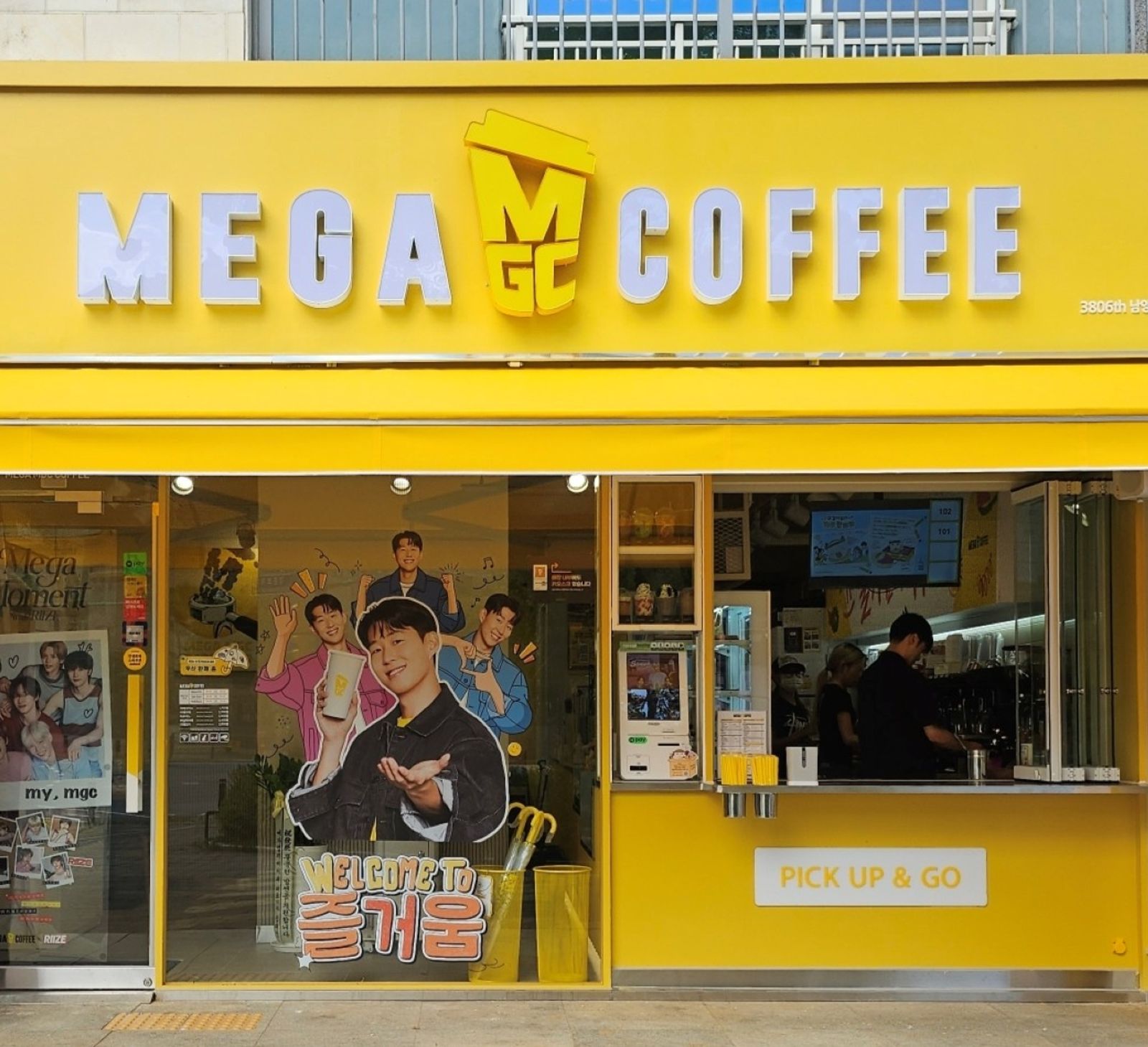
The balance of power in South Korea's coffee market is shifting. The long dominance of premium brands is under pressure, and an unusual phenomenon has emerged: Mega MGC Coffee, a value-focused chain, is rapidly closing the gap with Starbucks across both digital metrics and payments data.
According to app analytics and retail research firms, Mega MGC Coffee's monthly active users (MAU) have climbed to the very top of the domestic coffee-franchise rankings. During certain periods, it has either surpassed or pulled level with the Starbucks app — which had held the industry's top spot for years — while the gap in total payment volumes is narrowing quickly. The simultaneous rise in both active users and transaction values suggests the chain has moved beyond simple price competition into genuine consumer loyalty.
Several structural factors explain Mega MGC Coffee's ascent. The most immediate is price sensitivity, sharpened by persistent inflation. A standard Americano at Mega MGC Coffee costs between ₩1,500 and ₩2,000 (roughly $1.10–$1.50), compared with ₩5,000–₩6,000 at Starbucks — a difference of more than threefold. A survey by the Korea Consumer Agency found that the average price of a café beverage has risen more than 15% since 2020. In such an environment, a consumer drift towards cheaper brands is a pattern that repeats with each economic downturn.
The explosive expansion of store numbers has been equally important. By 2023, Mega MGC Coffee operated more than 2,500 outlets in South Korea, surpassing Starbucks's roughly 1,900. Much as convenience-store chains such as Emart24 and GS25 colonised neighbourhood retail by penetrating back-streets and residential areas, Mega MGC Coffee has applied the same logic — call it the economics of accessibility. For the consumer, an affordable coffee within easy walking distance becomes the default, not a considered choice.
The chain's app strategy has also grown more sophisticated. By building out a prepaid-wallet payment system alongside stamp-card rewards and digital coupons, Mega MGC Coffee has transformed what might have been a simple ordering app into a customer lock-in platform. The approach mirrors the loyalty ecosystem Starbucks has spent more than a decade cultivating through its Starbucks Rewards programme — replicated here at the budget end of the market.
International parallels sharpen the significance of what is happening in Seoul. In the United States, when Starbucks's MAU growth stalled in 2022–23, drive-through value chains such as Dutch Bros surged. In China, Luckin Coffee clawed back from the brink of bankruptcy with an aggressive low-price strategy and eventually overtook Starbucks in domestic revenues. The lesson from each case is the same: in coffee, price can be a driver of structural realignment, not merely a temporary competitive variable.
Yet assessments of Mega MGC Coffee's qualitative standing remain divided. Franchise-industry analysts caution that, even with superior MAU figures, the gulf in per-transaction value means overall revenues are still far lower than Starbucks's. More pressingly, if franchise-store profitability suffers under the weight of aggressive outlet expansion, the brand's long-term viability could be jeopardised. South Korea has already seen this script play out with other budget coffee brands, where unchecked growth eroded franchisee margins.
The gap in consumer experience is another complicating factor. Starbucks sells more than coffee: it offers what it calls the "third place" — a branded, aspirational space that carries emotional premium. Among higher-income consumers and those in their twenties and thirties, the brand functions as a form of social signalling that price alone cannot displace. For Mega MGC Coffee to overtake Starbucks in total payment volumes, it would need to compensate for its low unit prices with overwhelming transaction volumes — a structural ceiling it is unlikely to breach without meaningful investment in store environment and product quality.
What the data ultimately reveal is not simply a reshuffling of brand rankings. In a high-inflation consumer environment, a mass migration towards rational, everyday spending is reshaping the Korean coffee market. The new rule of survival is clear: brands that combine digital-platform strength with physical accessibility will endure. Over the next two to three years, the critical strategic questions will be whether Starbucks can defend its premium positioning while experimenting with lower-priced offerings, and whether Mega MGC Coffee can trade up its brand through investment in quality and space. On the policy side, there is growing support for institutionalising protections for franchisees and formalising impact assessments of new outlet licences, as over-expansion continues to threaten those at the bottom of the supply chain.