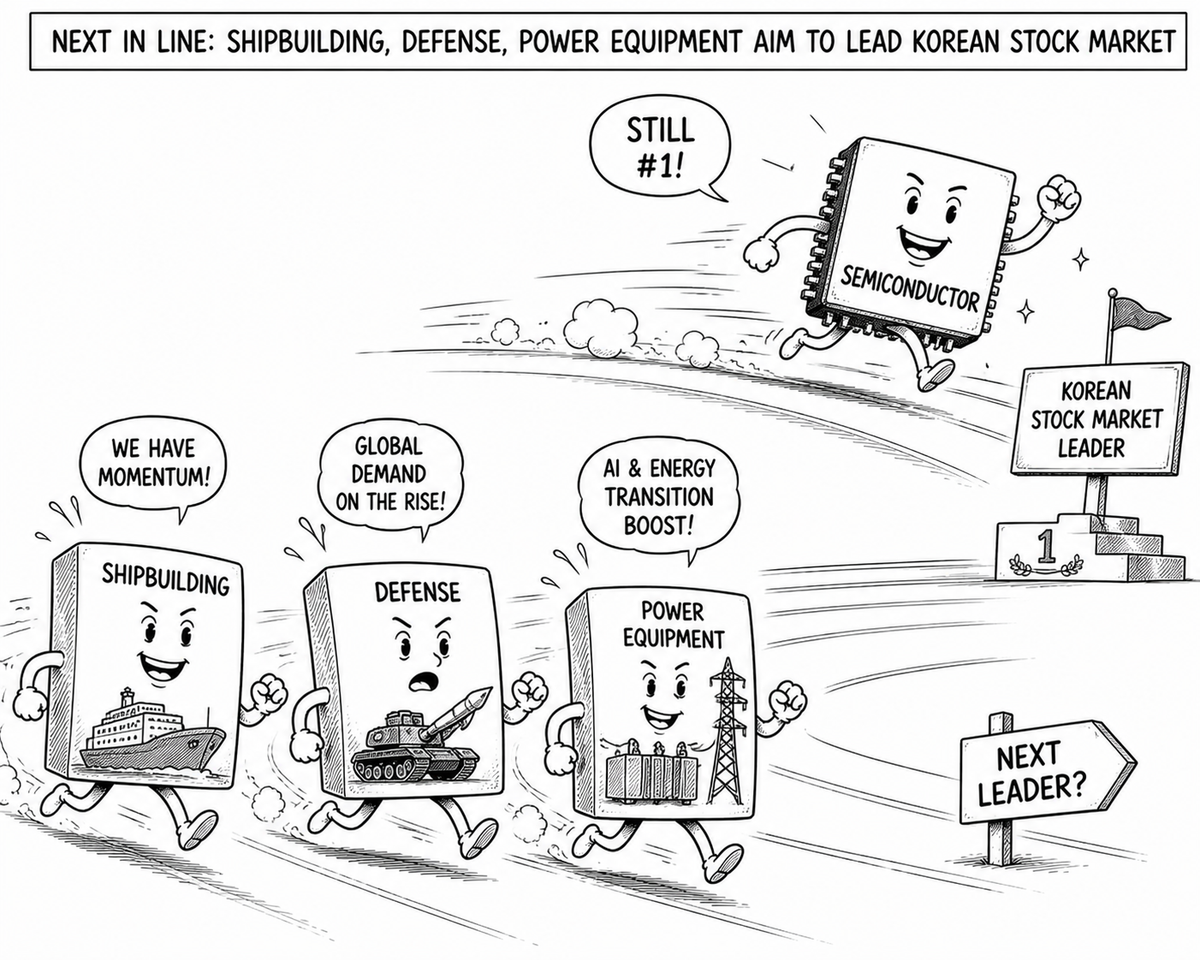
On 9th June, the KOSPI — South Korea's main stock index — jumped more than 8% in a single session. Yet Hanwha Ocean fell 0.87% that day, and HD Hyundai Heavy Industries dropped 1.45%. While the broader market was celebrating, both shipbuilders sat out the party.
More striking still, this was no one-day anomaly. Hanwha Ocean had declined on seven of the eight trading sessions between 28th May and 9th June. HD Hyundai Heavy Industries had fallen on eight of nine sessions since 27th May. All of this happened while a string of positive developments was accumulating for the sector: reports of Hanwha's participation in Canada's next-generation submarine programme, the commercialisation of marine data-centre vessel engines, and a series of high-value shipbuilding orders.
Then, on 10th June, the reversal came. Hanwha Ocean rose as much as 6.56% intraday to 108,900 won; HD Hyundai Heavy Industries gained 5.23% to 645,000 won. The rally extended across the sector: HD Korea Shipbuilding & Offshore Engineering rose 3.03%, HD Hyundai Marine Solution surged 7.38%, Sejin Heavy Industries gained 4.91%, and STX Engine climbed 4.04%. Analysts attributed the move to a straightforward dynamic — after a prolonged correction, bargain hunters stepped in as market rotation shifted funds away from the previous session's leaders.
Good news, but a queue had formed
To understand the pattern, it helps to survey the catalogue of positive news that accumulated for South Korean shipbuilders and defence companies through June. On 12th June, reports emerged that Hanwha Ocean had effectively been selected for a next-generation destroyer programme worth 7.8 trillion won (approximately $5.7bn). Around the same time, the evaluation phase began in earnest for the Korean Next-Generation Destroyer (KDDX) project. HD Hyundai Heavy Industries secured an order for a Swedish icebreaker and continued winning contracts for liquefied natural gas carriers and other high-value vessels. On 9th June itself, a Canadian defence publication reported on Hanwha's movements in the competition for Canada's Patrol Submarine Project (CPSP).
The reason share prices did not respond immediately to any of this is straightforward: capital and attention were concentrated elsewhere. On the day the KOSPI rose 8%, virtually the entire gain was attributable to Samsung Electronics and SK Hynix, South Korea's semiconductor giants, which had surged on the back of easing trade tensions and robust chip demand. Shipbuilding and defence stocks were simply waiting their turn.
A second wave on 15th June
The rotation did not exhaust itself in a single session. On 15th June, Samsung Heavy Industries, Daehan Shipbuilding, HD Hyundai Heavy Industries, and Hanwha Ocean all rose sharply again. HD Hyundai Heavy Industries led the sector with a gain of more than 8%. Analysts cited a combination of rising global vessel orders, growing demand for eco-friendly ships, and expectations of continued growth in the defence segment.
Taken together, the two rallies make a consistent argument: the fundamentals of the shipbuilding and defence sector had not weakened. The news flow throughout June was almost uniformly positive. What was in short supply was not good news, but market attention — a finite resource that had first been consumed by semiconductors before rotating into sectors that had been left behind.
What analysts think
According to data compiled by Investing.com, 19 of 20 analysts covering Hanwha Ocean maintain a buy recommendation, with just one dissenter. The consensus target price stands at 164,750 won, implying upside of 46.18% from current levels. The range is wide — from a low of 75,000 won to a high of 180,000 won — but the weight of professional opinion is unambiguous.
The sector also has policy tailwinds. The South Korean government has been expanding export financing support for the domestic shipbuilding industry under its "K-Shipbuilding" initiative and has announced plans to invest in AI-integrated shipyard technology. Power-equipment manufacturers — including Gaon Cable, Daehan Electric Wire, Iljin Electric, LS ELECTRIC, Hyosung Heavy Industries, and Jeronelectrics — are frequently grouped with shipbuilders as beneficiaries of similar structural trends.
The sector rotation dynamic is not new to 2024. In April, an earlier broadening of the market saw power equipment, shipbuilding, construction, and battery stocks outperform. In May, however, IT hardware, semiconductors, automobiles, and insurers dominated, leaving the rest of the market behind. May's underperformance, in effect, stored up the fuel for June's rotation.
Whether this is a trend or a blip
What remains uncertain is whether the rotation will prove durable. A single-session rebound — or even two — does not establish a trend. Several sources of volatility remain live: the prospect of a SpaceX public listing absorbing risk appetite, the next Federal Reserve policy meeting, and various political calendar risks. Whether capital that rotated out of semiconductors continues to flow into shipbuilding and defence, or reverses course, will be answered by the supply-and-demand dynamics of the next few weeks.
Two specific events are worth watching. The first is the announcement of a preferred bidder in Canada's CPSP submarine competition, in which Hanwha is a contender. The second is the formal contract signing for the 7.8 trillion won destroyer programme. If both are confirmed, the current rotation could harden from a tactical rebound into a more sustained re-rating of the sector.
**9th June (KOSPI +8%)** | **10th June (rotation rebound)** | **15th June (second rally)**
Hanwha Ocean | -0.87% | +6.56% | Broadly higher
HD Hyundai Heavy Industries | -1.45% | +5.23% | +8%-plus (sector leader)
Prior trend | 7–8 down days out of 8–9 sessions | Bargain buying on rotation | Vessel orders, eco-friendly demand
Accumulated positives | Canada submarine bid, destroyer contract, LNG orders | Rotation dynamic takes hold | Defence growth expectations added
Consensus target (Hanwha Ocean) | Avg. 164,750 won (+46.18% implied upside) | — | —