*15th July 2026*
Three things to know
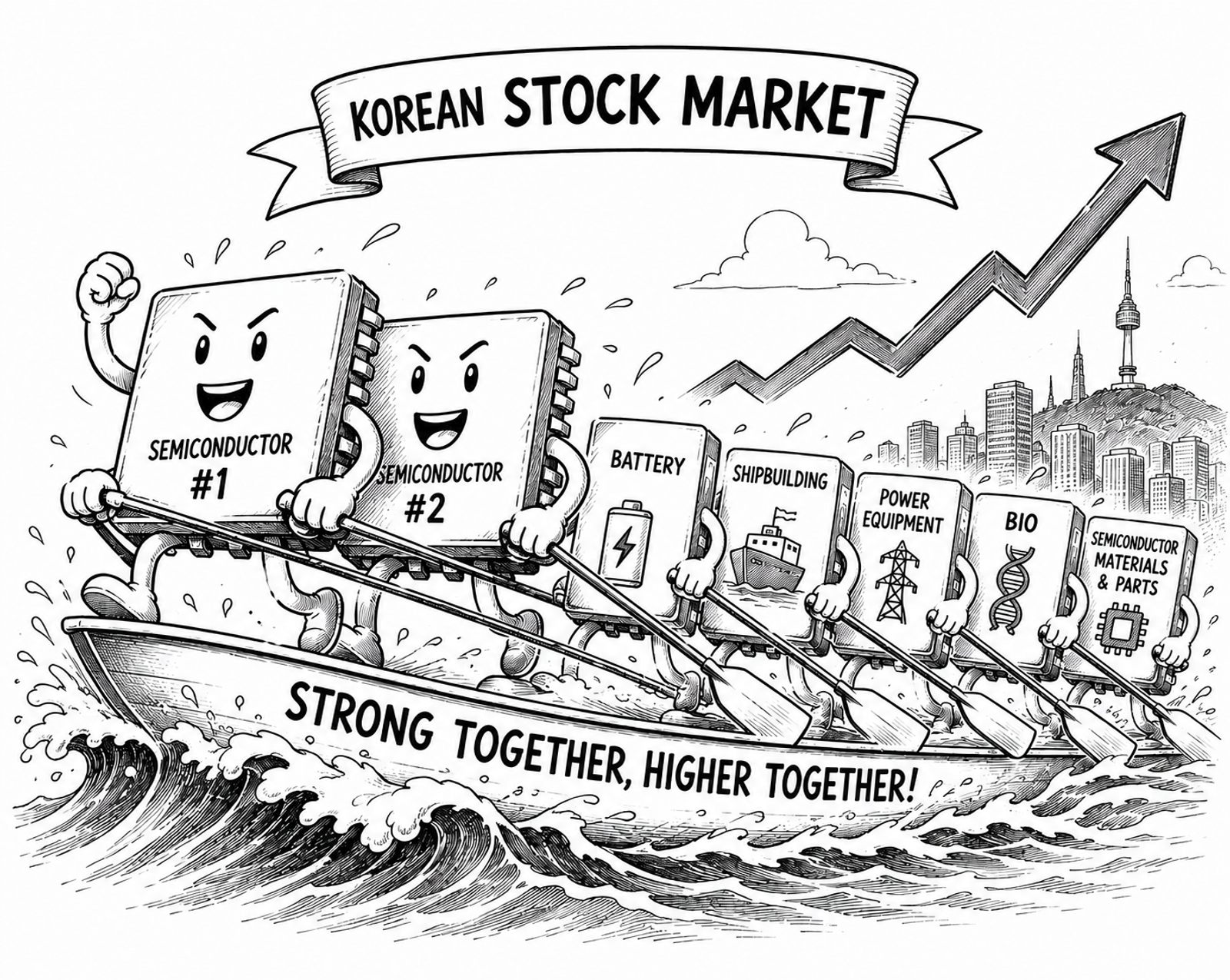
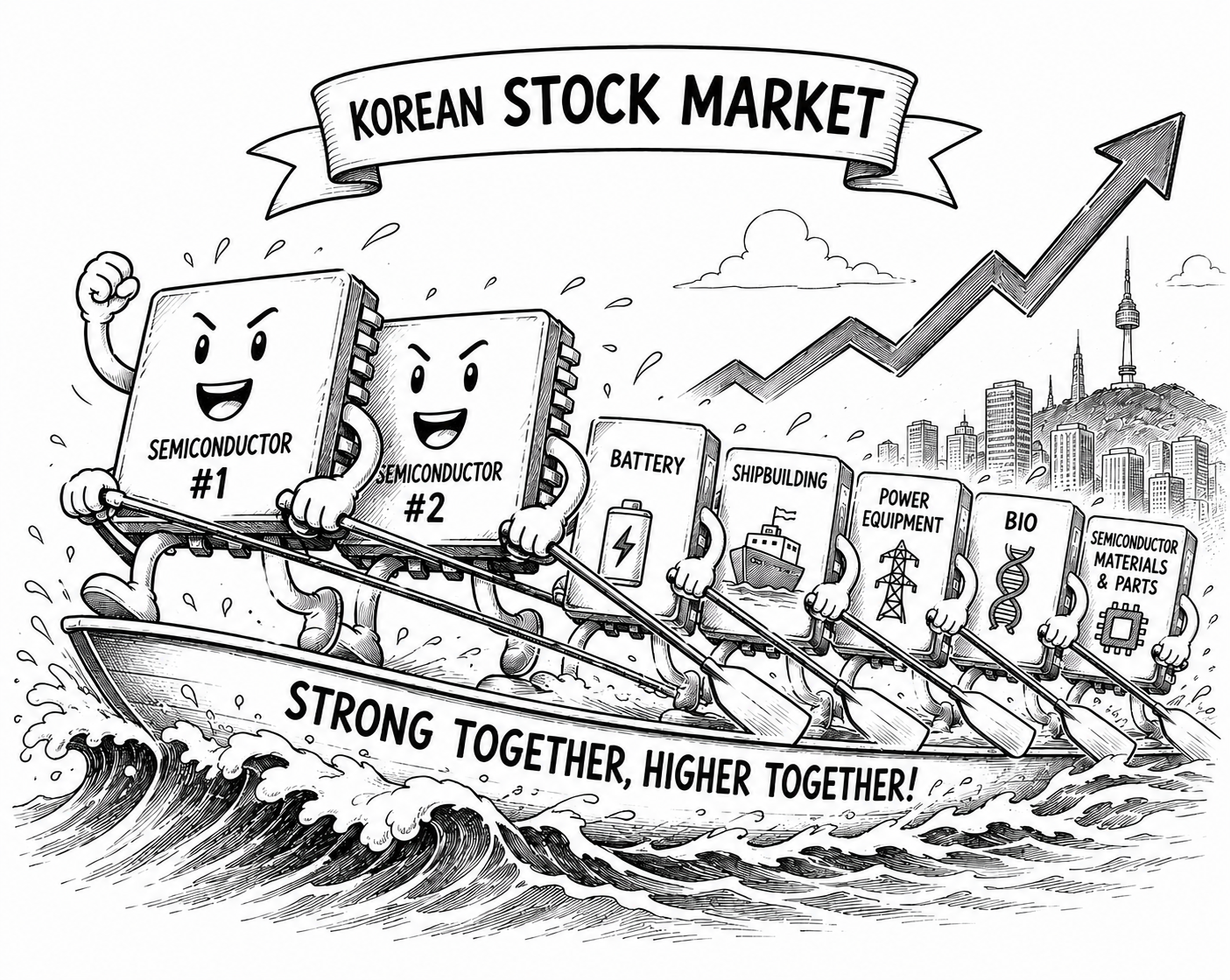
- The KOSPI surged 6.24% on 15th July to close at 7,284.41, extending a sharp two-day recovery. The junior KOSDAQ index rose 5.80% to 829.43. Both markets triggered automatic trading curbs — known as "sidecar" circuit breakers — within minutes of the open, a sign of the rally's unusual ferocity. - This rebound was not driven by retail investors. During both the preceding sell-off and the subsequent recovery, individual investors were consistent net sellers. Foreign and institutional buyers absorbed that supply and pushed the indices higher — a meaningful shift from the first half of the year, when retail money led the market upward. - Most significantly, this rally has breadth, not just height. Machinery and equipment, medical instruments, automobiles, secondary batteries (the Korean term for lithium-ion batteries used in electric vehicles and energy storage), financials, and defence all rose in concert. The semiconductor duopoly's grip on market direction is loosening.
The scale and speed of the rebound
The KOSPI closed on 15th July at 7,284.41, up 427.58 points, or 6.24%, from the previous session. Heavy buying from the open triggered a sidecar curb at 9:06am; at one point during the afternoon, gains exceeded 8%. The KOSDAQ's own curb fired at 9:17am before the index settled up 5.80% at 829.43. Simultaneous circuit breakers on both exchanges are rare and underscored the extraordinary momentum. The day before, on 14th July, the KOSPI had briefly touched 6,400 intraday before clawing back losses to close higher. Over the two sessions combined, the market has nearly recovered to pre-crash levels.
A shift in who is buying
The most striking feature of this rebound is the reversal in who holds the whip hand. On 15th July, foreign investors net-bought 2.32 trillion won on the main board; institutions added a further 182.4 billion won. Retail investors, by contrast, net-sold 2.47 trillion won. The pattern was identical the day before: institutions net-bought 3.22 trillion won and foreigners a further 952.8 billion won, while retail investors offloaded 4.14 trillion won. Even on the KOSDAQ, where retail participation is usually highest, individuals sold a net 140.7 billion won on 15th July while foreigners and institutions bought 23 billion and 108.5 billion won respectively.
What makes this pattern notable is its consistency. Retail investors sold during the crash and kept selling during the recovery. This suggests that many of the individual investors who fuelled the first-half rally — including those using borrowed money and leveraged instruments — are now taking profits or cutting losses rather than buying the dip. Foreigners and institutions, meanwhile, appear to be acting on the view that the sell-off was overdone.
Whether this reallocation of market power proves durable or merely transitory is, in the view of most Korean brokerages, the single most important question for the second half of the year. A note of caution is warranted: historically, sharp rebounds following steep falls on the Korean market have rarely marked a clean turning point. For this recovery to take hold, foreign buying will need to persist beyond a day or two, and the won-dollar exchange rate alongside the VKOSPI volatility index will need to stabilise.
Breadth, not just bounce: this rally looks different from the first half
During the first half of 2026, the KOSPI's gains were overwhelmingly concentrated in two stocks: Samsung Electronics and SK Hynix. The rest of the market was largely left behind. The 15th July session told a different story.
By sector, machinery and equipment rose 8.76%, medical and precision instruments 7.45%, and electricals and electronics 7.42%. Semiconductor heavyweights did hit double-digit gains at points during the day, but the advances were matched across a wide range of industries: Hyundai Motor rose 2.24%, Kia 3.87%, LG Energy Solution 4.04%, Samsung Life Insurance 6.47%, KB Financial Group 0.89%, Hanwha Aerospace 6.54%, and HD Hyundai Heavy Industries 1.07%. On the KOSDAQ, battery-materials companies EcoPro BM and EcoPro, along with semiconductor equipment makers Jusung Engineering and Wonik IPS, posted intraday gains in the double digits.
This rotation does not mean the semiconductor concentration has been fully unwound. Samsung Electronics and SK Hynix together still account for more than half of KOSPI market capitalisation, and their rebound contributed meaningfully to the day's gains. But capital is now flowing simultaneously into sectors that spent the first half of the year in the shadows. The "semiconductors or nothing" dynamic that defined the first half appears to be, if not broken, at least beginning to bend.
Policy adds another tailwind
The KOSDAQ's prospects are also being shaped by regulatory change. Korea Exchange (KRX) celebrated the bourse's 30th anniversary with a three-day event, "KOSDAQ CONNECT 2026", at the start of the month, at which it unveiled a package of measures to raise the quality of the junior market. The minimum market capitalisation required to maintain a KOSDAQ listing has been raised to 20 billion won this month — ahead of the original 2027 schedule. A further increase to 30 billion won, previously planned for 2028, has been brought forward to January 2027. Shares trading below 1,000 won — so-called "penny stocks" — have been added to the delisting review list for the first time. A new two-tier structure, dividing the KOSDAQ into "Premium" and "Standard" segments, is also under consideration; details are expected in September.
The government's broader "value-up" programme — modelled loosely on Japan's corporate governance push — is also expanding to the KOSDAQ. As of 15th June, 732 listed companies had published value-enhancement plans, of which 389 were KOSDAQ-listed. However, by market capitalisation, KOSPI companies account for 88% of disclosures against just 31.5% for KOSDAQ firms, suggesting considerable room to close the gap. KRX says it is focusing on companies with low price-to-book ratios and those that listed under the tech-exception fast-track route, offering consulting support to around 70 KOSDAQ firms.
Portfolio strategy for the second half
Taken together, these developments suggest that a second-half portfolio should look rather different from the one that served investors well in the first.
Semiconductors remain the core, but the weighting deserves trimming. The earnings trajectory for Samsung Electronics and SK Hynix is intact. Both companies, along with America's Micron, are engaged in a multi-hundred-trillion-won capacity race in anticipation of a memory supercycle. Samsung plans to invest 2,030 trillion won in its Pyeongtaek P5 and Yongin cluster facilities and a further 400 trillion won in the south-west Honam region. SK Hynix, which recently listed on the Nasdaq and raised 40 trillion won in the process, is directing that capital towards its Yongin cluster, a packaging plant in Cheongju, and EUV lithography equipment. Yet concentrating more than half a portfolio in two stocks — as some retail investors did in the first half — looks less compelling now that the market is broadening.
Semiconductor equipment makers are direct beneficiaries of this capex race. With Samsung, SK Hynix, and Micron all committing to massive facility investment simultaneously, the revenue visibility for Korean equipment and materials suppliers is improving. Jusung Engineering and Wonik IPS each gained around 12% on 15th July, reflecting these expectations.
Oversold, improving companies in non-semiconductor sectors are worth revisiting. Shipbuilding, power equipment, defence, and nuclear energy have all seen genuine earnings improvement, but were overlooked during the first-half semiconductor frenzy. Hanwha Aerospace's 6%-plus gain on 15th July is consistent with a broader reappraisal of these sectors.
The battery story still has momentum, driven by energy storage. The simultaneous gains in LG Energy Solution, EcoPro BM, and EcoPro on 15th July were partly driven by news of large-scale solar and energy-storage procurement contracts by global technology giants. AI data-centre power demand is emerging as a new and significant source of orders for the battery and ESS (energy storage system) industry.
Biotechnology may have the most upside in the second half after being the most neglected in the first. The gains in Samsung Biologics and Alteogen on 15th July were modest — precisely because the sector has accumulated substantial undervaluation while capital flowed into semiconductors. Korean pharmaceutical and biotech companies set a new record in the first half of 2026, generating roughly 13 trillion won in technology licensing deals; industry observers believe the annual total could exceed 30 trillion won if the second half matches expectations.
The calendar is busy with potential catalysts. HLB awaits an FDA ruling on rivoceranib, its liver-cancer drug. Kolon TissueGene is preparing to report Phase 3 trial results for TG-C in the United States. Ildong Bioscience's partner Immunovant plans to release two Phase 2 datasets for IMVT-1402, a treatment for autoimmune diseases. LegaChem Biosciences has Phase 1b data from its antibody-drug conjugate (ADC) pipeline due, alongside the possibility of further licensing deals. D&D Pharmatech expects its Phase 2 results for a MASH (metabolic dysfunction-associated steatohepatitis) treatment within the third quarter. And Aribio's Alzheimer's candidate AR1001 is set for Phase 3 readouts in the second half.
With regulatory decisions, clinical results, and technology-export events all clustering in the coming months, the valuation discount that accumulated through the first half — compounded by isolated company-specific setbacks and royalty-structure concerns — could unwind sharply once concrete results materialise. That said, most analysts expect the recovery to be selective: companies that deliver actual results will be rewarded; those that do not will not simply rise on sector sentiment alone.
The key variable to watch
Whether the foreign and institutional buying that powered this two-day rebound proves to be a fleeting tactical move or the beginning of a sustained trend is the pivotal question for the months ahead. History counsels caution: sharp Korean market rebounds after steep falls have rarely translated cleanly into lasting recoveries. Investors would do well to watch three gauges simultaneously — the won-dollar exchange rate, the VKOSPI volatility index, and the pace of retail net selling — before concluding that the character of this market has permanently changed.
First half vs this rebound: a comparison
First half rally | This rebound (14–15 July)
Leading sectors | Semiconductor duopoly; most other sectors left behind | Semiconductors, machinery, medical instruments, autos, batteries, financials, defence — all rising together
Who is buying | Retail investors, including leveraged and margin accounts | Foreign investors and institutions net buying; retail consistently net selling
KOSDAQ | Relative laggard amid semiconductor concentration; fell to the 850 range | Rose in tandem with KOSPI (+5.80%); sidecar triggered
Policy backdrop | Value-up index in early stages | KOSDAQ reform package advancing (tiered market structure, tighter delisting rules)