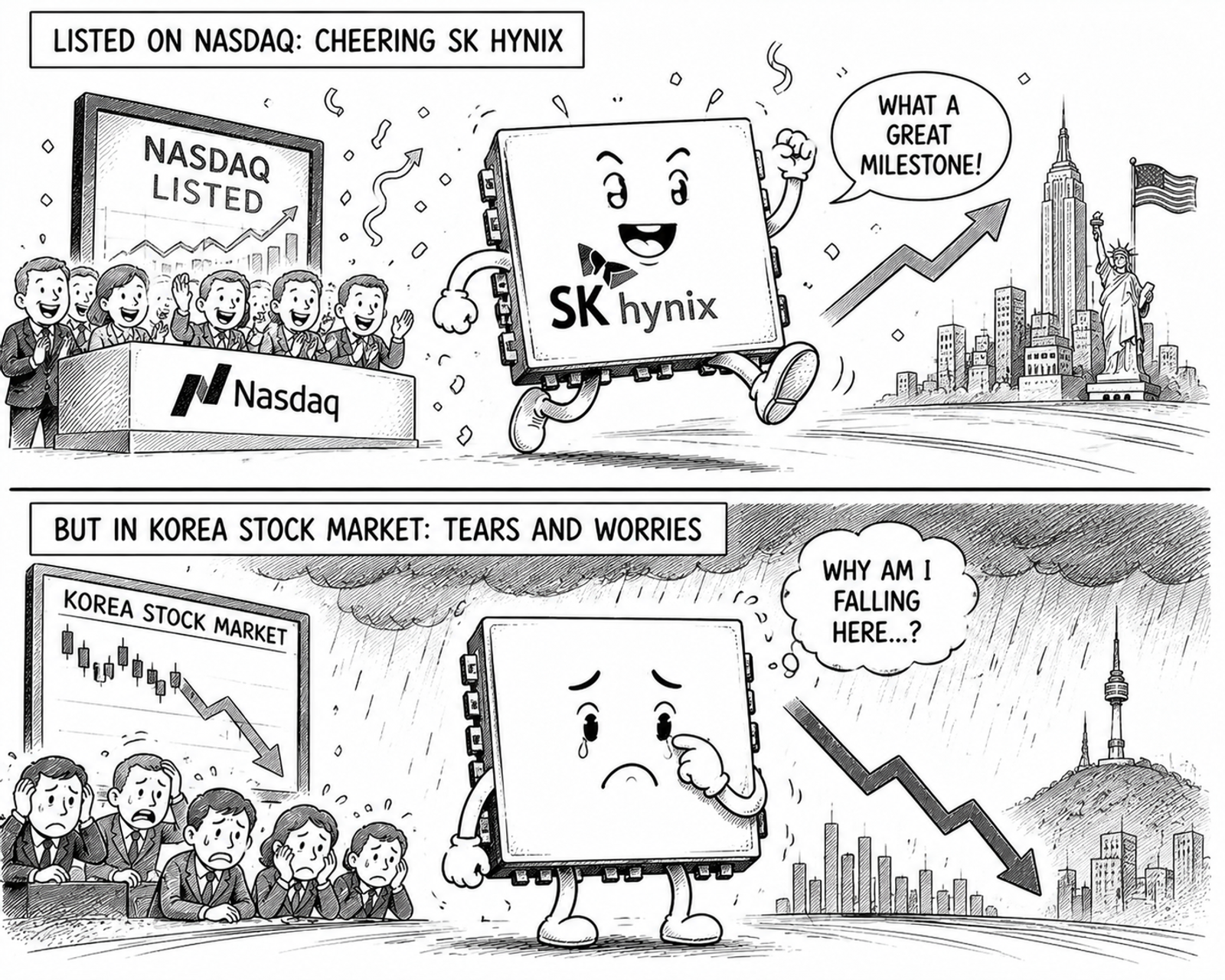
SK Hynix broke records with the largest-ever American IPO by a foreign company, its ADR surging 13% on debut. Three days later, its domestic shares crashed through the 2m-won threshold, halting trading twice. Earnings prospects have not changed — but the mood has.
*13th July 2026*
Three things to know
- On 10th July, SK Hynix listed American depositary receipts (ADRs) on the Nasdaq Global Select Market, raising $26.5bn (roughly 40trn won) — the largest US IPO ever by a foreign company. The ADRs closed 13% above their offer price on the first day. Domestic investors widely expected that premium to migrate back to Seoul-listed shares. - It did not. On 13th July, SK Hynix's domestic shares fell as much as 13% intraday, breaking below the 2m-won level. The broader KOSPI index (South Korea's main equity benchmark) fell nearly 8%, triggering both a trading sidecar — a brief suspension of index futures — and a full Level 1 circuit breaker. - There is no evidence of a fundamental deterioration. Several brokerages maintained or raised their price targets. The common trigger for the sell-off was Middle Eastern geopolitical risk, but the reason the KOSPI fell far harder than Japan's Nikkei lies elsewhere: the index's extreme concentration in two semiconductor giants, compounded by ADR-related short-selling, fading earnings-estimate momentum, and margin-call forced selling.
A triumphant debut in New York
On 10th July, SK Hynix made its Nasdaq debut via ADRs priced at $149 each. Demand exceeded supply by more than seven times. The $26.5bn raised surpassed Alibaba's $25bn offering in 2014 to become the largest US listing ever by a non-American company. On its first day of trading, the ADR closed at $168.49 — more than 13% above the offer price and roughly 16% above the closing price of the Seoul-listed parent share (2.18m won).
At a press event in New York, Chey Tae-won, chairman of SK Group (the conglomerate that controls SK Hynix), spoke confidently about exponentially growing memory demand in the AI era. Kwak Noh-jung, SK Hynix's chief executive, added that 2027 would be the most supply-constrained year in the industry's history. With virtually all of the company's 2026 production already sold, that remark was widely read as a signal that prices and margins for high-bandwidth memory (HBM) chips could improve further still.
A circuit breaker in Seoul
The euphoria lasted less than three days. On 13th July, SK Hynix shares fell sharply from the opening bell and at one point traded as low as 1.89m won — a drop of more than 13% from the previous close. The 2m-won level had not been breached since 8th June. Samsung Electronics fell more than 6%, and SK Square — SK Hynix's largest shareholder — tumbled more than 12%. The KOSPI index dropped as far as the 6,800 level during the session, down nearly 8% on the day. Futures trading was suspended by a sidecar in the morning; a Level 1 circuit breaker — which halts all trading for 20 minutes — was triggered in the afternoon.
Why a Nasdaq hit became a Seoul crash
The sell-off does not look like a verdict on earnings or the chip cycle. Instead, several distinct and unrelated forces collided on the same day.
The trigger: Middle East geopolitics. Over the weekend, the US president announced the end of a ceasefire with Iran; Iran responded by threatening to close the Strait of Hormuz. With a critical artery for global energy supply suddenly at risk, sentiment towards risk assets soured broadly, and large-cap semiconductor stocks bore the brunt.
The amplifier: index concentration. Geopolitical risk alone cannot explain why the KOSPI fell so much harder than comparable markets. Japan's Nikkei 225 index fell more than 1,300 points intraday before recovering to close down around 1%. Kioxia, Japan's leading memory chipmaker, was among the Nikkei's biggest drags on the day — yet the index's overall decline was a fraction of the KOSPI's. The difference lies not in the severity of the risk but in index architecture. Samsung Electronics and SK Hynix together account for more than half the KOSPI's total market capitalisation. Kioxia's weight in the Nikkei 225 is far smaller. The same wave of risk aversion, hitting a market so heavily anchored to two semiconductor stocks, was always going to inflict disproportionate damage. Geopolitics pulled the trigger; concentration loaded the gun.
The hidden pressure: ADR arbitrage. The very success of the Nasdaq listing appears to have created selling pressure on the Seoul-traded shares. Several foreign institutional investors publicly outlined strategies to buy the ADR and short-sell the domestic shares — a straightforward arbitrage to capture the valuation gap between the two. The data support this: between 23rd June and 8th July, the outstanding balance of stock lending for SK Hynix — a leading indicator of short interest — jumped 31.4%, far outpacing Samsung Electronics' 11.7% rise over the same period. Shinhan Investment & Securities noted that this pattern suggests foreign investors had been building short positions in the domestic shares in anticipation of the ADR listing. The brokerage outlined four scenarios for the post-listing period; the most worrying would see the American premium widen while the domestic share price weakens and short interest continues to rise — a combination that would indicate capital migrating from Seoul to New York. That is precisely what appears to be unfolding.
The backdrop: peak-cycle anxiety. Questions about the sustainability of AI-driven capital expenditure — notably debates around the terms of Meta's data-centre leasing plans — have lingered beneath the surface for weeks. Adding to the pressure, Korea Investment & Securities estimated SK Hynix's second-quarter operating profit at 60.4trn won, roughly 8% below the market consensus of 65trn won. The result is not bad in absolute terms; but after a prolonged run of upward earnings revisions, a downward adjustment to expectations carries an outsized psychological sting.
The structural vulnerability. South Korea's domestic equity market carries additional fragility. Margin-financed share purchases (known locally as credit loans) total 38trn won. The ratio of forced liquidations to outstanding margin balances exceeded 10% at the start of July — historically, a reading above 5% has often preceded a cascade of distressed selling. Single-stock leveraged products linked to Samsung Electronics and SK Hynix, launched recently, are also reporting significant losses, amplifying the pressure.
The fundamentals have not moved
There are clear reasons not to interpret this sell-off as a verdict on SK Hynix's business. The company commands a 56–58% share of the global HBM market and remains Nvidia's primary supplier. In the first quarter, revenue reached 52.58trn won and operating profit 37.61trn won — up 198% and more than 400% respectively year on year. The Nasdaq listing itself was, by any measure, a success: demand was seven times supply, and the ADR's premium over the domestic share price has since widened from 15.8% to 18.3%.
Brokerage sentiment also moved in the opposite direction to the share price. Daeshin Securities raised its target price for SK Square by 12% to 2.1m won, citing the ADR premium. KB Securities held its target price for Samsung Electronics at 600,000 won with a buy recommendation, forecasting that operating profit would improve further in both the third and fourth quarters.
In other words, what analysts think about the business has not changed. What changed, abruptly, was what the market was willing to pay.
What to watch: The key question is which of Shinhan Investment & Securities' four post-listing scenarios the market converges on. If short positions are unwound and the American premium is transmitted back to domestic shares, this week's decline will prove a transient supply-and-demand distortion. If short interest keeps rising, it signals a more durable migration of capital from Seoul to New York. Two additional variables matter: whether Middle East tensions ease, and whether SK Hynix's second-quarter results — due this week — are strong enough to dispel the anxiety that the earnings upgrade cycle may have peaked.
**Nasdaq (ADR)** | **Seoul (domestic shares)**
10th July | ADR up 13% on debut, closing at $168.49 | 2.18m won (prior close)
13th July | Premium widens to 15.8–18.3% | Falls as much as 13% intraday to 1.89m won; closes below 2m won
Key drivers | 7x oversubscribed; hopes of eliminating "Korea discount" | Middle East risk (common trigger) + index concentration (amplifier) + ADR-related short-selling + fading earnings estimates + margin-call liquidations
vs Japan | — | Nikkei 225 down ~1%; Kioxia fell but its index weight limited the damage
Fundamentals | HBM market share 56–58%; Q1 operating profit up 400% year on year | Price targets maintained or raised (KB Securities, Daeshin Securities)