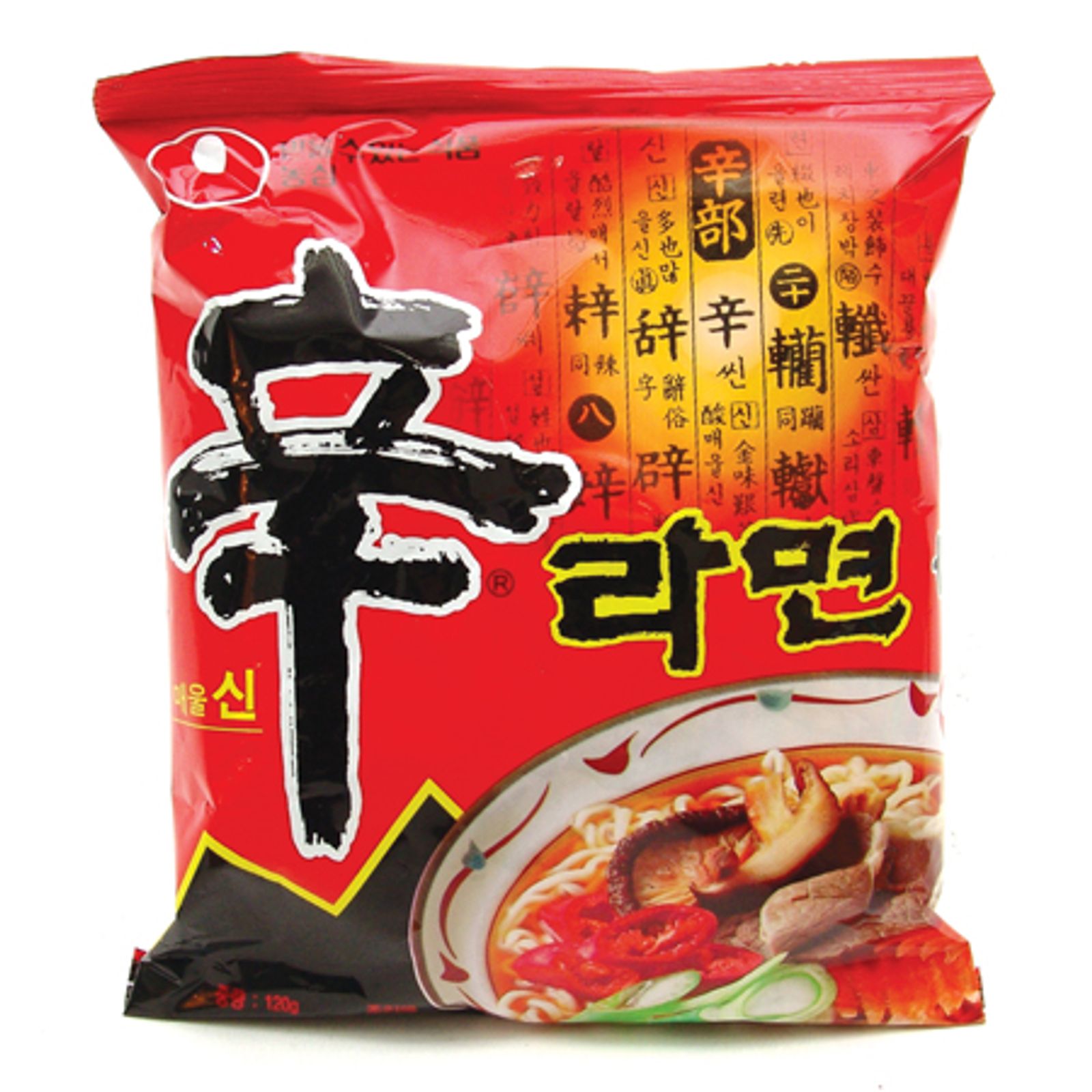
*This is the second instalment of "Noodle Wars", a series that examines Korea's instant-ramen brands one by one — their origins, market battles, and an honest verdict on taste.*
Instant noodles are Korea's national dish. Yet most people know little about them beyond tearing open the packet and boiling the contents. The most scrutinised brand of all is Nongshim's Shin Ramyun — and for good reason. In Korea, spiciness is measured against it. Something is "twice as hot as Shin Ramyun" or "milder than Shin Ramyun." Lately, however, that benchmark has been wobbling. People are saying Shin Ramyun has gone soft.
The story
By 1986, Nongshim had already been in the instant-noodle business for more than two decades. That year, company founder Shin Chun-ho decided to gamble. He would launch a noodle built entirely around one proposition: heat. He named it himself. *Shin* (辛) is the Chinese character for "spicy" — and, by coincidence, his own surname. He was, in effect, signing his name to the product. He also wrote the advertising slogan himself: *"The ramyun that makes grown men cry"* — hot enough to draw tears even from those who never shed them.
The initial reception was lukewarm. Many consumers complained it was simply too spicy. Nongshim persisted. By 1991, Shin Ramyun had reached the top of the market, a position it has held for 35 consecutive years. In 2025, cumulative sales exceeded 20 trillion Korean won (roughly $15bn), a first for any domestic food brand. Some 42.5 billion packets have been sold — enough noodles, end to end, to travel between the Earth and the Moon roughly 2,200 times. The product is now exported to more than 100 countries, making it one of the most recognisable symbols of the Korean food wave. In 2024, after 38 years, the founder's original slogan was quietly retired and replaced with *"The ramyun that moves your life"* — a signal, if one were needed, that times had changed.
Shin Ramyun's symbolic weight in Korea extends well beyond sales figures. Koreans consume an average of 74 packets of instant noodles per person each year, the highest rate in the world. Shin Ramyun is the single most purchased of those 74. Deep in the archives of Nongshim's noodle research laboratory, dozens of versions of Shin Ramyun's "prescription" — the closely guarded seasoning recipe — are kept on file. The reason there are so many is that the pungency and condition of chilli peppers vary with each harvest, requiring constant fine-tuning of the blend. The recipe itself does not change; the raw ingredients always do. Forty years of those minute adjustments are recorded in those binders.
Taste verdict
It is difficult to review a product one has eaten for decades with fresh eyes. So this assessment is blunt: Shin Ramyun is not what it once was.
The broth remains warming and full-bodied, with a genuine beef-stock flavour. The noodles have a satisfying bite. But something has clearly changed — the heat. Anyone who ate Shin Ramyun in the 1990s or 2000s will recognise the difference. Back then, a single mouthful of broth could produce a visible sweat. That intensity has measurably diminished. Nongshim has made no official announcement of a recipe change, but industry observers attribute the shift to a combination of factors: alterations in the chilli-pepper varieties used, changes in ingredient sourcing, and a deliberate mellowing of the flavour profile to broaden its appeal in overseas markets.
The paradox is almost poetic. The further Shin Ramyun has spread around the world, the more its original fieriness has been diluted. More people in more countries can now eat it comfortably — but the ferocity that made Shin Ramyun *Shin Ramyun* has faded. The noodle that stormed the market by putting spice front and centre has, after 40 years, become measurably less spicy.
The irony is that Nongshim appears to know it. Shin Ramyun The Red, Shin Ramyun Gold, Shin Ramyun Rosé, Shin Ramyun Toomba — the Shin Ramyun family keeps expanding. Each new variant is, in part, an attempt to satisfy the appetites the original can no longer fully meet.
Overall assessment
Shin Ramyun is still a good noodle. The problem is not that it has become bad; it is that it is no longer the noodle it was at its peak. Thirty-five consecutive years at number one and 20 trillion won in cumulative sales leave no doubt about its commercial achievement. But a noodle's identity lies in its taste, not its sales record — and that taste has been quietly shifting.
The ramyun that once made grown men cry now claims to move lives. Honestly, though, it is hard to shed tears over a bowl of it these days.
★★★☆☆ (3.0/5.0)
In a word *"The throne has been held. Whether the noodle sitting on it is the same one that seized it is another question entirely."*