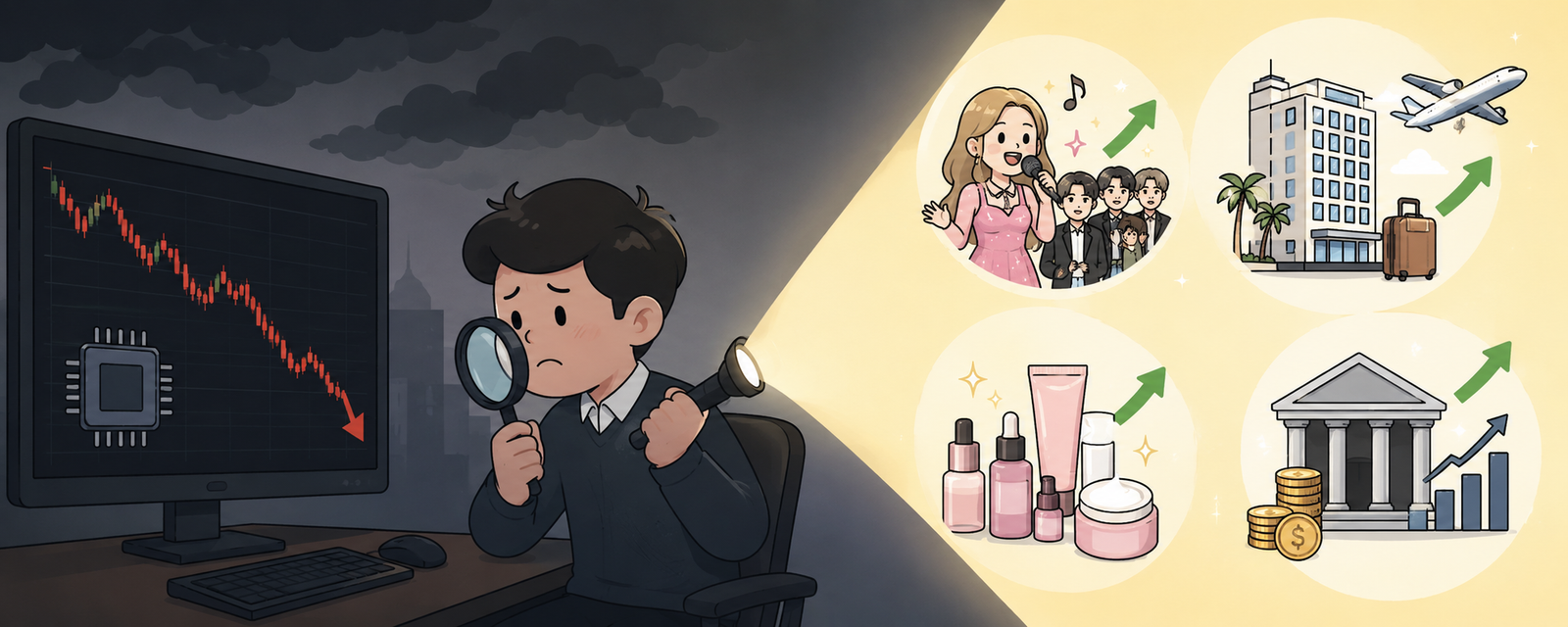
An AI infrastructure glut warning and a consumer memory shortage signal arrived on the same day. Circuit breakers were triggered on both the KOSPI and KOSDAQ, and beyond semiconductors, capital has already begun to move elsewhere.
*2 July 2026*
Start with the numbers. The KOSPI — South Korea's main stock exchange index — fell nearly 7% intraday, breaking below the 8,000-point threshold and touching a low of around 7,700. Automatic trading curbs, known as "sidecar" circuit breakers, were triggered first on KOSPI 200 futures at the open, then on the KOSDAQ — the country's second board — in the afternoon. Samsung Electronics fell as much as 9% intraday, slipping below the ₩300,000 mark. SK Hynix plunged as far as 14%, dropping into the ₩2.2m range. Leveraged products tied to the two stocks as underlying assets lost nearly 20%.
The trigger: Meta's resale plan
The immediate catalyst was a sharp sell-off in American semiconductor shares the previous session. The Philadelphia Semiconductor Index fell more than 6%, with Micron and Sandisk both posting double-digit declines. The spark was a Bloomberg scoop: Meta is internally developing a plan called "Meta Compute," under which it would rent out spare capacity from its data centres to external customers — a move into cloud computing.
The implications reach beyond Meta as a company. Markets read it as a signal that the hyperscalers who have driven AI infrastructure spending might be shifting from being buyers of computing capacity to sellers of it. Surplus capacity implies that AI computing resources may already be in oversupply, or at the very least that demand is not as explosive as previously assumed. Semiconductor and AI infrastructure stocks, which have thrived on the narrative of tight supply and rising prices, bore the full force of that concern.
A second signal: Apple and Tim Cook's unusual move
By an unhappy coincidence, a second semiconductor headline landed at roughly the same moment — and at first glance it seemed to point in the opposite direction. Bloomberg reported that Apple is in discussions to purchase DRAM and NAND flash chips from Chinese memory makers ChangXin Memory Technologies (CXMT) and Yangtze Memory Technologies (YMTC), both of which are on the US Department of Defence's blacklist. More striking still, chief executive Tim Cook reportedly contacted Scott Bessent, the US Treasury Secretary, and other officials in the Trump administration, asking them to help soften any political backlash should a deal go through. The backdrop is an extraordinary surge in memory prices that Cook has described as unlike anything seen in any industry over the past several decades; Apple has already raised prices on MacBooks and iPads by more than 20%.
On the surface, the two stories seem contradictory. Meta is saying it has computing capacity to spare; Apple is saying it is so short of memory chips that it is prepared to consider buying from blacklisted Chinese suppliers. Yet most market participants read them not as opposing signals but as two faces of the same anxiety.
The shortage of finished memory products is real — that much is confirmed by Apple's willingness to accept political risk in search of alternative suppliers. But the root cause of that shortage matters. Samsung, SK Hynix, and Micron have all shifted production capacity towards high-bandwidth memory (HBM) chips, the high-margin product designed for AI accelerators, at the expense of conventional consumer-grade memory. That reallocation created today's shortage. The troubling question is whether the AI data-centre investment that underpins HBM demand is, as Meta's case suggests, peaking sooner than expected. If so, the "tight-supply premium" that has enriched chipmakers may not last as long as the market assumed. Supply is constrained; the sustainability of the demand that created that constraint is now in doubt. That combination — rather than either signal alone — is what hit both stocks hardest.
Why the swings keep happening: concentration, leverage, and this time the national pension fund
The structural dynamics that this publication has flagged previously played out again in identical fashion. Samsung Electronics and SK Hynix together now account for roughly 55% of total KOSPI market capitalisation, up from around 35% at the start of the year. When two stocks represent more than half of an index, any shock to those stocks becomes a shock to the index at the same ratio. Leveraged exchange-traded products linked to the pair amplify moves in both directions — their near-20% intraday plunge on the day illustrated the mechanism precisely.
One new variable compounded the pressure. It happened that 2 July was also the first day of the National Pension Service's second-half portfolio rebalancing. The fund was confirmed to be reducing its Samsung weighting and adding to SK Hynix, adding institutional selling pressure to the foreign investors already taking profits in large-cap chipmakers. The pretext for each bout of volatility changes — geopolitical risk, Micron earnings, failed MSCI index inclusion, and now Meta and Apple — but the reason those pretexts produce such violent moves is always the same: extreme concentration, leverage, and accumulated profit-taking waiting for a reason to unwind.
The rotation: money moving beyond semiconductors
While semiconductors dragged the index lower, a tentative rotation appeared on the other side of the market. Entertainment stocks rallied on the "deeply undervalued" thesis, with SM Entertainment gaining around 8% and Hybe around 6%. Beauty stocks rose on the back of strong K-beauty export data, with Korean Kolmar up roughly 9%. Shipbuilding and financial stocks were cited as holding up relatively well compared with semiconductors, as were selected construction names.
Hotel and casino stocks also warrant attention. Seobu T&D, GS P&L, Paradise, and Lotte Tour Development either advanced intraday or outperformed the broader index on the day, continuing a trend from the previous session. These companies have been flagged by analysts as undervalued relative to earnings, supported by rising inbound tourism and improving casino revenue. As capital began to exit semiconductors, they attracted a share of it.
It would be premature to conclude that this rotation signals a durable change in market direction. The KOSDAQ itself fell more than 5% and triggered its own circuit breakers; Alteogen, Ecopro, and other KOSDAQ heavyweights declined in tandem. The rotation is better described as early-stage differentiation at the individual stock and sector level rather than a broad market shift.
How to respond: keep the core, broaden the satellites
It is too early to conclude that the semiconductor cycle has turned. Even after the plunge, brokers were upgrading their price targets: Kyobo Securities raised its Samsung Electronics target from ₩330,000 to ₩500,000, while NH Investment Securities lifted its SK Hynix target from ₩3.2m to ₩4m. At the intraday lows, Samsung was trading on a forward price-to-earnings ratio in the low sevens — a level that several analysts described as a buying opportunity. A series of potentially supportive events lies ahead: Samsung's preliminary second-quarter results on 7 July; SK Hynix's listing of American Depositary Receipts on 10 July; SK Hynix's full earnings release and results from America's "Magnificent Seven" tech companies later in the month.
The portfolio principle flagged in earlier articles remains valid. Semiconductors can stay at the core of a portfolio, but their weight should not be allowed to crowd out everything else. In a market where the trigger for volatility changes its name each time — geopolitics, earnings, index inclusion, now Meta and Apple — while the underlying mechanism stays the same, the prudent approach is to hold the core while using satellite positions in other sectors to cushion the swings. The sectors that held up relatively well today are the natural candidates for those satellite positions.
Candidates for the next wave
It is too soon to identify a clear new market leader to replace semiconductors, but the field of candidates can be narrowed.
*Oversold stocks.* Companies that fell alongside the chip giants for no fundamental reason are typically the first to recover once selling pressure eases. Semiconductor materials and components suppliers that were dragged down by association, rather than by any deterioration in their own business, belong in this category.
*Earnings improvers hidden in semiconductors' shadow.* Shipbuilding and power equipment are the clearest examples. Both sectors have been improving operationally, yet have remained relatively cheap because capital has been concentrated in chips. The outperformance of shipbuilding stocks today, and the pattern of target-price upgrades for power equipment companies on the back of overseas order wins, reflect this.
*KOSDAQ leaders.* This requires more caution. While the KOSPI surged in the first half of the year on the strength of its two chip stocks, the KOSDAQ barely moved; Alteogen and Ecopro failed to find clear upward momentum. The KOSDAQ fell broadly today, with most stocks outside semiconductor equipment declining. That said, last week's sharp double-digit gain in Alteogen — driven by renewed optimism about the biotech sector's valuation — shows that the KOSDAQ retains the capacity to decouple from the chip-dominated KOSPI. The gap between the two markets' market capitalisations has stretched to a record; if and when it begins to close, the KOSDAQ's heavyweight stocks are likely to be where the move starts.
What to watch: whether Meta's "Meta Compute" concept develops into a real commercial service, and whether Apple's negotiations with Chinese memory makers result in an actual supply agreement. Both remain at the exploratory stage. Should Meta's plan materialise into a functioning cloud business and a slowdown in AI infrastructure demand show up in the numbers, today's sell-off would need to be reinterpreted not as noise but as an early signal of a cycle turning.
**Meta issue** | **Apple issue**
What happened | Meta exploring resale of surplus data-centre computing capacity | Apple in talks to buy chips from blacklisted Chinese memory makers
Implication | AI infrastructure demand may be falling short of supply | Finished memory products are genuinely scarce
Surface signal | Oversupply | Undersupply
Market interpretation | Both signals read as two sides of the same concern: the AI data-centre demand underpinning tight memory supply may not be as durable as assumed | Same
Domestic impact | Samsung Electronics and SK Hynix plunge; circuit breakers triggered on KOSPI and KOSDAQ | Same