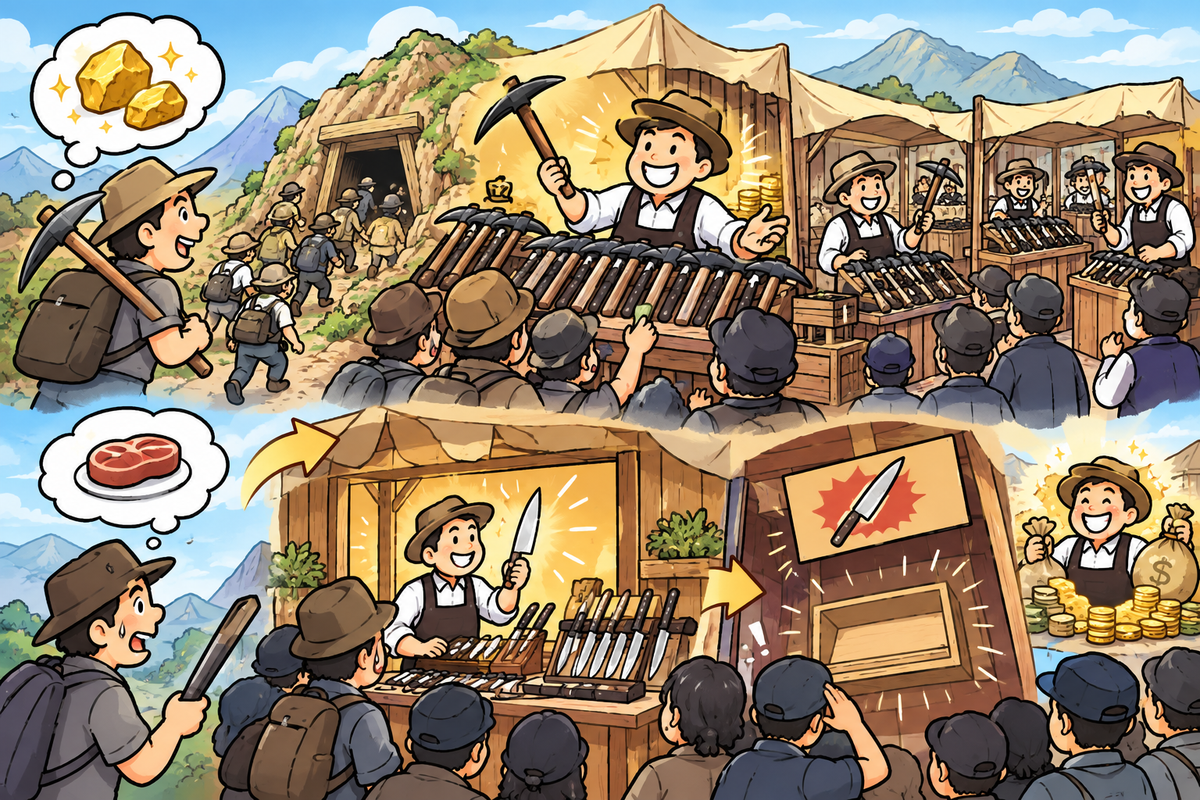
There is an old parable beloved of investors. When a gold rush begins, the fortunes are made not by the miners but by the merchants selling pickaxes: the miners may or may not strike gold, but everyone needs a pickaxe. The story has long been applied to the AI boom, where chip-equipment makers and infrastructure providers have prospered regardless of which AI model ultimately prevails.
But a new chapter is being written. The pickaxe sellers have become so consumed by pickaxe orders that they no longer have time to make kitchen knives. Knives carry thinner margins than pickaxes, so the blacksmiths' logic is sound. The problem is that people still need to cook dinner. And when the knife-makers down tools, someone else must fill the gap.
This, in miniature, is what is happening across South Korea's advanced manufacturing sector. As the country's largest technology companies direct every available resource towards AI, a distinct class of beneficiary is emerging in the markets they have vacated — or, in some cases, in niches they never bothered to enter in the first place.
Case One: Foundries — DB HiTek fills the 8-inch void
Samsung Electronics and TSMC are racing to concentrate production on leading-edge 12-inch (300mm) wafer processes, which yield the high-margin chips — AI accelerators, smartphone processors — that the market currently prizes most. In pursuit of this, both are winding down their 8-inch (200mm) legacy foundry operations. A Samsung foundry executive said earlier this year that the company planned to phase out 8-inch production of power semiconductors, display driver ICs, and image sensors in sequence.
The awkward timing is that demand for power semiconductors is rising, not falling. Data centres, electric vehicles, industrial robots and consumer electronics all require them. The overflow has poured into DB HiTek, a mid-tier Korean foundry specialising in 8-inch wafers. In the first quarter of this year, DB HiTek ran its fabs at roughly 98% utilisation, and operating profit rose 21% year on year. The company has gained sufficient pricing power to begin raising the prices it charges Chinese customers for power semiconductors.
Case Two: MLCCs — Amotech and Samwha Capacitor, the quiet victors of the commodity market
An identical dynamic is playing out in electronic components. Murata Manufacturing and Samsung Electro-Mechanics, the dominant producers of MLCCs (multilayer ceramic capacitors, tiny components used in virtually every electronic device), have shifted production capacity towards the high-specification, high-margin MLCCs demanded by AI servers. The result is a tightening supply of the commodity-grade components that go into ordinary consumer electronics.
An analyst at iM Securities noted that, given the leading manufacturers' reluctance to expand capacity, they would "inevitably reduce the share of general-purpose MLCC output and redirect it to server applications" to meet AI demand. Smaller Korean manufacturers are the beneficiaries. On the 11th of this month, shares in Amotech hit their daily price limit, rising 29.98%, after supply-shortage concerns made headlines; Samwha Capacitor surged roughly 20%. Both companies have recorded multiple similar rallies this year for the same reason.
Case Three: Memory chips — the gains flow abroad
The same structural shift is occurring within the product portfolios of the chipmakers themselves. Samsung and SK Hynix have prioritised their limited wafer capacity for high-bandwidth memory (HBM) and server-grade DRAM, causing shortages of the consumer-oriented memory chips — mobile DRAM, PC DRAM, and NAND flash for solid-state drives — used in smartphones and personal computers. The average selling price of mobile DRAM (LPDDR) rose 89% quarter on quarter; SSD prices jumped 54%.
This case, however, carries a different lesson from the previous two. The entities filling the void are not overlooked Korean mid-caps but rather end-product manufacturers such as Apple, which must absorb higher component costs, and Chinese memory producers, who are exploiting the gap left by their Korean rivals. The same structural pattern can represent opportunity or threat depending on who captures the vacancy. For domestic Korean investors, the memory case is a warning as much as an analogy.
Case Four: Power transformers — Sanil Electric, growing in a field the big players ignored
Sanil Electric's story has a different character from the three preceding it. The transformer market in Korea has long been segmented along clear lines: large conglomerates such as LS Electric, Hyosung Heavy Industries, and HD Hyundai Electric dominate the step-up transformer business (which raises voltage for transmission), while specialists such as Sanil Electric and Jeoryong Electric have traditionally supplied step-down and specialty transformers. Sanil did not inherit a vacancy; it cultivated expertise in a segment the large groups never considered worth entering.
What has changed is that the niche has outgrown its boundaries. The global race to build AI data centres has generated surging demand for specialty transformers, and Sanil won a contract worth 50.3bn won (roughly $37m) to supply transformers for a data centre project involving Bloom Energy of the United States. Having established itself in the lower-voltage segment, Sanil is now pushing into the 154kV ultra-high-voltage market — territory long considered the exclusive preserve of the large conglomerates. This is not a company filling someone else's abandoned space; it is a company whose own space has expanded around it.
Why the pattern persists
The common thread running through all four cases is the physical rigidity of advanced manufacturing. Building a new semiconductor fab or transformer plant takes years and costs billions. When a market leader decides to migrate towards higher-margin products, the supply of lower-margin goods does not automatically replenish itself — it remains structurally depleted until somebody else invests. The lopsided capital allocation driven by the AI super-cycle is therefore not a temporary anomaly; it is a repeating pattern.
The crucial variable is who captures the resulting gap. When domestic Korean companies fill it — as DB HiTek, Amotech, Samwha Capacitor, and Sanil Electric have done — investors gain a new set of opportunities. When the gap is filled by foreign competitors, as in the consumer memory case, the same structural vacancy becomes a burden for Korean end-product manufacturers and a windfall for Chinese rivals.
Where is the next kitchen knife?
Investors alert to this framework can scan for future opportunities in markets currently overshadowed by AI excitement. The risks, however, are real and specific. These are reflective beneficiaries: a single strategic decision by a dominant player can collapse the opportunity almost overnight. Samsung and SK Hynix are already showing signs of raising commodity DRAM production again, prompted by the narrowing profitability gap between general-purpose DRAM and HBM as commodity prices surged. A market leader's return can close the window as quickly as it opened.
The prudent approach is to assess not merely whether a shortage exists, but how structurally entrenched it is and how strong the dominant players' incentive to re-enter the market would be.
Three indicators to watch: whether Samsung and SK Hynix meaningfully shift wafer allocation back to commodity DRAM; whether DB HiTek's 8-inch boom can withstand intensifying competition from Chinese legacy foundries; and whether Sanil Electric builds a credible track record in the 154kV ultra-high-voltage segment. The answers will determine whether the periphery's current moment of ascendancy proves fleeting or marks a more durable structural shift.