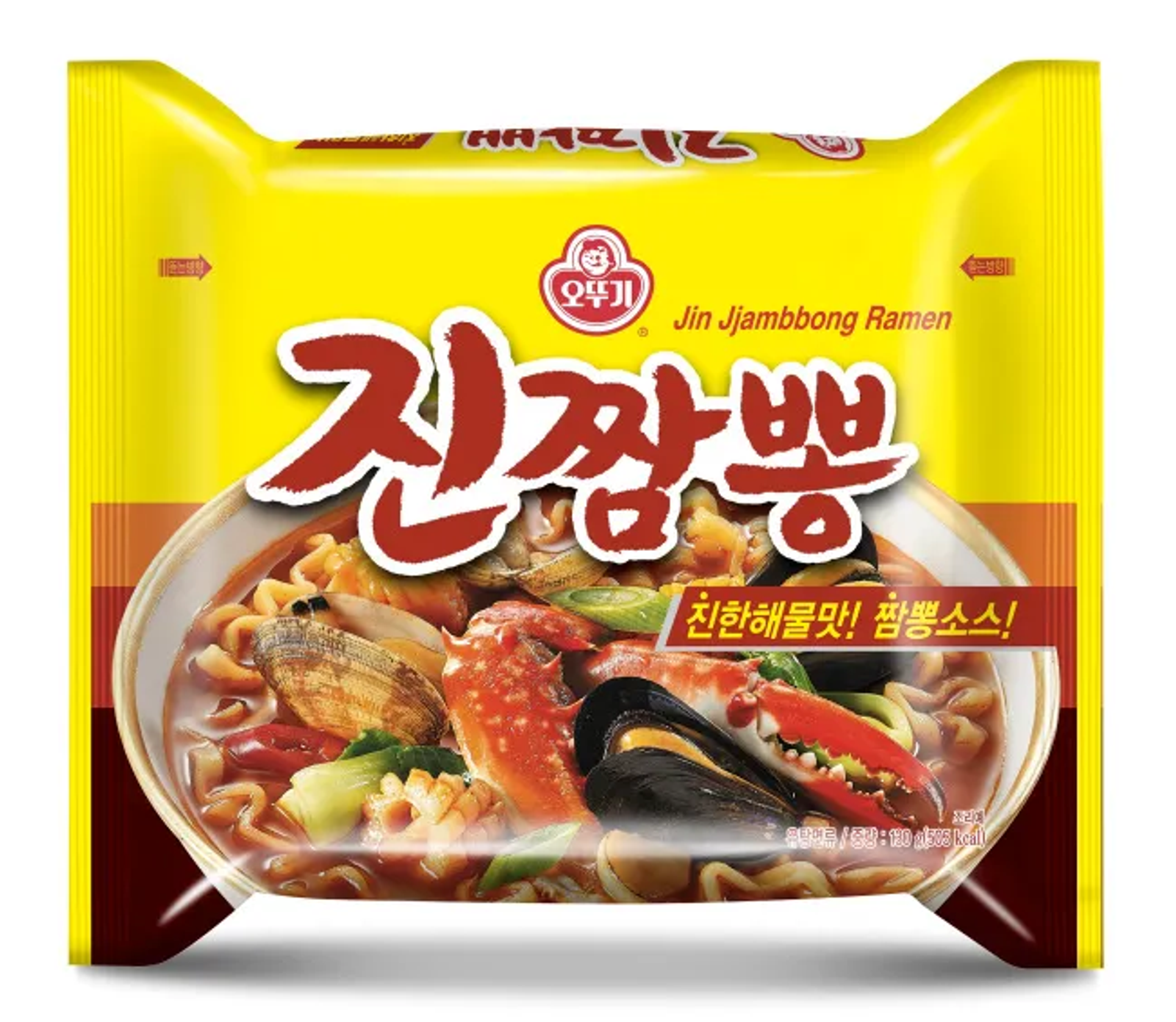
In April 2015, a single packet reshaped the instant-noodle aisle. Until then, jjamppong — Korea's spicy seafood noodle soup — was something you ordered at a Chinese restaurant, not something you boiled at home from a bag. Ottogi's Jin Jjamppong changed that. It sold out within weeks of launch, and a procession of imitators followed: Samyang's Majjajang, Paldo's Paldo Jjamppong, and others. Yet a decade later, "jjamppong ramen" still conjures one name first.
Origins
While the instant jjajangmyeon market (Korea's black-bean noodle equivalent) had been locked in place by a single dominant product — Nongshim's Chapagetti — for 40 years, the instant jjamppong market did not exist at all. Authentic jjamppong depends on furious wok heat: ingredients scorched at high temperature to produce the characteristic smokiness Koreans call "fire flavour" (bulmmat). Replicating that in a dried-noodle packet was a fundamentally different engineering problem from ordinary broth-based ramen, where flavour simply dissolves into hot water. Fire flavour is a volatile aromatic — it must be seared into ingredients in an instant — making it stubbornly difficult to capture in powder or liquid seasoning.
Ottogi is understood to have focused its development effort on a seasoning process capable of embedding genuine fire flavour into the soup base. The company blended specific flavour compounds into its seasoning packet so that boiling water alone would release aromas indistinguishable from those of a wok-fried dish. Industry observers credit this technique with influencing the broader wave of bold, spicy broth noodles that followed.
The gamble paid off. Jin Jjamppong launched to reviews declaring it "the real thing," and is widely credited with inventing an entirely new product category. The timing was shrewd. Just as Nongshim was attempting to reignite the jjajangmyeon craze with Jjawang — essentially a premium self-remake of Chapagetti — consumer attention pivoted toward jjamppong. While Nongshim fought to defend its turf, Ottogi simply drew a new map. Competitors that followed were inevitably compared against the fire-flavour benchmark Jin Jjamppong had established. Within a few years, the instant jjamppong segment had grown to rival the jjajangmyeon market in scale.
Tasting Notes
The first spoonful of broth leads with fire flavour. It does not carry the blunt, artificial note of something merely scorched; the smokiness feels fully integrated into the soup, as though the ingredients genuinely passed through a wok. Combined with a seafood-based stock, the overall impression is deep and rounded rather than harsh.
The heat level surprises. Despite the jjamppong name — a dish Koreans associate with serious spice — Jin Jjamppong is, by any objective measure, not particularly hot. The sensation is warming and robust, but it never overwhelms the palate; those sensitive to chilli will manage it without distress. This is, in fact, one of the product's most calculated qualities. Rather than competing on raw heat, Ottogi chose to deliver jjamppong's character through fire flavour and umami. Measured against Nongshim's Shin Ramyun — Korea's benchmark spicy noodle — Jin Jjamppong actually registers a lower capsaicin level, yet drinkers consistently report a richer sense of satisfaction. The distinction matters.
The noodles are calibrated to a thickness that holds up in the broth. The garnish sachet — squid and cabbage — lends visual credibility to the bowl. Among Korean consumers, a popular enhancement involves adding a few slices of Korean green chilli and spring onion before boiling, reportedly bringing the result within reach of a restaurant-delivered jjamppong.
Verdict
What consumers want from instant jjamppong is, ultimately, one thing: fire flavour. Jin Jjamppong delivers that single quality more completely than any rival has managed within the constraints of a dried-noodle packet. Its weapon is not aggression but technique — seasoning chemistry in place of sheer heat. The proof is structural: the instant jjamppong category came into existence after Jin Jjamppong, and ten years on, every challenger is still being evaluated against the standard it set.
★★★★☆ (4.0/5.0)
One-line verdict "It does not intimidate with heat. It persuades with craft."