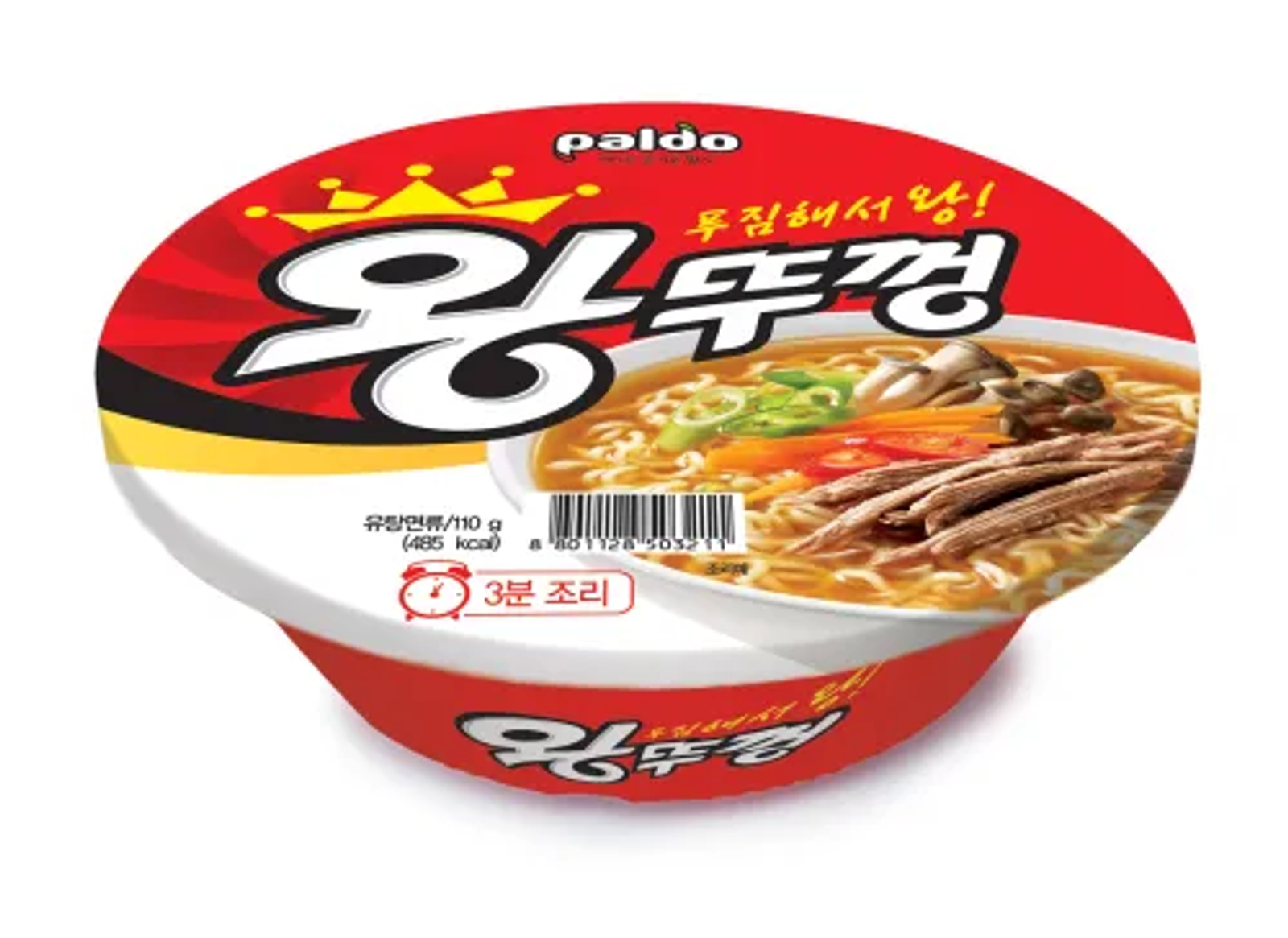
In 1986, Paldo entered South Korea's instant cup-noodle market with a product whose name was as bold as its design. Wang Tudukkeong — literally "king lid" — distinguished itself from rival cups not by what was inside, but by what sat on top: an unusually wide, flat lid that could be folded in half and used as a makeshift bowl.
The Story
By the time Paldo arrived, Nongshim already dominated the cup-noodle segment with stalwarts such as Yukgaejang Sabal-myeon. Rather than challenge the incumbent head-on, Paldo took a different route: it sold an experience. Where other cup noodles offered a lid to be peeled back and discarded, Wang Tudukkeong's lid was engineered to flip over and serve as a side dish — a shallow tray into which noodles and broth could be portioned and shared. The concept proved especially appealing outdoors, at campsites and picnics where extra bowls are rarely to hand.
That single insight transformed the product's identity. Wang Tudukkeong was no longer merely a cup of noodles to be consumed; it was something to be played with, shared, and remembered. Word spread, the brand's personality crystallised, and nearly forty years later Wang Tudukkeong remains a fixture on convenience-store shelves — its distinctive silhouette still impossible to overlook.
Taste Assessment
The broth draws on a rich beef-bone (seolleongtang-style) base with a moderate kick of spice. The opening impression is hearty and full-bodied — a genuine strength. There is none of the thin, one-dimensional quality that mars lesser instant noodles, which helps explain the product's loyal following. The noodles are broad and substantial, with a satisfying chew and an ability to absorb broth well. The dried-vegetable sachet contributes a quiet undercurrent of spring onion and garlic, making for a flavour that feels familiar and comforting rather than brash.
The difficulty arises when the lid experience is set aside and the noodles are judged on taste alone. The broth is honest and warming, but it lacks the immediately arresting character of, say, Nongshim's Shin Ramyun or Ottogi's Jin Jjambbong. The heat level is mild enough to disappoint those seeking a fiery bowl. Strip away the ritual of flipping the lid and sharing the contents, and Wang Tudukkeong becomes a perfectly decent but rather unremarkable beef-broth cup noodle. A notable number of consumers report a meaningful gap in satisfaction between eating straight from the cup and engaging with the full lid-sharing ceremony — which itself says something.
Verdict
Wang Tudukkeong's formula was always transparent: rather than compete on flavour, Paldo turned the act of eating into the product. For nearly forty years that strategy held. The brand's identity remains intact and genuinely distinctive. But an experience cannot indefinitely substitute for culinary merit. Without the theatre of the inverted lid, Wang Tudukkeong is little more than a serviceable beef-bone cup noodle in a crowded field.
As a feat of brand-building, it deserves respect. As a bowl of noodles judged purely on its own terms, it leaves something to be desired. The cup-noodle market is drifting steadily upmarket, with competitors racing to offer bolder, more complex flavours. If Wang Tudukkeong intends to hold its ground, a rethink of what goes inside the cup — not just what rests on top of it — seems overdue.
★★★☆☆ (3.0/5.0)
One-line verdict "The lid was extraordinary. The noodles beneath it were not."