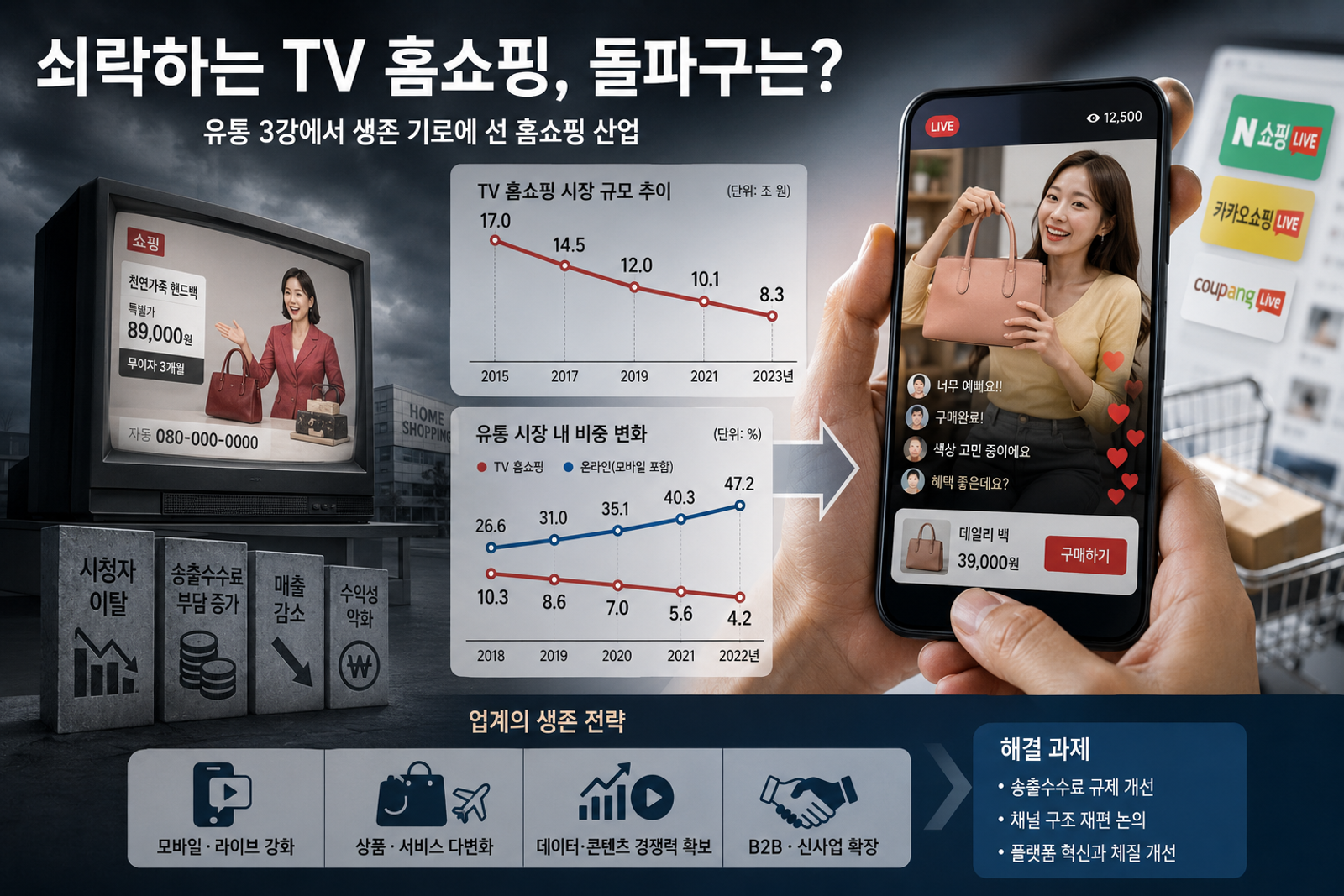
There was a time when TV home shopping stood alongside department stores and large-format supermarkets as one of the three pillars of South Korean retail. That era is drawing to a close. The convergence of surging mobile commerce, the rise of live-streaming platforms and a steady haemorrhage of pay-television viewers has pushed the industry into structural crisis — a far cry from its heyday in the mid-2010s.
From golden goose to also-ran
South Korea's TV home-shopping industry was born in 1995, when CJ Home Shopping and LG Home Shopping (now GS Shop) launched simultaneously. They were soon joined by Hyundai Home Shopping, Lotte Home Shopping and NS Home Shopping, among others, and by the 2000s and 2010s the sector had firmly established itself alongside department stores and hypermarkets as one of the country's three dominant retail formats. At the industry's peak around 2015, the combined gross merchandise value (GMV) of the six main home-shopping operators reached roughly 17 trillion won (approximately $13bn), with operating margins comfortably above 10%.
The good times did not last. According to retail sales data from the Ministry of Trade, Industry and Energy, the home-shopping sector's share of total retail has been in steady decline since 2018. Over the same period, online shopping — including mobile commerce — has surged, and now accounts for well over half of all retail sales in South Korea.
Vanishing viewers, rising fees
The most immediate cause of the industry's distress is the collapse of its viewing environment. Pay-television subscribers are watching less and less, with the sharpest declines among those under 50. Data from the Korea Communications Commission show that per-capita daily television viewing time has fallen every year since 2019, while usage of over-the-top (OTT) streaming services has risen sharply in inverse proportion.
To compound matters, home-shopping operators face a crushing and paradoxical cost burden in the form of channel-carriage fees paid to cable, IPTV and satellite-television providers. Across the industry, these fees are estimated to total nearly 2 trillion won per year. For some operators, carriage fees now consume more than 20% of revenues. The result is a perverse structural trap: as viewership falls and revenues stagnate, the toll charged simply to retain a channel slot keeps rising.
"Even as fewer people watch television, we cannot afford to give up our channel," one industry insider said, "so we are always negotiating from a position of weakness."
Assault from mobile and live commerce
Competitive pressure from outside the industry has been equally fierce. Platform-based live-commerce services — among them Naver Shopping Live, Kakao Shopping and Coupang Live — have transplanted the home-shopping format's core proposition, live selling with instant purchase, directly onto the smartphone. Lower barriers to entry mean that influencers and small brands can participate with ease, drawing in both consumers and vendors at speed.
China offers a cautionary precedent. Since 2020, live commerce in China has exploded, growing to account for roughly 20% of all e-commerce — while traditional TV home shopping has become virtually irrelevant. Industry analysts widely expect South Korea to follow a similar trajectory.
"The formula that made TV home shopping powerful — live broadcast plus instant purchase — is now being replicated by live-commerce platforms far more cheaply and flexibly," said one retail analyst. "Operators tied to the television platform will find it very hard to overcome that structural disadvantage."
Responses are emerging, but constraints are real
The industry is not standing still. Operators are investing in proprietary apps and mobile live-streaming channels, and broadening their product mix beyond physical goods into services such as travel, financial products and healthcare. CJ OnStyle has adopted a so-called "one platform" strategy, integrating its television, mobile and data-broadcasting (T-commerce) operations to generate synergies. GS Shop has similarly stepped up investment in mobile live broadcasting.
Some operators are exploring expansion into business-to-business services, or monetising their customer data and targeted-marketing capabilities externally. Yet with television-derived revenue still accounting for more than half of total sales at most operators, analysts caution that these initiatives are unlikely to transform the industry's underlying economics quickly.
A global affliction
South Korea's predicament is not unique. In the United States, Qurate Retail Group — which operates QVC and HSN — moved early to invest in streaming platforms and social-media selling, yet it too has struggled against an ageing viewership and relentless online competition, undergoing significant restructuring since the late 2010s. Japanese home-shopping operators have similarly ceded ground to e-commerce giants such as Yahoo Japan and Rakuten. TV home shopping's decline is a global phenomenon, not a Korean peculiarity.
Restructuring and regulation: a double-edged sword
The industry has been pressing the Ministry of Science and ICT to enshrine carriage-fee calculation standards in law and to establish a government-level mediation mechanism. The dispute between home-shopping operators and pay-television providers over fees has festered for years, yet no clear regulatory solution has emerged.
Some analysts argue that a more radical consolidation is unavoidable — that with six home-shopping channels dividing a shrinking market, an industry-wide restructuring commensurate with actual market size is necessary to prevent all operators from failing together. Consumer groups, however, urge caution, warning that channel consolidation would reduce choice for viewers.
Can past glories be recaptured?
Over its thirty-year history, TV home shopping has left a meaningful imprint on South Korean consumer culture — from popularising overnight fresh-food delivery and making luxury goods accessible to a mass audience, to driving the mainstream adoption of health supplements. But now that the platform paradigm has shifted definitively from television to mobile, past success is no guarantee of future survival.
Industry specialists are broadly agreed that home-shopping operators must shed their identity as mere "channels that sell things on television" and redefine themselves around data analytics and content capabilities as core competitive assets. Without success in that platform transition — and without relief from the twin burdens of carriage fees and outdated regulation — the industry that was once a titan of Korean retail faces an inexorable narrowing of its ecological niche.