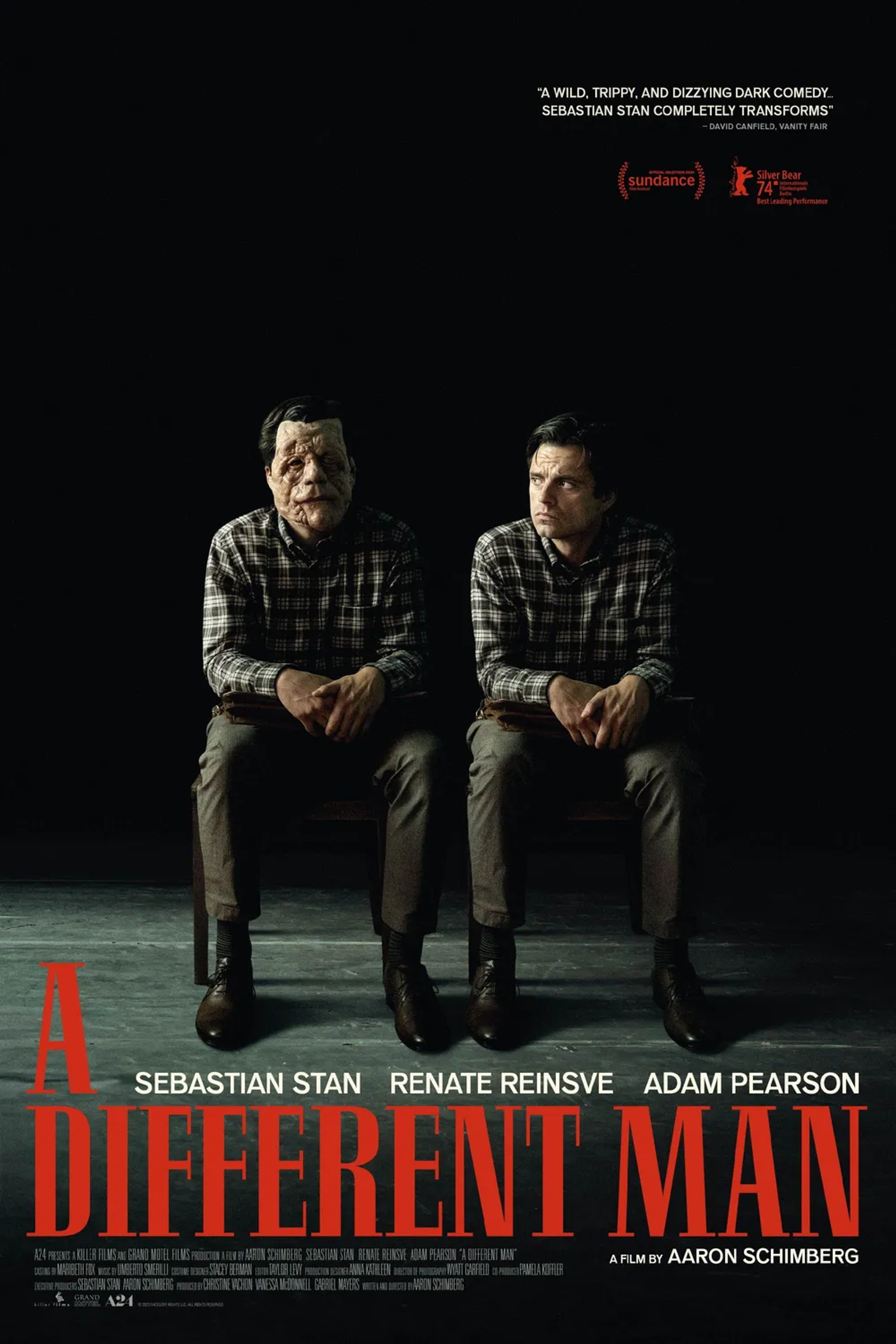
*A Different Man* — Review
Edward (Sebastian Stan) has neurofibromatosis, a condition that has severely disfigured his face. He dreams of becoming an actor but fails every audition. He is drawn to Ingrid (Renate Reinsve), a playwright who moves in next door, yet cannot bring himself to express his feelings. Then he undergoes an experimental medical procedure. The surgery succeeds. Edward emerges with Sebastian Stan's actual face and begins a new life under the name "Guy Moratz". Everything, it seemed, was about to change.
Nothing changed.
Director Aaron Schimberg has a single point to make, and he makes it without flinching: the face was never the problem. Edward has acquired handsome features, yet he remains a coward — hesitant and apologetic before the world. When Ingrid writes a play based on his story, he schemes to land the lead role, but even that obsession is tinged with timidity. Then Oswald (Adam Pearson) arrives.
Oswald also has neurofibromatosis. He has precisely the face Edward paid to erase. Yet Oswald is something else entirely. The moment he enters a room, he owns it. His laugh is loud, his speech unguarded, and people are simply drawn to him — Ingrid, the audience, and eventually Edward himself. The film's cruelest moment comes when Edward, handsome and unrecognised, shrinks into a corner watching Oswald with naked envy.
It was never the face. It was the force of self-possession. What matters in life is not appearance but the degree to which a person accepts themselves completely and steps forward to meet the world. Oswald never once apologises for his face. Edward, even after his transformation, offers a continuous, wordless apology for his own existence. That single difference determines everything between them.
Sebastian Stan's performance is the film's greatest virtue. What he preserves across both halves — the prosthetics-heavy opening and the conventionally handsome second act — is the expression in his eyes. The face changes; the eyes do not. That same frightened, retreating gaze is the film's most eloquent argument that Edward's trouble is interior, not dermatological. The casting of Adam Pearson, who has neurofibromatosis in real life, as Oswald is the film's most decisive choice. It is not a performance that fills the screen so much as a presence. The moment after Pearson appears, when Stan's character begins to look diminished by comparison, is the film's true climax.
The film is not without its weaknesses. In the later stages, Edward's obsession curdles into violence at a pace that feels somewhat schematic. The tonal tightrope between psychological thriller and black comedy occasionally destabilises the film's centre of gravity. The range of references — Kafka, David Lynch, Todd Haynes — is impressively wide, but the film's own voice is sometimes buried beneath them.
Even so, the question the film leaves behind is sharp and clear: are you standing in front of the world, or are you still waiting in the corner for the world to come to you? Why Edward's new face changed nothing; why Oswald, who changed nothing, seemed to have everything — when both answers converge on that one quality, the film lingers in the mind longer than expected.
★★★☆☆ (3.0/5.0)
In a sentence: "He changed his face, and nothing else changed. The face was never the problem."