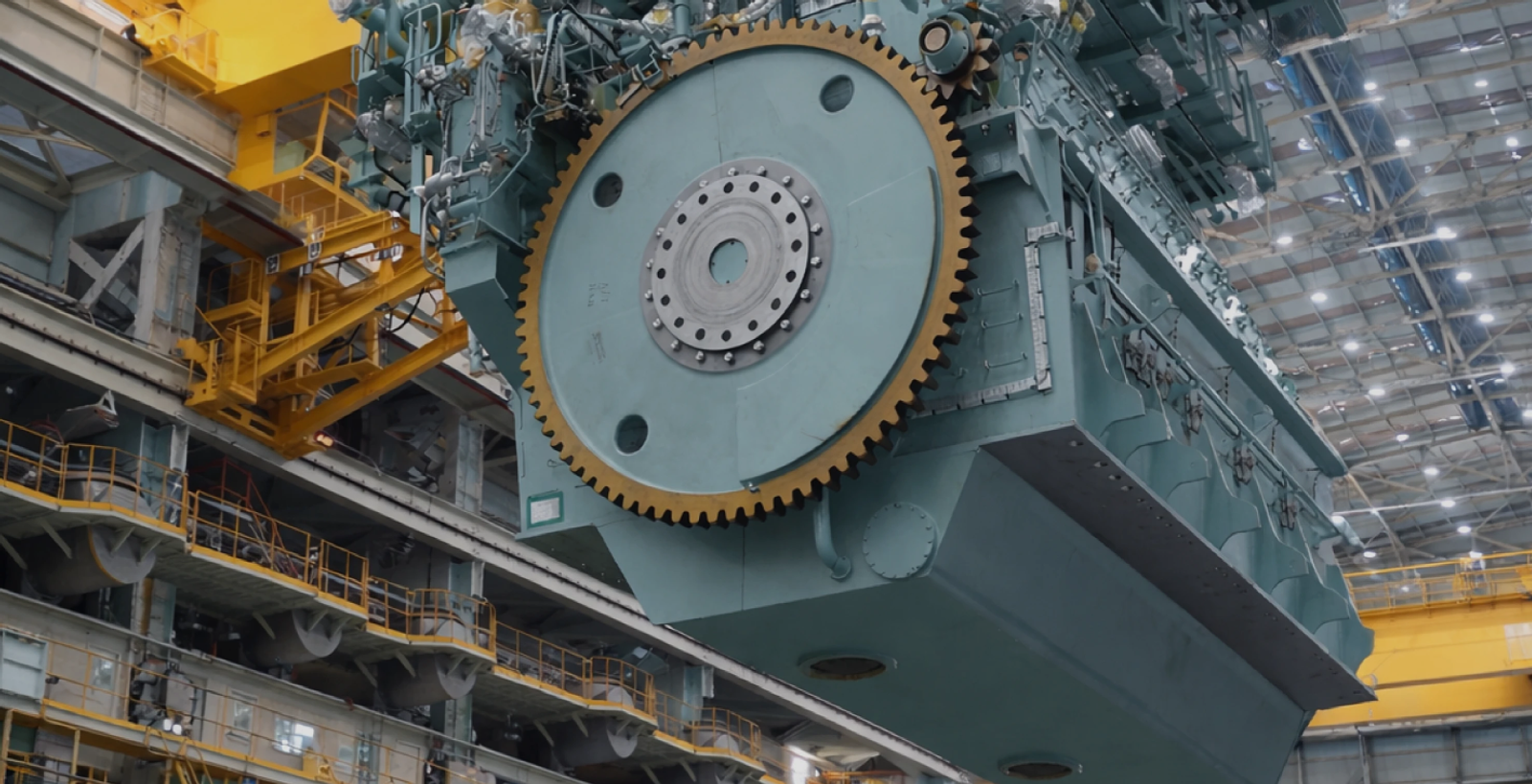
Yuanta Securities initiated coverage of Hanwha Engine (KOSPI: 082740) on 25 August with a Buy recommendation and a target price of 107,000 won, implying upside of 138% from the closing price of 44,900 won on 24 August.
The target was derived using a sum-of-the-parts (SOTP) valuation, applying a price-to-earnings multiple of 25 times to the marine engine division's forecast net operating profit after tax for fiscal year 2027, and a multiple of 40 times to the data-centre power generation business.
A three-pronged investment case
Yuanta has branded its thesis the "Holy Trinity," built on three arguments. First, the possibility that Hanwha Engine is selected as the primary OEM partner for Everllence, a European holder of marine engine intellectual property. Second, the company's scarcity value as the sole listed entity within Hanwha Group's North American power generation supply chain. Third, steady earnings growth in its core marine engine business.
Everllence designs and manufactures two- and four-stroke marine engines and was formerly part of the Volkswagen group. On 25 June this year, global private equity firm Bain Capital agreed to acquire a 51% stake in the company. Yuanta argues that with Bain as the controlling shareholder, Everllence is likely to maximise returns by collecting royalties from existing licensees rather than investing directly in its own production capacity. In that scenario, Hanwha Engine—which has produced large two-stroke marine engines under licence from Everllence for several decades—would be the natural OEM partner of choice, given that it requires no new qualification process.
However, this scenario remains firmly in the realm of possibility. Yuanta itself acknowledges the limits of visibility: "Due to non-disclosure agreements, there is no way to verify externally whether any licence has been updated; the company's own announcement of a power generation engine order would itself serve as the confirmation signal." The constraint is real. So far, the only Korean marine engine maker to have secured orders for engines destined for AI data centres is Hyundai Heavy Industries' engine division. Hanwha Engine holds no proprietary IP of its own and cannot manufacture medium-speed engines above 10MW for power generation without an explicit update to its licence from Everllence. Investors should keep this uncertainty squarely in view.
Group positioning as a second lever
The second pillar concerns Hanwha Engine's place within a broader group strategy. Hanwha is rapidly assembling a vertically integrated power value chain in North America, stretching from forged materials and precision machining through to turbomachinery, engines, and electricity generation. The links in this chain include Hanwha Energy (power purchase agreements), Hanwha Solutions (solar), Hanwha Materials (forgings—which completed the acquisition of US-based Firth Rixson Forgings LLC for 349 billion won on 31 March this year), and Hanwha Power (gas turbines—which completed a brand merger with US firm PSM on 25 March this year).
Within this constellation, Hanwha Engine is the only publicly listed entity with exposure to the group's power generation ambitions, giving it a scarcity premium as the capital markets' window into that business. In a domestic environment where Korean investors are increasingly hostile to multiple listings by the same chaebol, there is also a medium-to-long-term option value in the possibility that unlisted group assets could be contributed in kind to the listed vehicle, restructuring the business through non-cash injections into Hanwha Engine.
Core business momentum is building
The marine engine order book is improving rapidly in mix and quality. The share of container-ship engine orders has surged from 32% (1 trillion won) in the fourth quarter of 2024 to 60% (3 trillion won) in the first quarter of 2026, while orders from Chinese shipyards have risen from 33% (1.1 trillion won) to 49% (2.5 trillion won) over the same period. Engines supplied for ultra-large container vessels built in China command higher per-unit prices than captive orders from domestic Korean shipyards. As revenue recognition from these orders ramps up from the second half of 2026 through fiscal year 2028, margins are expected to improve steadily. The company also completed the construction of a dedicated medium-speed engine factory in Changwon on 19 August this year—roughly 8,250 square metres of floor space—giving it in-house annual production capacity of 900MW.
Earnings forecasts and the data-centre caveat
Yuanta projects revenue rising from 1.202 trillion won in fiscal year 2024 to 2.347 trillion won in fiscal year 2027, with operating profit more than quadrupling from 72 billion won to 439 billion won over the same period. The operating margin is expected to widen from 6.0% to 18.7%.
Investors should note, however, that these forecasts assume data-centre power engine orders begin to be reflected in the numbers from fiscal year 2027. If those orders fail to materialise, operating profit for fiscal year 2027 would fall to approximately 37.9 billion won, and the fair-value target for the marine-only business would drop to 86,000 won per share.
A sharp de-rating creates the entry point—but risks remain
Part of what has attracted attention to this report is the stock's recent trajectory. Hanwha Engine's shares have fallen roughly 50% from their 52-week high of 89,500 won to 44,900 won as of 24 August. The absolute return over the past three months stands at minus 40%. Second-quarter 2026 operating profit of 38 billion won came in 26.2% below the previous quarter and 32.1% below consensus, further dampening sentiment.
Yuanta has interpreted this de-rating as a buying opportunity. Yet investors face a classic tension: near-term earnings are disappointing and the new growth business remains unconfirmed. That intersection of short-term weakness and speculative upside deserves careful scrutiny before committing capital.