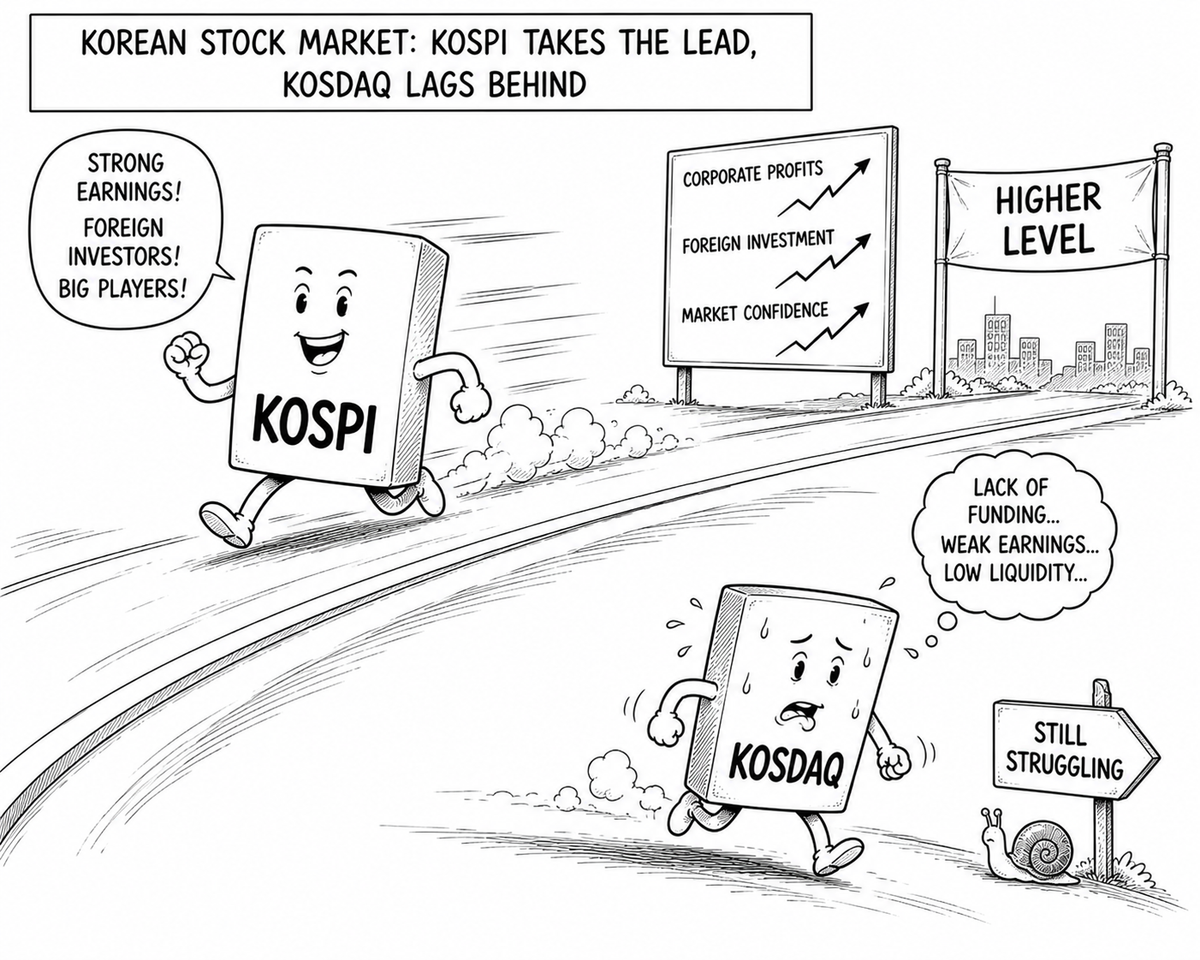
It is rare to see two indices within the same national market tell such different stories. According to the Korea Exchange, the KOSPI — South Korea's main board, home to the country's largest conglomerates — rose roughly 72% over 2025 (2 January to 26 December). The KOSDAQ, its smaller, technology-and-growth-focused counterpart, gained just 34% over the same period: less than half as much. The gap was the widest ever recorded, exceeding even the divergence seen during the collapse of the dot-com bubble in 2000. A measure of the KOSPI's relative strength against the KOSDAQ — calculated by dividing one index by the other — surged from 3.49 at the start of 2025 to a record 4.64 by year-end. In market-capitalisation terms the contrast is equally stark: the KOSPI's total market cap rose roughly 77% to 3,483 trillion won, while the KOSDAQ's grew by 47.8% to 509 trillion won.
Nor did the divergence close as 2026 began. On 19 June 2026 the KOSPI broke through 9,000 for the first time in its history, setting successive all-time highs. Yet at the very same moment, market analysts were noting a ninefold gulf between the two indices and warning that the KOSDAQ could fall below 1,000 — a level Korean commentators have dubbed "Cheonsdaq" (a portmanteau of *cheon*, Korean for one thousand, and KOSDAQ). The polarisation that defined 2025 has not merely persisted into 2026; it has deepened. The issue has even surfaced in high politics: President Lee Jae-myung raised the market divide during a press briefing on a European tour, a sign that it has moved beyond the realm of financial commentary. Ahn Ju-won, head of corporate research at DS Investment Securities, put the underlying problem plainly: "Looking at the top stocks on the KOSDAQ by market cap, you see enormous expectations about the future — but almost none of them are making money right now."
Foreign investors move in opposite directions
One striking feature of the divergence is that foreign investor flows have told the opposite story on each exchange. While foreigners have been net sellers on the KOSPI, in May 2026 they recorded net purchases of nearly 3 trillion won on the KOSDAQ — the largest monthly figure ever. This suggests that money rotating out of large-cap semiconductor stocks on the main board is beginning to find its way to the junior market. Yet this flow has not been large enough to lift the KOSDAQ index as a whole. The fact that foreign buying has increased is a different matter from the KOSDAQ closing the gap with the KOSPI. Because so many of the junior market's largest constituents have yet to turn a consistent profit, fresh capital does not translate quickly into broad index gains.
The government's first card: culling the weaker companies
The centrepiece of the government's KOSDAQ revival plan is a structural clean-up. From next month, companies with a market capitalisation below 20 billion won will begin to be delisted, and shares trading below 1,000 won — so-called "penny stocks" — will also face removal. Under the Korea Exchange's published roadmap, the delisting threshold will rise in stages: from the current 4 billion won to 15 billion won imminently, then to 20 billion won in 2027 and 30 billion won in 2028. A tiered system to identify and promote higher-quality KOSDAQ stocks is scheduled to begin next year.
Lee Hyo-seop, a senior researcher at the Korea Capital Market Institute, spelt out the logic: "If companies with very poor profitability or revenues are delisted, the index will be composed increasingly of higher-quality stocks, which should push the KOSDAQ higher over the medium to long term." The mechanism is straightforward — raise the average quality of constituents and the index should reflect that improvement. The caveat, however, is in those words "medium to long term." Delisting proceedings beginning next month will not produce an immediate index rebound.
Lee Jae-won, a researcher at Shinhan Investment Corp, offered a similarly cautious timeline. He argued that active government support for the KOSDAQ, combined with a more buoyant IPO market next year, should spread benefits across the venture-capital ecosystem. Tighter delisting standards and the removal of sub-threshold companies will, he suggested, raise confidence in the index as a benchmark — though he, too, placed that improvement firmly in next year's column.
The government's second card: a 150 trillion won investment fund
The second potential catalyst is the National Growth Fund (*Gungmin Seongjang Pundeu*), a flagship policy vehicle through which the government and private sector together plan to deploy 150 trillion won over five years — 75 trillion won from public sources and 75 trillion won from private — into strategic industries including artificial intelligence, semiconductors, biopharmaceuticals, batteries and robotics. In 2026 alone, 30 trillion won is earmarked for disbursement. A retail tranche, the "Public Participation National Growth Fund", offered 600 billion won to ordinary investors over three weeks from 22 May; it sold out on a first-come, first-served basis.
The fund's relevance to the KOSDAQ lies in its allocation rules. Each sub-fund is required to direct at least 30% of its capital to new investments in unlisted companies (minimum 10%) and KOSDAQ-listed firms that gained their listings under a technology-based fast-track scheme (minimum 10%). Investments in KOSPI-listed companies are capped at 10%. Lee Sang-heon, head of corporate analysis at iM Securities, highlighted the significance: "The 600 billion won retail tranche sold out completely, and from mid-June onwards that money can start flowing into the KOSDAQ — which could become another source of upward momentum for the market."
Even so, the fund comes with caveats. Previous government-backed investment vehicles of a similar type — the Green Growth Fund under President Lee Myung-bak, the Unification Jackpot Fund under Park Geun-hye, and the New Deal Fund under Moon Jae-in — all followed the same pattern: an early rush of government-promoted subscriptions, followed by indifferent performance as policy priorities shifted, economic conditions changed, or administrations turned over. Most delivered returns at or below deposit rates; some posted losses. The National Growth Fund has added two safeguards — the government absorbs losses first, and investors receive tax incentives — but as the fund's own documentation acknowledges, past patterns are no guarantee of future returns.
New listings: a positive sign, though modest in scale
The pipeline of new KOSDAQ listings provides another reason for cautious optimism. In 2025, 84 companies joined the KOSDAQ (excluding special-purpose acquisition companies), four fewer than the year before, but the total capital raised was 110 billion won higher than in 2024. Biopharmaceutical and AI-semiconductor firms drew particular investor interest in the IPO market.
That said, characterising this as a flood of high-quality new entrants would be premature. The number of new listings actually fell, and the increase in capital raised is modest relative to the concentration of funds on the KOSPI's large-caps. In theory, combining stricter delisting rules with a flow of better-quality new listings should raise the average quality of the KOSDAQ's constituents — but for that improvement to show up in the index, enough weak companies must first be removed and the track records of new entrants must accumulate. Industry participants generally reckon this process takes one to two years at a minimum.
A market waiting for its moment
The KOSDAQ's predicament can be summed up in two overlapping problems. The first is structural: the largest companies on the index are valued on hope rather than earnings. The second is temporal: the policy remedies — culling poor-quality listings and channelling fresh capital via the National Growth Fund — both take time to work. May's record foreign net buying is a genuine signal that interest in the KOSDAQ is reviving. But for that interest to translate into a sustained index recovery, two things must happen first: the delisting roadmap must be visibly enforced, and the National Growth Fund's capital must demonstrably support the growth of real KOSDAQ businesses.
While the semiconductor giants on the KOSPI shine and industries such as shipbuilding and defence enjoy their own rallies in rotation, the KOSDAQ is running on a different, slower clock — one set by government policy rather than by earnings. Whether this is the right moment to buy in will become clearer once the July delistings materialise in number and the first tranches of the National Growth Fund begin arriving in KOSDAQ technology companies from mid-June onwards.
Watch for: the scale of actual delistings enforced in July against companies below the 20 billion won market-cap threshold, and the first confirmed investments by the National Growth Fund's retail tranche into KOSDAQ technology-listing recipients. If both become visible simultaneously, it may mark the moment when the standing verdict on the KOSDAQ — "all promise, no profit" — begins to change.
**KOSPI** | **KOSDAQ**
2025 annual return | ~72% | ~34%
2025 market-cap growth | ~77% | 47.8%
2025 market cap (absolute) | ₩3,483tn | ₩509tn
June 2026 | First-ever breach of 9,000 | Ninefold gap versus KOSPI flagged (18 June)
Foreign investor flows, May 2026 | Net sellers | ₩3tn net bought (record)
Core weakness | — | Most top constituents not yet profitable
New listings (2025) | — | 84 firms; 4 fewer than 2024; ₩110bn more capital raised
Policy response ① | — | Delisting threshold raised in stages: ₩4bn → ₩15bn → ₩30bn
Policy response ② | — | National Growth Fund sub-funds required to allocate ≥30% to KOSDAQ/unlisted firms
Expected timeline for impact | — | Medium to long term (Lee Hyo-seop); next year (Shinhan Investment)
*Sources: Korea Exchange (as of 30 December 2025); Investing.com and lovefund (as of 18 June 2026). Statistics are drawn from different reference dates; readers should verify the applicable date when citing individual figures.*