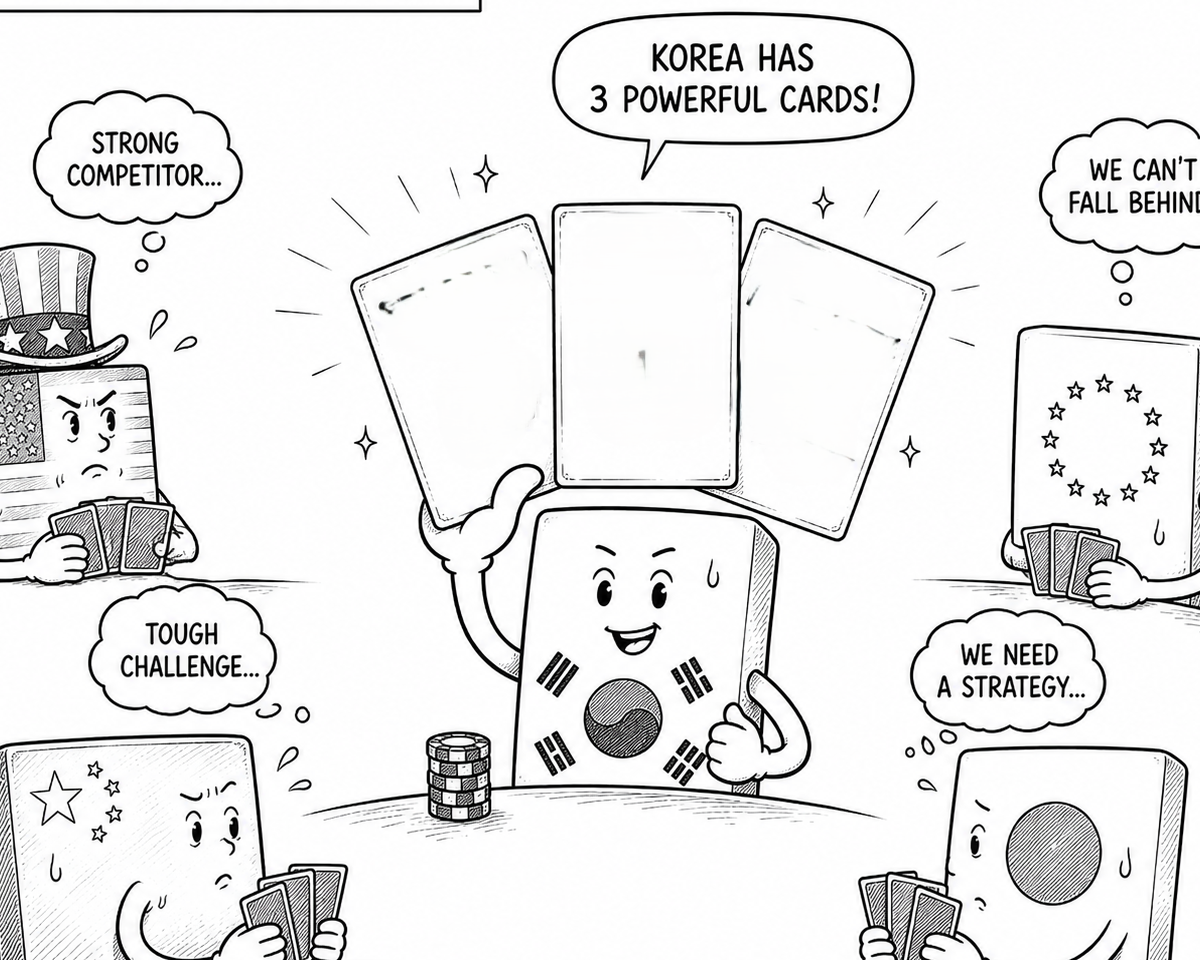
The more America controls AI's brain, the more it must rely on allies to power it, train it, and trust it
The recent blocking of access to Fable 5 and Mythos 5 — two of America's most advanced AI models — carried a dimension that deserves as much attention as the conflict between Washington and its own technology firms. The restrictions were not aimed solely at adversaries. They swept up citizens of allied nations alongside those of rival states. The fact that Gregory Allen, director of the geopolitical research firm Decisiontree, felt compelled to clarify that the move was "not intended to exclude allies" is itself telling: it confirms that countries like South Korea were caught in the net from the outset.
A Different Texture from the Semiconductor Wars
The contrast with earlier American export controls is instructive. When Washington moved to restrict exports of semiconductor equipment and technology to China, allies including South Korea, Japan, and Taiwan were granted exemptions or grace periods with relative speed. A framework existed for distinguishing friends from adversaries.
This time, the mechanism worked differently. The stated reason — that it was technically impossible to identify users' nationalities in real time — led to a blanket block that made no distinction between allied and hostile citizens. Two conclusions follow. First, controlling access to AI models is technically far harder than controlling exports of physical chips. Second, faced with that difficulty, Washington defaulted to a cruder approach: block everyone first, and sort out exceptions later.
The message for South Korea is uncomfortable but clear. Allied status no longer guarantees automatic exemption. That era has begun.
The First Card: Power and Chips
Yet to read this episode purely as a story of Korean vulnerability is to see only half the picture. What America seeks to control is AI's brain — the model itself. But that brain requires two things to function: semiconductors capable of processing vast computations, and the electricity to run them. In both areas, South Korea occupies a position that America cannot easily replace.
It has been demonstrated repeatedly that removing South Korea from the supply chain for high-bandwidth memory (HBM) and advanced DRAM would stall the computational capacity underpinning America's entire AI industry. Electricity is an equally binding constraint. The American transformer market, valued at $12.2 billion last year, is projected to grow at an annual rate of 7.7% to reach $25.7 billion by 2034. Korean electrical equipment makers — HD Hyundai Electric and LS Electric — have established themselves as critical suppliers for this surging demand. Doosan Enerbility's gas turbine and nuclear technology similarly forms an important pillar of America's effort to secure stable power for AI data centres.
Across all these areas, the underlying premise is the same: supply chains from which China has been excluded. Having designated Chinese firms as unreliable suppliers in the AI race, America has few allies capable of filling the gap in semiconductors, electrical equipment, and nuclear infrastructure. An asymmetric structure is taking shape: however aggressively America controls access to AI's brain, the power and chips needed to run it lead back to South Korea.
The Second Card: The Next Frontier Is Physical, Not Textual
There is a further step to take. The models America is currently restricting — Fable and Mythos among them — operate primarily in the realm of language and reasoning. But the next stage of the AI race is where those reasoning capabilities meet the physical world: so-called physical AI. For a robot to move objects and work on a factory floor, it needs not text data but information accumulated from real movements, sensors, and physical environments. Simulation alone cannot fill that gap. It must come from actual factories and real operational settings.
This is where South Korea's position becomes interesting again. The country hosts some of the world's most sophisticated manufacturing operations in semiconductors, automobiles, shipbuilding, and batteries. As those factories transition to robots and automated systems, they generate precisely the kind of physical data that American AI companies desperately need. Even the most powerful language model cannot advance in physical AI without access to real manufacturing environments in which to train the hands and feet of actual robots.
Hyundai Motor Group's recent moves illustrate this trajectory most clearly. Its acquisition of Boston Dynamics, a nine-trillion-won investment in the Saemangeum development zone, and construction of the HMG Future Complex in Wirye are not simple acts of business diversification. The automobile, already the closest thing to a robot that is mass-produced at scale, provides manufacturing knowledge that transfers naturally to humanoid and industrial robots. Markets have begun to reassess Hyundai not merely as a car company but as an AI and robotics firm with deep manufacturing capability.
This is not conjecture. Jensen Huang, chief executive of Nvidia, confirmed it directly during a visit to Seoul last June. Meeting with executives from LG and Hyundai, he observed that building robots requires building an AI factory — the brain — alongside the physical infrastructure. His remark, that a robot's brain and body must be developed together, is evidence that American AI companies already view South Korea's manufacturing base as a primary source of physical AI training data.
The Third Card: Trusted Ground for Real-World Experimentation
If the first two cards represent tangible assets — hardware and data — the third operates on a different level. It is South Korea's status as a democratic ally that is simultaneously one of the most willing and capable countries in the world for testing advanced technology in real social conditions.
Returning to the stated rationale for blocking Fable 5 sharpens the point. America's deepest fear was that its most capable models might flow into the military or surveillance apparatus of authoritarian states. AI export control is therefore inseparable from the question of trust: who can be relied upon? In that framework, South Korea sits near the top of America's list of trusted partners. Liberal democratic governance, strong intellectual property protections, and decades of accumulated military and technological alliance provide the foundation.
South Korea's particular conditions add further value. World-class mobile and internet infrastructure, consumers who adopt new technology with unusual speed, and a government comparatively willing to permit real-world trials of emerging industries together create an environment in which the social impact of new AI services and robotics can be assessed more rapidly than almost anywhere else. For American companies, South Korea offers the opportunity to conduct experiments that would carry heavy political and social risks at home — in a trusted allied country — and then carry the findings back to inform domestic policymaking.
This card is less tangible than the other two but may prove more durable. Semiconductor processes and manufacturing equipment are domains where other countries can close the gap given enough time and capital. The accumulated relationship of a trusted ally, and the experiential record of real-world technology deployment, cannot be replicated on the same timescale.
Asymmetric Interdependence
Set together, the Fable 5 episode and Korea's points of leverage reveal a coherent structure. The more tightly America controls access to frontier AI models, the more deeply it becomes reliant on allies for the power and chips to run them, the manufacturing environments in which to train them on the physical world, and the trusted partners to whom it can safely extend access. South Korea is virtually the only ally positioned simultaneously across all three layers: hardware (semiconductors and power equipment), physical data (manufacturing environments), and trust (the alliance relationship).
The implication is straightforward. The ambition of developing an independent, sovereign frontier AI model to rival American capabilities in the short term is not realistic for South Korea. With heavy dependence on American suppliers for GPUs, data infrastructure, and top-tier research talent, closing that gap quickly is not feasible.
South Korea's real leverage lies elsewhere. Rather than racing to replicate the model itself, the more viable strategy is to become irreplaceable in the three domains that any frontier model requires in order to function, to learn, and to be trusted: power and chips, manufacturing data, and allied credibility. Access to a model can be severed by a single American decision, as Fable 5's three-day window demonstrated. Power grids, factories, the data accumulating within them, and decades of alliance cannot be replaced so easily. That is where South Korea's strategic direction should begin.
What to Watch
Whether America's next AI executive order or export-control measure introduces differentiated provisions for allies will be a critical signal. So too will be the timing of the first concrete results from Hyundai and LG's investments at Saemangeum and Wirye — the moment those projects begin producing measurable physical AI training data will mark the point at which South Korea's manufacturing leverage moves from aspiration to reality.
The Structure at a Glance
America's Domain (The Brain) | South Korea's Domain (The Body, Experience, and Trust)
Asset | Frontier language models (Fable 5, Mythos 5, etc.) | Semiconductors, power equipment, nuclear technology, manufacturing data, allied trust
Ease of control | Access can be cut within days | Supply chains and trust relationships take years or decades to replace
Key examples | Blanket block on Fable 5 and Mythos 5 | HBM, transformers, gas turbines, Hyundai's robotics pivot, the US–Korea technology alliance
Precondition | Unilateral control justified on security grounds | No substitute allied supplier in a China-excluded, authoritarian-excluded network
Korea's strategic direction | Short-term race to build a rival frontier model is unrealistic | Maximise all three levers simultaneously: infrastructure, manufacturing data, and allied trust