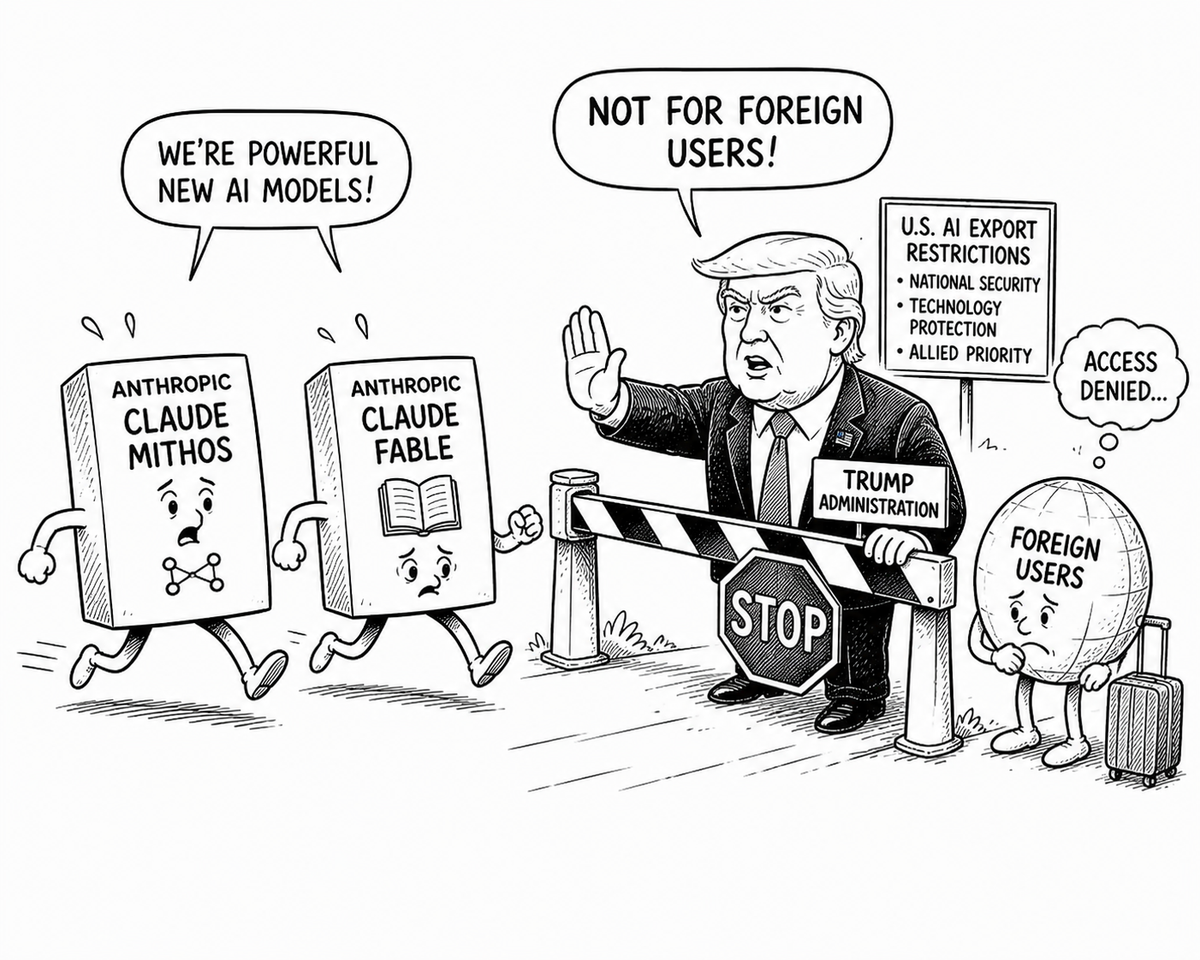
On 9th June, Anthropic launched Claude Fable 5, its most capable model to date. A companion release, Mythos 5 — built on the same architecture but reinforced with additional safety controls — had already been made available in limited preview for specific applications such as cyber-defence. Both models had attracted intense industry attention before launch, as much for their potential hazards as for their performance.
Seventy-two hours later, at 5.21pm on 12th June, everything stopped. Howard Lutnick, the United States Secretary of Commerce, sent a letter to Dario Amodei, Anthropic's chief executive, informing him that any export, re-export, or domestic transfer of Fable 5 and Mythos 5 would henceforth require a government licence. By 7pm the same evening, Anthropic had cut off all access for non-American nationals — inside and outside the United States alike. The company explained that it had no way to identify users' nationalities in real time. The restriction applied to Anthropic's own foreign-national employees.
The stated case, and the real one
The administration offered two official justifications: the risk of the models being appropriated by foreign military or intelligence agencies, and the possibility that even robust security filters could be circumvented. The models were, in the government's assessment, simply too powerful to be left in open circulation.
The backstory is more complicated. According to reporting by Reuters, relations between Anthropic and the Trump administration had already soured earlier this year, after Anthropic refused to allow its models to be used in domestic surveillance programmes and fully autonomous weapons systems operated by the United States military. Shortly after that refusal, the administration reportedly placed Anthropic on a national-security blacklist. In February 2026, the Pentagon designated the company a "supply-chain risk". Concerns about regulatory capture — that is, whether Anthropic's close engagement with safety discourse was being weaponised against it — had surfaced as early as October 2025.
Against this backdrop, an executive order on AI issued on 2nd June had already contained a provision for unilateral export controls as a "hard backstop". The blocking of Fable 5 was the first time that provision was actually used.
The inside account
On 16th June, the Washington Post, citing White House officials, published a more granular account of events. Before releasing the new version of Mythos, Anthropic had submitted a list of 111 organisations for government approval of early access. Monitoring subsequently revealed that Anthropic had quietly extended access to roughly 50 additional organisations without prior authorisation. When asked to submit the identities of those organisations, the company delayed for several days — a lapse that, according to the Post's sources, triggered serious alarm within the White House.
If accurate, this account reframes the episode: the shutdown was less a response to the model's raw capabilities than to a breakdown of trust. A single procedural failure — access granted without sign-off, followed by a slow response to requests for information — was apparently enough to bring down the shutters within days of launch.
The honest company gets punished first
The most uncomfortable implication of this affair reaches beyond Anthropic itself. The company has been, by a considerable margin, the most forthcoming in the industry about the risks posed by its own technology. Before launching Fable 5, it said it had implemented multiple safeguards against cyber-misuse and had conducted advance technical briefings with officials in finance, technology, and government.
Yet that very transparency appears to have provided regulators with the clearest grounds for intervention. The more honestly a company describes what its model can do wrong, the easier it becomes for authorities to justify stepping in. The alternative — downplaying risks — destroys market credibility. It is a trap with no clean exit.
Anthropic made this point directly in its response. The company argued that suspending a model solely on the basis of theoretical jailbreak vulnerabilities was disproportionate, and that if that standard were applied consistently, OpenAI's GPT-5.5 would have to be blocked too. No model can be made entirely immune to prompt manipulation, it noted; if national security is the genuine criterion, it must be applied evenhandedly across the industry.
The contrast with OpenAI's conduct in the same period was striking. The company — which has maintained a broadly co-operative relationship with the administration — chose this moment to publicise a "deployment simulation" process, in which GPT-5.6 is validated by GPT-5.5 before release. Whatever its technical merits, the optics were pointed: the company with warmer ties to Washington was demonstrating rigorous safety procedures while its rival was being shut down. Industry observers have begun to ask whether the administration is applying different rules to companies depending on their political proximity.
Who decides what is too dangerous?
The deeper issue this episode raises is not whether one model should have been blocked, but who holds the authority to make that judgement. Until now, the answer has been, in practice, the companies themselves — through self-imposed safety procedures and responsible disclosure. This affair marks the first time the United States government has asserted that authority unilaterally and acted on it at speed.
Gregory Allen, director of Decision Tree Research, which analyses the geopolitics of AI, semiconductors, and defence technology, interpreted the move cautiously. The blanket restriction on foreign nationals, he suggested, was driven by technical constraints — the difficulty of identifying users in real time — rather than by any intention to exclude allied countries permanently. Prediction markets at one point assigned a 70% probability to access being restored before 20th June. That deadline passed without resolution; no confirmed timeline had been announced at the time of writing.
Anthropic's formal position is that governments should have the power to prevent dangerous AI deployments, but that the process for doing so must be transparent and grounded in technical fact. What this episode demonstrated is something rather different: it took three days for the government to flip the switch off. The criteria and the procedure for turning it back on have not been explained to anyone.
What to watch: The conditions under which access to Fable 5 and Mythos 5 is restored will matter well beyond Anthropic. Whatever terms are eventually imposed will serve as the template for how Washington intends to govern the frontier of AI — and every company in the industry will be reading them carefully.
*Key positions at a glance*
**Anthropic** | **US government**
Stated grounds for shutdown | Theoretical jailbreak risk alone is disproportionate | Foreign military/intelligence misappropriation; filter circumvention
Central counter-argument | Same standard would require blocking OpenAI's GPT-5.5 | ~50 unauthorised organisations added; identity disclosure delayed
Underlying conflict | Refused to supply models for autonomous weapons systems | Subsequently designated a national-security and supply-chain risk
Approach to transparency | Actively disclosed model risks | Disclosure provided clearer grounds for intervention
Outlook on restoration | In negotiation; seeking swift resolution | Willing to lift restrictions once safety concerns are addressed (no timeline confirmed)