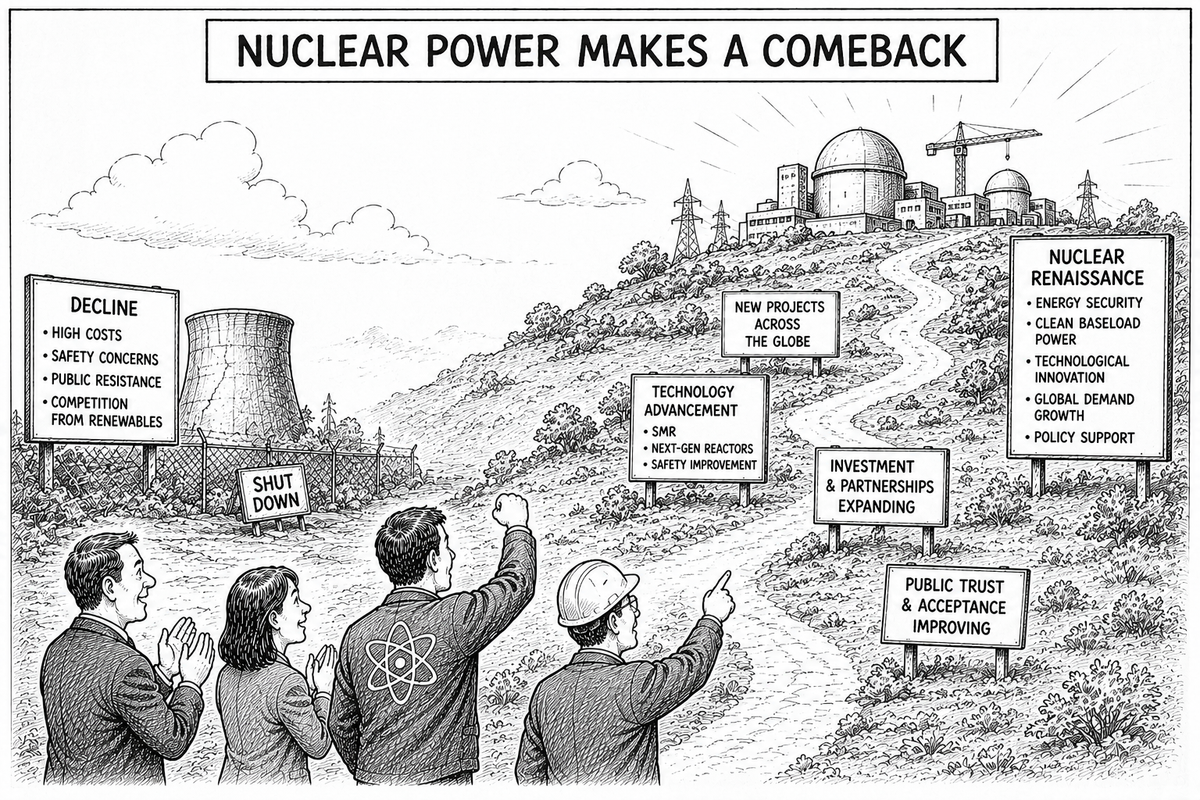
On 17th June, Korea Hydro & Nuclear Power (KHNP) formally designated two new nuclear sites following a review by its site-selection committee: two large reactors will be built in Yeongdeok county in North Gyeongsang Province, and one small modular reactor (SMR) in Gijang county near the southern port city of Busan. It was the first such decision in over a decade.
In almost the same week, on the other side of the world, Doosan Enerbility — South Korea's principal manufacturer of nuclear reactor components — appeared alongside NuScale Power, an American SMR developer, at the opening of a new facility belonging to Alleima, a Swedish specialist in alloys and tubing for nuclear applications. Taken separately, each event is a routine industry development. Taken together, they suggest something more significant: South Korea's domestic nuclear revival and its industrial ambitions abroad are, for the first time in years, reinforcing one another.
The sites and what they signify
The gap since South Korea last confirmed a new nuclear site is not a trivial one. Through successive governments, repeated reversals of energy policy, local community opposition, and a formal phase-out programme introduced under President Moon Jae-in, the construction of new reactors had remained perpetually "under review." That pause ended on 17th June.
The choice of Yeongdeok for the large reactors was not entirely a fresh start. The site had previously been designated for a project known as the Cheonji nuclear plant, where land acquisition, geological surveys, and environmental assessments had already been partially completed before the previous government halted proceedings. Selecting Yeongdeok — over rival candidate Ulju in Ulsan — was therefore less a bold new commitment than a resumption of interrupted work.
The SMR competition was more fiercely contested. Gyeongju city in North Gyeongsang Province and Gijang county near Busan both made their cases; Gijang prevailed. The reactor to be built there is the i-SMR, an innovative small modular reactor under development by the South Korean government. Where a conventional large reactor — generating between 1,000MW and 1,700MW — functions as a baseload power source for major cities, an SMR produces up to 300MW in modular units that can be deployed close to wherever power is needed: industrial parks, data centres, or remote communities. The technology is attracting interest from countries with vast territories, such as the United States and Saudi Arabia, where distributed generation can reduce the cost of long-distance electricity transmission.
The immediate spur behind these decisions is the surge in electricity demand driven by artificial intelligence data centres. The East Sea coastal corridor that encompasses both sites is expected to become the nucleus of South Korea's nuclear industry. South Korean construction companies were quick to grasp what this implies beyond the domestic market. The project is valued at roughly ten trillion won (approximately $7.3bn). Contractors note that building reactors at home bolsters credibility when competing for contracts abroad — a self-evident logic: no country looking to import nuclear technology is likely to trust a supplier that cannot build reactors in its own back yard.
Korea and America, meeting in Sweden
Doosan Enerbility's presence at Alleima's opening ceremony alongside NuScale Power encapsulates how South Korean nuclear industry is repositioning itself. Alleima supplies the specialised alloys and tubing that are essential to reactor construction globally; the fact that South Korea's leading component manufacturer and a prominent American SMR developer were both present reflects the degree to which Korean firms have embedded themselves in the global nuclear supply chain.
Doosan Enerbility's international pipeline is already substantial. The company has signed a contract to supply a 370MW steam turbine and generator believed to be linked to xAI, the American artificial intelligence start-up founded by Elon Musk. It is investing 806.8bn won ($588m) to build a dedicated SMR manufacturing facility at its Changwon plant. It has won a contract worth 5.6 trillion won ($4.1bn) to supply major components for units five and six of the Dukovany nuclear plant in the Czech Republic. Shinhan Investment Securities forecasts that Doosan Enerbility's operating profit will reach 1.2 trillion won in 2026, a 58.7% increase on the prior year.
Why America is coming back to nuclear
Underpinning these developments is a pronounced shift in American policy. The Trump administration has signed four executive orders aimed at streamlining reactor approval processes, restructuring the Nuclear Regulatory Commission (NRC), accelerating next-generation reactor development including SMRs, and strengthening domestic nuclear fuel supply chains. The stated goal is to quadruple America's nuclear generating capacity to 400GW by 2050. The Department of Energy has been directed to add 5GW to existing plants and to begin construction of ten large reactors by 2030.
The opportunity this creates for South Korea is clear. Since 1996, the United States has brought just three new reactors into service. The two most recently completed units cost $35bn to build — roughly twice their original budget. America wants to rebuild its nuclear capacity but lacks the institutional knowledge and supply-chain depth to do so on time and within budget. South Korea, by contrast, has a well-established track record of delivering reactors to schedule and to cost. One policy paper noted that, should the two countries deepen their co-operation on nuclear energy, South Korea could play a decisive role. America's renewed commitment to nuclear power is, in effect, an open door for Korean exporters.
Where the two decisions converge
The near-simultaneous occurrence of the Yeongdeok and Gijang designations and Doosan Enerbility's appearance in Sweden is not mere coincidence of timing. The relationship between the two is structural: without a functioning domestic nuclear programme, South Korea's case for selling reactors abroad is weakened; without credibility in export markets, the justification for domestic investment becomes harder to sustain. The two axes are mutually reinforcing, and this week they moved in the same direction at the same time.
Whether the decisions announced in June translate into real momentum will only become clear when ground is broken at Yeongdeok and Gijang, and when further commercial agreements with American SMR developers are signed. But at this moment, the domestic and international clocks surrounding South Korea's nuclear industry are showing the same time — something that has not been true for a very long while.
*Watch for: the formalisation of construction schedules at Yeongdeok and Gijang, and any new partnership agreements between Doosan Enerbility and American SMR companies. If both accelerate simultaneously, South Korea's nuclear industry could establish a self-reinforcing cycle in which domestic construction and export growth drive each other forward.*