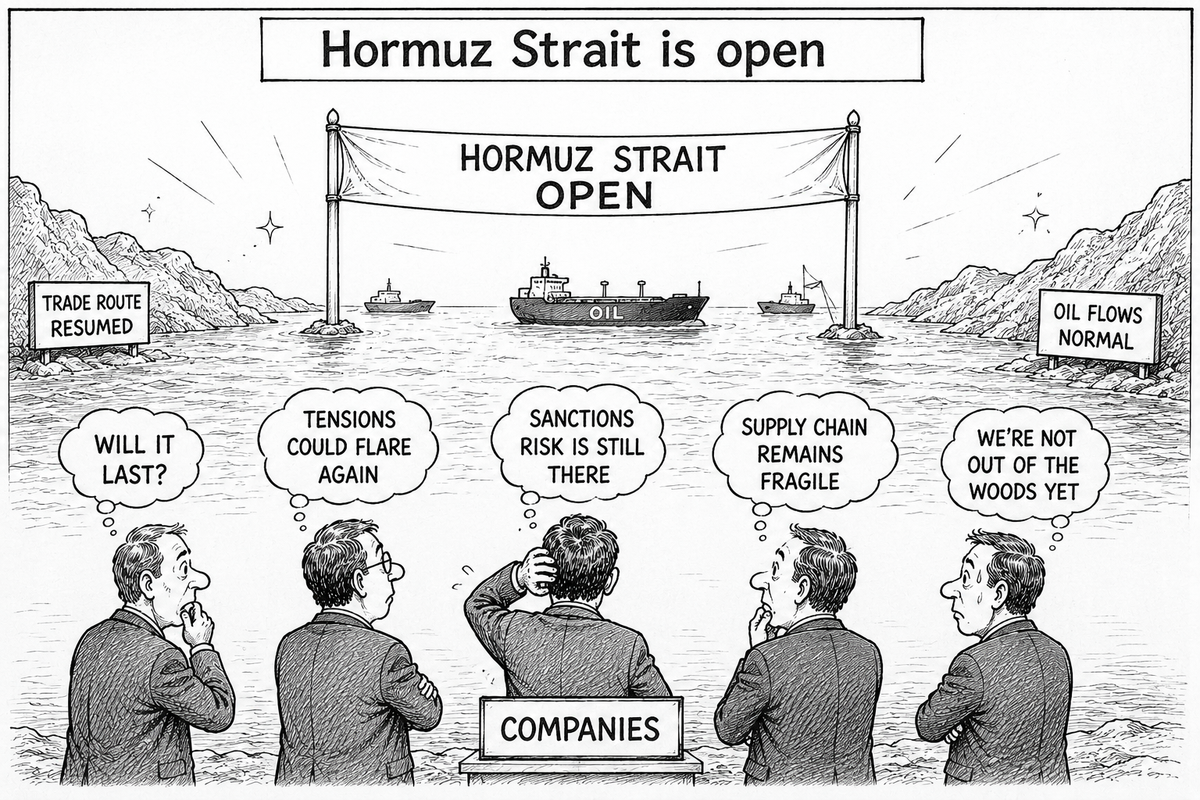
On June 17th, after signing a ceasefire memorandum of understanding, Donald Trump declared that America had achieved "every goal we set out to accomplish, and then some." It sounded like total victory. But those who read the 14-clause agreement carefully the following day wore less triumphant expressions. Article 5 was the reason. Iran would guarantee free passage for commercial vessels through the Strait of Hormuz — but only for 60 days, and at no cost only for that period. What had begun was not peace, but a trial subscription to peace.
The world's narrowest, most expensive chokepoint
A handful of numbers explain why Hormuz matters so much. Some 20% of all seaborne oil passes through the strait. For South Korea, the dependency is even more acute: 70.7% of its crude oil imports and 20.4% of its liquefied natural gas come from the Middle East, and 95% of those crude imports transit Hormuz. It is scarcely an exaggeration to say that a single narrow waterway determines the diameter of the South Korean economy's main artery.
Since the conflict began, international crude prices surged from the low $70s per barrel to briefly above $100. Scenario analysis by the Korea Institute for International Economic Policy (KIEP) suggests that even with an early ceasefire, prices are unlikely to return to their pre-war level of around $63 a barrel, settling instead at roughly $90. The war may end; the costs linger. South Korea sources 34.4% of its naphtha imports from the Middle East, which means the raw-material supply chains of its refining and petrochemical industries have been held hostage to the stability of a single strait.
Two speeds of relief
When the ceasefire news broke, the industrial response quickly diverged. Airlines were identified as the most immediate beneficiaries. Fuel costs account for roughly 30% of an airline's operating expenses. Industry insiders noted that the stabilisation of the won — which had been pushed higher by war-related risk aversion — would ease both passenger demand and carriers' foreign-currency cost burdens. A visible reduction in fuel surcharges could in turn revive travel demand more broadly.
Refiners were far more guarded. The industry's official response was that the situation would depend on how Hormuz transit conditions and crude markets actually developed, and that it was "too early to say." Between a ceasefire announcement and a genuine normalisation of oil flows, there is always a lag — and during that lag, the arithmetic for refiners grows complicated.
The source of that caution is Article 5 itself. A 60-day window is an awkward signal for an industry that operates on long-term shipping contracts and multi-month cargo schedules. No refiner can rationally restructure its long-haul supply agreements around a route that may carry tolls again in two months. This is the divide between industries, such as aviation, that can translate falling oil prices directly into lower operating costs, and those, like refining and petrochemicals, that must redesign entire supply chains before the benefit can be felt.
What happens after 60 days
Reading Article 5 closely reveals Iran's strategic logic. The clause explicitly limits the toll-free period to 60 days, while simultaneously enshrining Iran's intention to negotiate with Oman and the Gulf coastal states over the future management of the strait and the fees to be charged for maritime services. The message is clear: Iran may have lost militarily, but it has no intention of losing economically. Iran's chief negotiator made the point explicitly, stating publicly that "Hormuz will not return to what it was before the war" and confirming that tolls would be reimposed after the grace period expires.
The New York Times framed the outcome bluntly: Iran, defeated militarily, had won economically. In exchange for its agreement not to develop nuclear weapons — essentially a reaffirmation of its existing position — Tehran secured sanctions relief, guarantees of $300 billion in financing, and the resumption of crude exports. The full transfer abroad of Iran's highly enriched uranium stockpile, a longstanding American demand, does not appear in the agreement. The final settlement remains unfinished business, to be renegotiated within that same 60-day window.
Markets have placed their bets; industry is still doing the sums
Financial markets greeted the ceasefire with relief. But there is a gap between that relief and the calculus on the factory floor. The headline that Hormuz has reopened is a different proposition from the operational reality that South Korean refiners can safely re-enter long-term crude contracts. As the deadline approaches, the industry's next question sharpens into focus: when the exemption expires in mid-August, will Iran actually impose tolls? And if it does, whose invoice will carry the cost?
The world cheered the end of the war. But those who read the small print of this particular peace have quietly circled a date in mid-August on their calendars.
Watch for: the expiry of the Hormuz toll exemption in mid-August, and the outcome of the 60-day final negotiation that precedes it. Should no extension be agreed, cost pressures on South Korea's refining and petrochemical sectors are likely to resurface sharply.