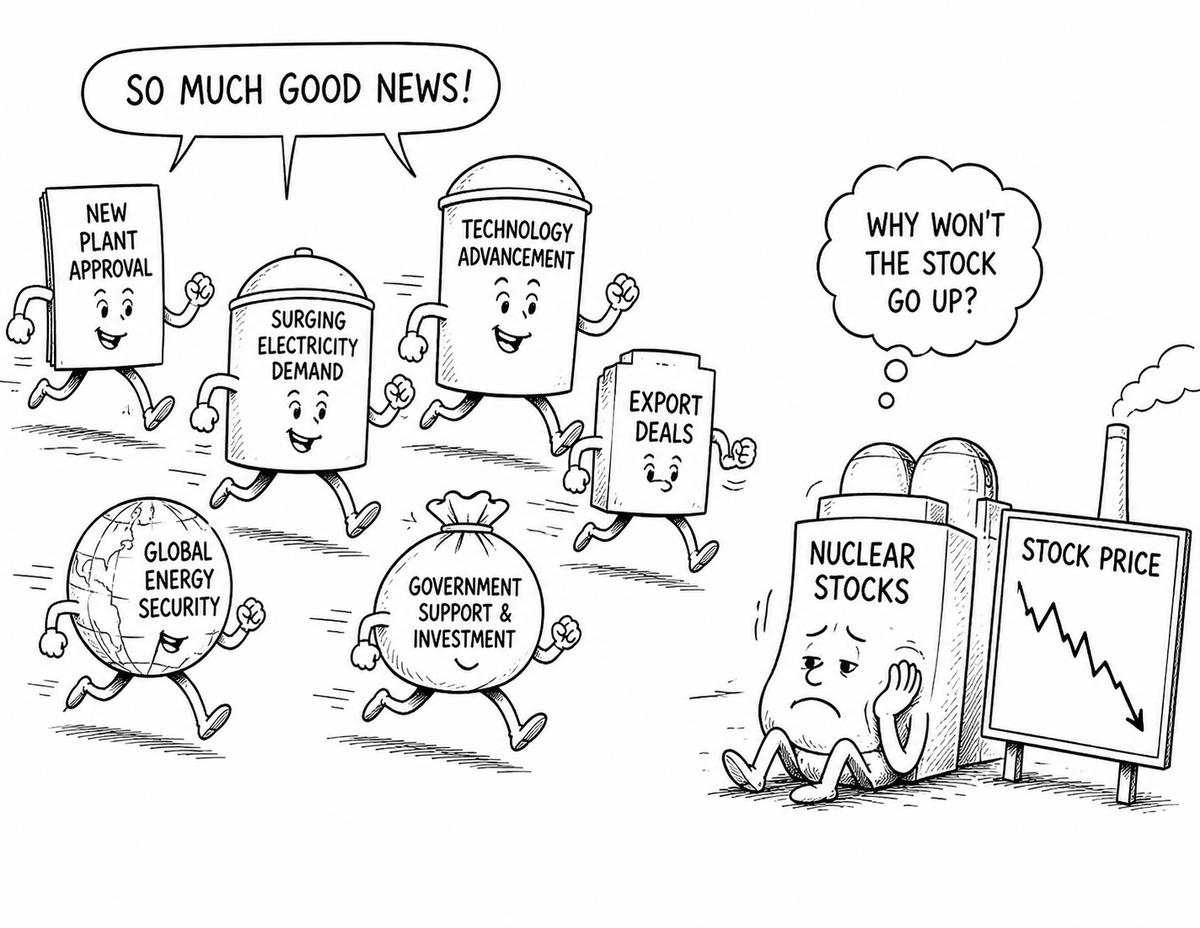
There is something counterintuitive about what happened to Doosan Enerbility this month. South Korea confirmed its first new nuclear power plant site in a decade. Across the Pacific, American nuclear stocks surged. Yet shares in South Korea's pre-eminent nuclear engineering company fell. One local outlet captured the absurdity neatly: "US nuclear stocks soar — but Doosan Enerbility drops during trading." Good news arrived; the stock went down. The question is why.
What the numbers say
The answer begins with valuation. As of December 2025, Doosan Enerbility traded at a price-to-earnings ratio of 951 times. Even by the standards of growth-hungry emerging markets, this figure is extraordinary — a P/E of 20 to 30 times is enough to invite talk of overvaluation. At 951 times, the share price reflects not what the company earns today, but an elaborate vision of what it might earn in the years ahead: a landmark reactor contract in the Czech Republic, a pipeline of small modular reactors (SMRs), and a growing foothold in the North American gas turbine market. The future, in other words, had already been purchased.
This is not unusual in capital markets. Stocks are claims on future cash flows, and when a sector captures the imagination of investors, share prices race ahead of reported earnings. What is unusual is the magnitude. At nearly 1,000 times earnings, even genuinely positive news — a new reactor site, a buoyant market in America — arrives as an anticlimax. The good news was already in the price.
The simplest explanation: profit-taking
The most straightforward account of the recent weakness is profit-taking. Doosan Enerbility's shares had risen several times over in a short period, driven by enthusiasm about nuclear power's revival and the surge in demand for gas turbines from AI data centres. When stocks rise sharply, the impulse to sell is equally sharp. Analysts have described the recent softness as "a natural pause for breath following a rapid advance, rather than any deterioration in the company's underlying business."
The trading data bear this out. On 12th May, shares climbed as high as 134,000 won intraday before closing down 2.97% at 121,500 won. Foreign investors — often a leading indicator of sentiment — actually bought 290,000 shares that day. But domestic institutions sold 100,000 shares, and the tug of war between the two groups ended with the stock lower and intraday volatility amplified.
A broader rotation — or the lack of one
Doosan Enerbility's travails are not unique to the company. In June, as global market volatility increased, profit-taking by foreign investors broadened across South Korean equities. Nuclear stocks fell alongside AI-related names. On 2nd June, Doosan Enerbility closed down 6.17% at 100,300 won; other nuclear plays, including Woori Technology, fell in sympathy. The whole sector appeared to be swept up in a general re-rating of elevated valuations.
Yet a closer look at May's market dynamics complicates the "everything fell together" narrative. The KOSPI (South Korea's main stock index) hit record highs during May, but the rally was almost entirely driven by semiconductor and AI-related stocks — principally Samsung Electronics and SK Hynix. Analysts described it as a "semiconductor monopoly market", with the proportion of rising stocks falling to multi-year lows. Capital did not rotate broadly; it piled into a single trade.
Lee Jae-won, an analyst at Yuanta Securities, identified the implication clearly: "Given the excessive concentration of investment flows into semiconductors and IT hardware during May's surge, attention should shift in June to sectors with scope for catch-up gains — those that have fallen sharply despite improving earnings." Nuclear energy was cited alongside shipbuilding, defence and batteries as one of the "neglected sectors" most likely to benefit when the rotation eventually comes. Han Ji-young of Kiwoom Securities issued a similar warning, cautioning that the most crowded trades faced the risk of a sharp reversal.
A single day illustrates the mechanics well. On 11th June, disappointing AI guidance from Broadcom and concerns that memory chip makers were nearing peak cycle conditions triggered heavy selling in Samsung and SK Hynix. But the money did not leave the market; it moved immediately into robotics, biotechnology and banking stocks. Capital shifted its seat, it did not depart. This suggests that nuclear shares' June weakness reflects not a loss of faith in the industry, but the fact that the funds flooding into semiconductors have not yet found their way back to the nuclear trade.
KB Asset Management made the same point in its June market outlook. The current concentration in semiconductors is driven partly by passive funds' growing weight in the sector; once profit-taking from those funds runs its course, a broader rotation is likely. "The time is right," the firm advised, "to maintain core holdings in semiconductors and industrial materials while reviewing neglected satellite assets." Nuclear power stocks were among the candidates it had in mind.
The fundamentals, unmoved
What makes the divergence between price and news striking is that the underlying business continued to perform while the share price softened. In the first quarter of 2026, Doosan Enerbility's consolidated revenue rose 13.7% year on year, operating profit grew 63.9%, and the company returned to net profit. Mirae Asset Securities, initiating coverage with a buy recommendation and a target price of 105,000 won, estimates that the company's new order intake will grow by more than 80% — from 14.9 trillion won in 2025 to 27.4 trillion won by 2034.
The same research report noted a distinctive pattern in the company's valuation. Doosan Enerbility's market multiple tends to track closely the rolling sum of new orders won over the following four quarters. When the order pipeline expands, the valuation multiple expands with it; when orders thin, it contracts. In effect, this is a stock that investors price not on current earnings but on the expectation of contracts yet to be signed. A large wave of such expectations was priced in; now the market is digesting it.
Two different questions, two different time horizons
The confirmation of new reactor sites at Yeongdeok and Gijang, the nuclear renaissance under way in America, Doosan Enerbility's expanding global footprint — all of these are unambiguously good for the industry. But "good for the industry" and "good for the share price right now" are different questions. For a stock already trading at 951 times earnings, the arrival of anticipated good news can paradoxically serve as a trigger to sell rather than to buy.
Nor, however, is the current weakness best read as a bubble bursting. The dominant force in South Korea's equity market during June was the extreme concentration of capital in the semiconductor and AI trade. Nuclear, shipbuilding, defence and batteries were all neglected in consequence. The rapid redeployment of semiconductor profits into robotics, biotech and banking on a single June day is evidence that money is circulating, not vanishing.
Seen in this light, nuclear stocks face two distinct time pressures simultaneously. In the near term, a P/E of 951 times represents a level of expectation that needs to be worked down, even if the underlying business continues to improve. Over a slightly longer horizon, the capital crowded into semiconductors has not yet cycled back to the nuclear trade. The fundamentals — the first domestic reactor site confirmed in a decade, rising global demand for SMRs, a decisive shift in American nuclear policy — have not changed. If anything, they have strengthened.
The paralysis of Doosan Enerbility's share price in the face of positive news is therefore most likely a timing problem rather than a verdict on the industry. The market's attention is elsewhere. When it returns, the fundamentals will be waiting.
What to watch: Doosan Enerbility's second-quarter results, due in July, will reveal whether the pace of new order intake is accelerating. Equally important is whether the semiconductor and AI trade begins to cool, releasing capital for a broader sector rotation into nuclear, shipbuilding and defence. If both signals appear together, the recent weakness may come to be viewed as an entry point rather than a warning.