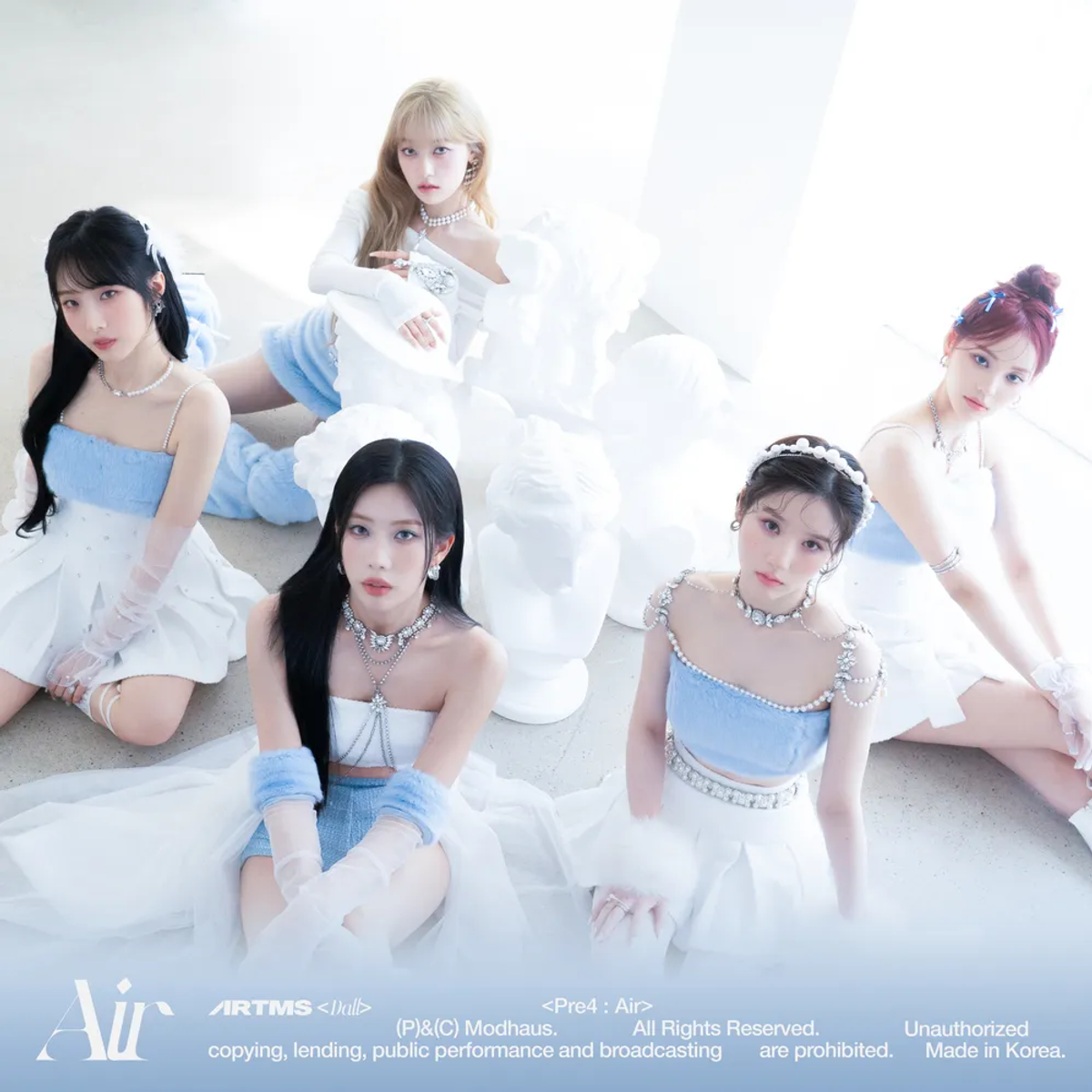
ARTMS is a five-member girl group signed to Modhaus, a South Korean entertainment start-up. The group debuted on 1st December 2023, with a line-up comprising Heejin, Haseul, Kim Lip, Jinsoul and Choerry. The name is borrowed from Artemis, the moon goddess of Greco-Roman mythology — a deliberate echo of the group's predecessor, LOONA (stylised as LOOΠΔ), whose name was itself derived from "luna", the Latin word for moon. If LOONA was the first generation of moon goddesses, ARTMS positions itself as the second — a symbolic framing of what is, in effect, a relaunch.
The group's official slogan, "We rise together, back to the Moon and beyond", is lifted verbatim from NASA's declaration when it launched the first mission of its Artemis lunar programme.
From lawsuits to a new system
ARTMS did not have an easy beginning. Its members originally belonged to the twelve-member girl group LOONA, under the agency BlockBerry Creative. After a protracted contract dispute, a South Korean court granted an injunction in the members' favour, allowing them to move to the newly established Modhaus. When the project was first announced publicly in April 2023, it was presented as a project rather than a fully formed group — initially comprising four members: Heejin, Kim Lip, Jinsoul and Choerry. Haseul joined in June 2023, completing the five-member configuration. The remaining former LOONA members went their separate ways, joining other agencies or pursuing independent careers.
Reconstituted, ARTMS launched its activities on Cosmo, a fan-participation platform developed in-house by Modhaus. The system works as follows: fans purchase NFT photo cards — called "Objekts" — which come bundled with tokens known as "COMO" and voting rights. Those voting rights can then be exercised on substantive decisions about the group: unit compositions, creative concepts, and the direction of content production. Physical NFT photo cards have also been sold through an exclusive arrangement with the GS25 convenience-store chain. According to Dune Analytics, a blockchain data platform, the number of NFT holders for ARTMS's sister group tripleS exceeded 50,000 within two years — suggesting the system has embedded itself in fandom economics faster than many anticipated. Baek Gwang-hyun, deputy chief executive of Modhaus, has stated that the platform's ultimate ambition is to incorporate additional idol intellectual properties, building out a multi-IP ecosystem.
Back after fourteen months — but not at full strength
On 7th May, ARTMS released its second mini-album, *Hyper-Ego*, marking a return after fourteen months away. The record features two lead singles — "Born Stunner" and "Blue Blood" — and is presented as an extension of the fictional universe established through earlier releases, "Virtual Angel" and "Icarus". Notably, the title tracks were made available globally on 24th April, ahead of the album's release, accompanied by promotional activity in the United States — a signal that the group is orienting itself firmly towards international markets from the outset.
There is, however, a significant caveat: member Haseul is absent from this comeback. Shoulder surgery has ruled her out of both the promotional cycle and the group's 2026 world tour. She does make a surprise appearance on the album's introductory track, "From Wings To Soul", which at least ensures she is not entirely missing from the record. Plans call for her to resume solo activities within the limits of her recovery. ARTMS is scheduled to launch its new world tour, "Art of BLUE BLOOD", in Seoul on 5th and 6th September.
The harder question: can the platform sustain the group?
Modhaus raised 21bn won (roughly $15m) in a Series B funding round in August last year, led by IMM Investment. The round also drew in LB Investment — an early backer of HYBE, the entertainment giant behind BTS — along with several other prominent South Korean venture capital firms. It was the largest single-company fundraising in the domestic entertainment sector in 2025. What attracted investors was not so much the ticket and album sales of ARTMS or tripleS individually, but the scalability of the Cosmo ecosystem — a model in which fans participate directly in decisions about IP development, and in doing so help build the value of that IP themselves.
This represents a meaningful departure from the conventional K-pop industry model. Ordinarily, fans are consumers: buyers of albums, merchandise and concert tickets. Within the Cosmo system, they become something closer to stakeholders, holding tokens and voting rights. The experiment is not without friction, however. When Cosmo's live-streaming feature launched, a surge in traffic caused automatic logouts and degraded video quality — problems that drew complaints given the service's paid-subscription nature. Separately, the platform's reliance on the Ethereum blockchain means that spikes in network transaction fees (known as "gas fees") have caused token transfers to fail, leaving fans with limited technical knowledge confused and frustrated. Such episodes have recurred.
Ultimately, ARTMS faces a dual test. The first is musical: whether the group can sustain artistic momentum and commercial appeal. The second — and arguably more consequential — is structural: whether the model of fans-as-shareholders can prove itself a genuinely durable business rather than an intriguing prototype. The outcome of this comeback, completed without Haseul, and the fortunes of the September world tour will serve as important waypoints for Modhaus's broader ambition to build a multi-IP entertainment platform.