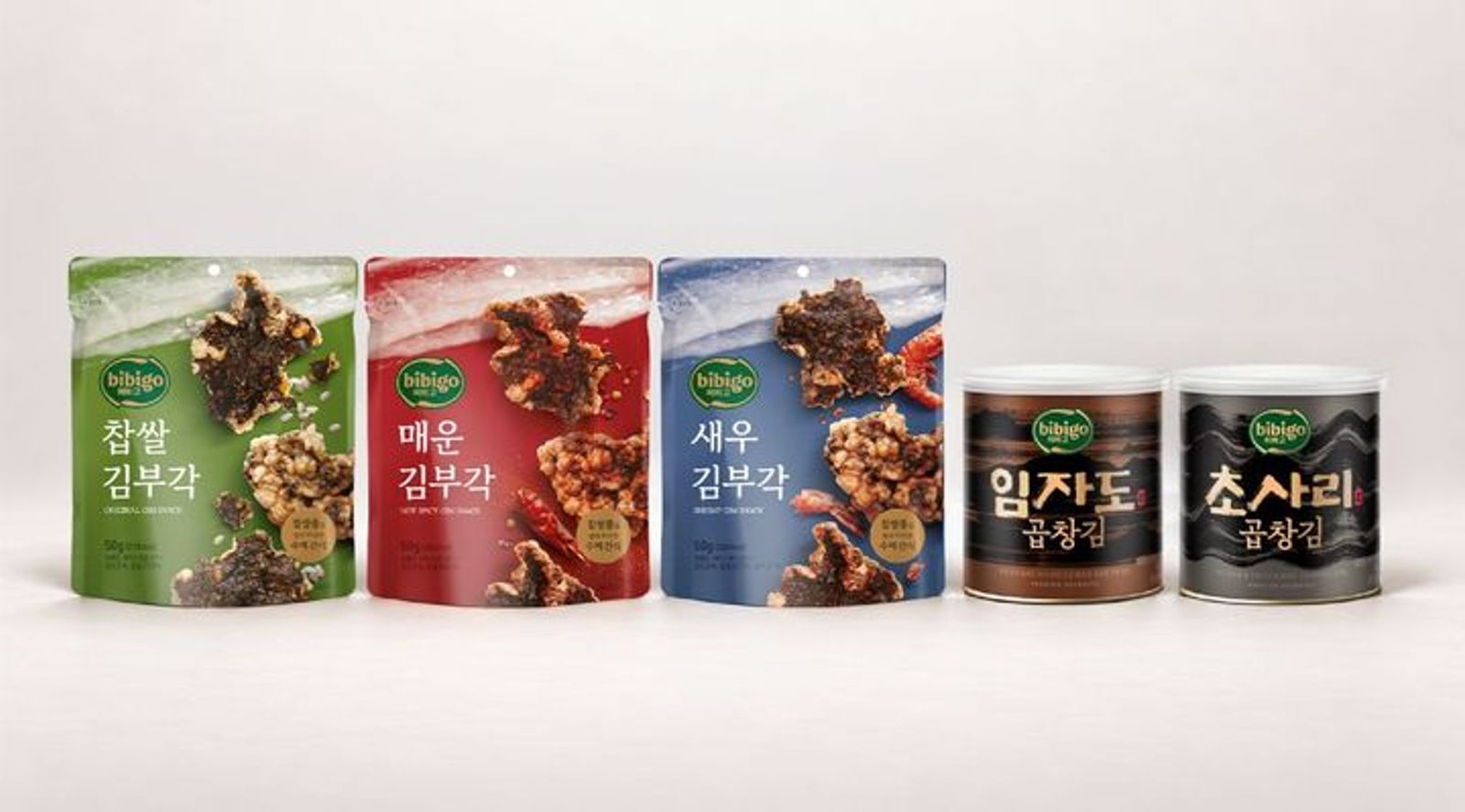
CJ CheilJedang's "Bibigo Gimbuak" — crispy, deep-fried seaweed crisps coated in glutinous rice paste — has sold nearly 500,000 packs since launch, rapidly establishing itself in the premium snack-seaweed segment. The company has now compounded that momentum by introducing two new products in canned packaging, a move that is prompting the broader food industry to ask whether South Korea's domestic seaweed market, worth over one trillion won (roughly $750m) annually, is on the cusp of structural change.
From sidedish to premium snack
Gimbuak is a traditional Korean preserved food: sheets of seaweed coated in glutinous rice paste, then deep-fried or roasted until crisp. Historically it was made at home as a banchan — a small side dish served alongside rice — rather than sold as a branded consumer product. CJ CheilJedang has repackaged the concept as an individually portioned snack, combining convenience with a premium image and backing it with the established Bibigo brand, which already enjoys wide recognition both in Korea and internationally.
The strategy appears to be resonating, particularly with younger consumers and health-conscious shoppers. "Gimbuak ticks the right boxes — low-calorie, gluten-free — making it an easy sell to health-aware consumers," said one food industry executive. "The premium positioning, clearly differentiated from ordinary seasoned seaweed, is what drove the early sales numbers."
Canned seaweed: shelf life as a selling point
The two new canned products represent a more deliberate push into the gift and premium snack market. Metal cans offer markedly better protection against moisture and oxygen than conventional foil pouches, preserving the crisp texture far longer. That functional advantage translates into a commercial one: canned goods tend to command higher prices and lend themselves to gift-set configurations.
There is international precedent for this approach. Canned seaweed snacks have already succeeded as premium products in Japan, and canned Asian snacks have gained traction in the United States. Korean seaweed snacks sold in America have grown at an average annual rate of more than 20% over the past five years, according to local distribution data, with premium packaging identified as a key driver of purchase conversion.
A market at an inflection point
According to the Korea Agro-Fisheries and Food Trade Corporation (aT), the domestic processed-seaweed market exceeds one trillion won a year, and the share accounted for by higher-value snack formats — including seaweed crisps and canned products — is rising steadily. The shift reflects broader changes in consumer lifestyles, with seaweed snacks increasingly consumed through convenience stores and online channels rather than prepared at home.
The entry of a major food conglomerate poses a direct challenge to established seaweed specialists. Gwangcheon Gim and Dongwon's Yangban Gim — both well-entrenched brands — face intensifying competition. Yet some smaller producers take a sanguine view. "When a large company enters a category, it raises overall awareness," said one executive at a mid-sized seaweed manufacturer, acknowledging the double-edged nature of the development.
The K-food export angle
CJ CheilJedang's ambitions are not confined to the domestic market. Bibigo products are already distributed across more than 100 countries, including the United States, China, and much of Europe. Seaweed snacks are among the fastest-growing items within South Korea's broader food export portfolio: customs data show that seaweed exports surpassed $800m in 2024, a record high.
Premium canned packaging is particularly well-suited to placement in upmarket foreign supermarkets and to gift-set configurations favoured in several Asian export markets. "Canned seaweed is arguably better positioned for overseas premium channels than for the domestic market," said one food marketing specialist. "If the global K-snack trend continues, it could become a significant export earner."
Risks: price sensitivity and raw material supply
The strategy is not without hazards. Bibigo Gimbuak is priced at a meaningful premium to conventional seasoned seaweed, and whether consumers will buy it repeatedly — rather than occasionally as a novelty — remains unproven. Raw material costs add another layer of uncertainty: seaweed harvest yields are highly sensitive to climatic conditions and aquaculture environments, and poor harvests driven by abnormal weather have recurred in recent years. Securing a stable supply chain will be a prerequisite for sustained growth.
Whether CJ CheilJedang can use the Bibigo brand's premium equity and its global distribution network to set a new benchmark in seaweed snacks — or whether the initial sales surge proves to be short-lived — will become clearer over the next one to two years, as sales trends and export figures accumulate.