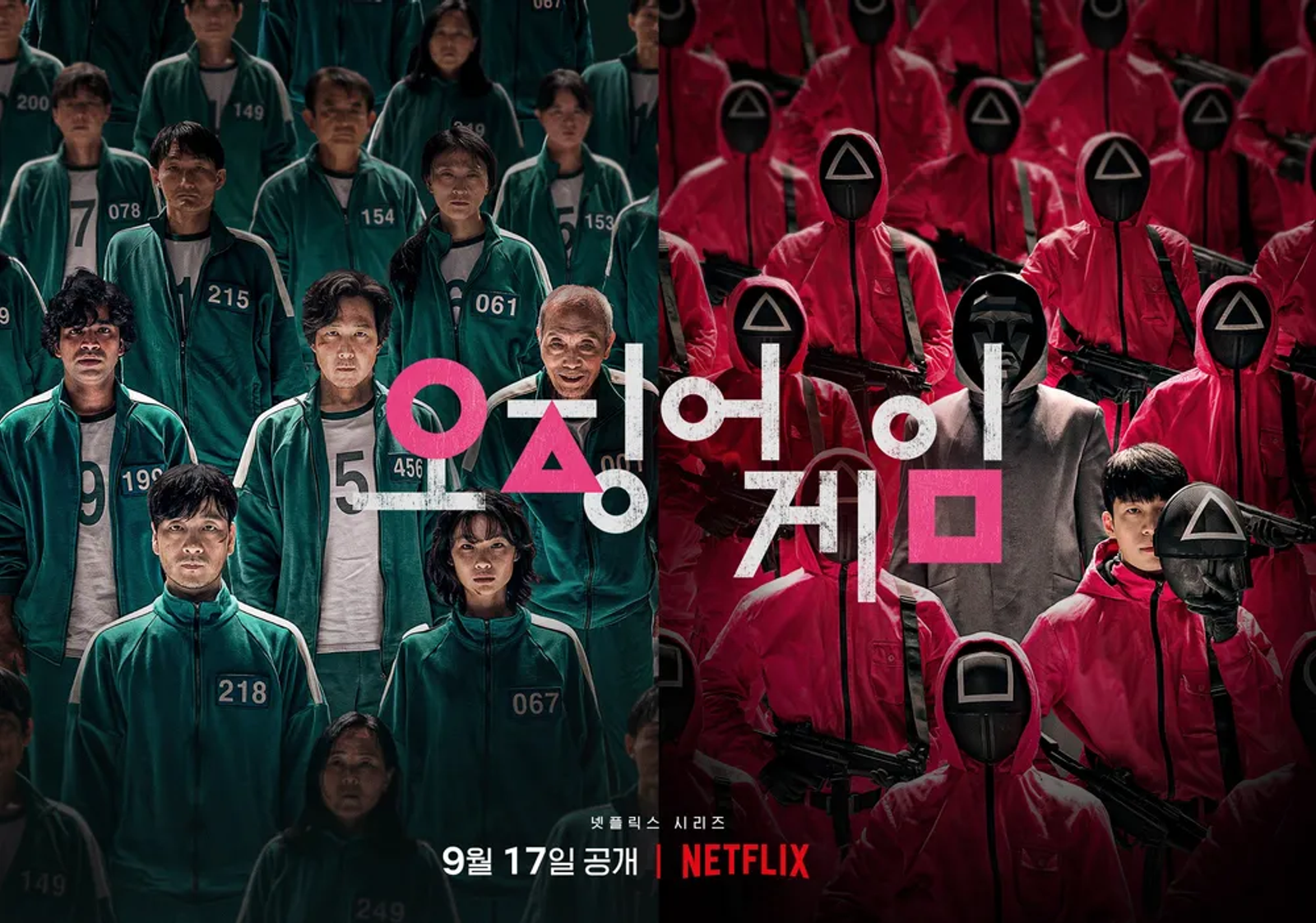
*Editor's note: "Behind the Scenes" is a series examining the production stories and industry dynamics behind hit Korean dramas. The first instalment looks at Squid Game.*
The stress of making Squid Game cost director Hwang Dong-hyuk six teeth. He first conceived the story in 2008, only to be turned away by investors and actors alike. More than a decade passed before it reached the screen. When it did, in September 2021, over 140 million households watched it within 28 days of release, making it the most-watched series Netflix had ever produced. Behind that record lie some unexpectedly modest details: a prize-money figure borrowed from the national lottery, game rules hidden in plain sight on a dormitory wall, and a bank account number that briefly received deposits of 456 won from viewers.
A decade of rejection, and the nights that cost him his teeth
Hwang first developed the concept for Squid Game in 2008. The project was dismissed as "bizarre and implausible" — a verdict shared by both potential investors and the actors he approached. It was Netflix that eventually opened the door. The platform imposed no restrictions on format, content or length, and Hwang later said: "Squid Game was a show that could only have been made at Netflix." The streamer initially referred to the series internally as "Round Six," but Hwang insisted on the Korean title. During production, he has spoken openly about the toll the work took: grinding through scripts late into the night, haunted by the fear that audiences would laugh at a story in which adults stake their lives on children's playground games.
456: the number that came from the lottery
In the original 2008 draft, the competition featured 1,000 participants playing for a prize of 10 billion won. Revisiting the script a decade later, Hwang felt that sum no longer felt like a life-changing fortune, so he looked to the largest lottery jackpot ever paid out in South Korea — a figure in the 40-billion-won range — as his new benchmark. From there, his reasoning was almost mundane. "I wanted something easy to remember, a round number somewhere in the middle," he said. "456 was simple to recall." There was no hidden symbolism; he just wanted a number that would stick.
Cat's cradle was cut; the answers were on the wall
Choosing the games themselves involved careful calculation. Hwang selected "Red Light, Green Light" — known in Korean as Mugunghwa Kkochi Pieotseumnida — as the opening challenge because it would produce, in his words, the most surreal and visually striking images of mass death. He also considered cat's cradle as an alternative to the ddakji tile-flipping game, but concluded that its rules would be too difficult for international audiences to follow quickly. Simplicity, with a global viewership in mind, was the governing principle.
The participants' dormitory, meanwhile, contained a detail that most viewers missed entirely. All the rules for every game in the competition were illustrated on the walls. Hwang said he wanted to hide the series' secrets in plain sight: the contestants were too busy watching each other to look at the walls, and the images only became legible once most players had been eliminated and the space had emptied.
A 20 billion won production, two employees, and 456 won deposits
The budget for the first season was reported at approximately 20 billion won (roughly $15 million). The production company behind it was a small, unlisted firm with just two employees. Netflix paid around 120% of production costs upfront regardless of commercial performance, but retained all intellectual property rights. Some analysts estimated that Netflix's market capitalisation increased by roughly 28 trillion won in the three weeks around the show's launch, though that figure reflects multiple variables and cannot be attributed to Squid Game alone.
The production also generated a handful of unintended incidents. A phone number shown on screen had been used because the crew believed it was unassigned — it was not. The bank account number that appeared in one scene belonged to a member of the production team, and viewers promptly began making deposits of exactly 456 won. The team eventually had to close the account. The honeycomb toffee known as dalgona proved equally surprising: Hwang had joked in passing that the snack might fetch a premium somewhere, and dalgona-making kits subsequently appeared for sale on eBay and similar platforms.
A favour asked over drinks, and three days of audition tapes
The casting process was, in several cases, decidedly informal. Gong Yoo, a close personal friend of the director, agreed to appear after being asked at a private gathering. Lee Byung-hun, with whom Hwang had stayed in regular contact since their collaboration on the 2017 film The Fortress (남한산성), gave his assent when the question was raised at a convivial dinner. For the lead role of Seong Gi-hun, Hwang chose Lee Jung-jae specifically because he wanted to dismantle the actor's established image as a charismatic, commanding presence.
Jung Ho-yeon, who had no prior acting experience, received the script while abroad, spent roughly three days doing little else but studying the material, and submitted a self-recorded audition. She learned she had been cast when her agency's chief called to say: "Congratulations, Saebyuk" — using her character's name. At a dinner following a script read-through, Lee Jung-jae told her: "We're colleagues now." Her Instagram following subsequently grew from around 400,000 to 9.6 million.
The red hair, and what came after
The red hair that Gi-hun sports at the end of the series was an image Hwang arrived at intuitively. Asking himself what the most extreme thing his protagonist could do would be, he settled on the dye job as an expression of barely contained fury. The character of Gi-hun was partly inspired by workers laid off by SsangYong Motor during the company's restructuring. When asked at the time about a second season, Hwang demurred: "I'm sorry, but I'll have no comment on that for now." The series has since continued: Season 2 arrived in December 2024, and Season 3 in June 2025. The third season recorded 60.1 million views in its first three days and reached number one in 93 countries tracked by Netflix. Whatever the scale of that success, the complaint that the production company has little ability to share in the derivative revenues the franchise generates continues to resurface.
A closing thought
Every number, every wall, every bank account had a reason behind it. But as ever, the biggest variable was people.