Saemangeum has long carried an unkind nickname: "hope torture". Since construction began in 1991, this vast stretch of reclaimed tidal flat on South Korea's western coast has repeatedly cycled through grand announcements — an international airport, a new port, industrial estates — only for delays and downsizing to follow. For 33 years, ambitions for the site have been vivid in political rhetoric and blurry in reality.
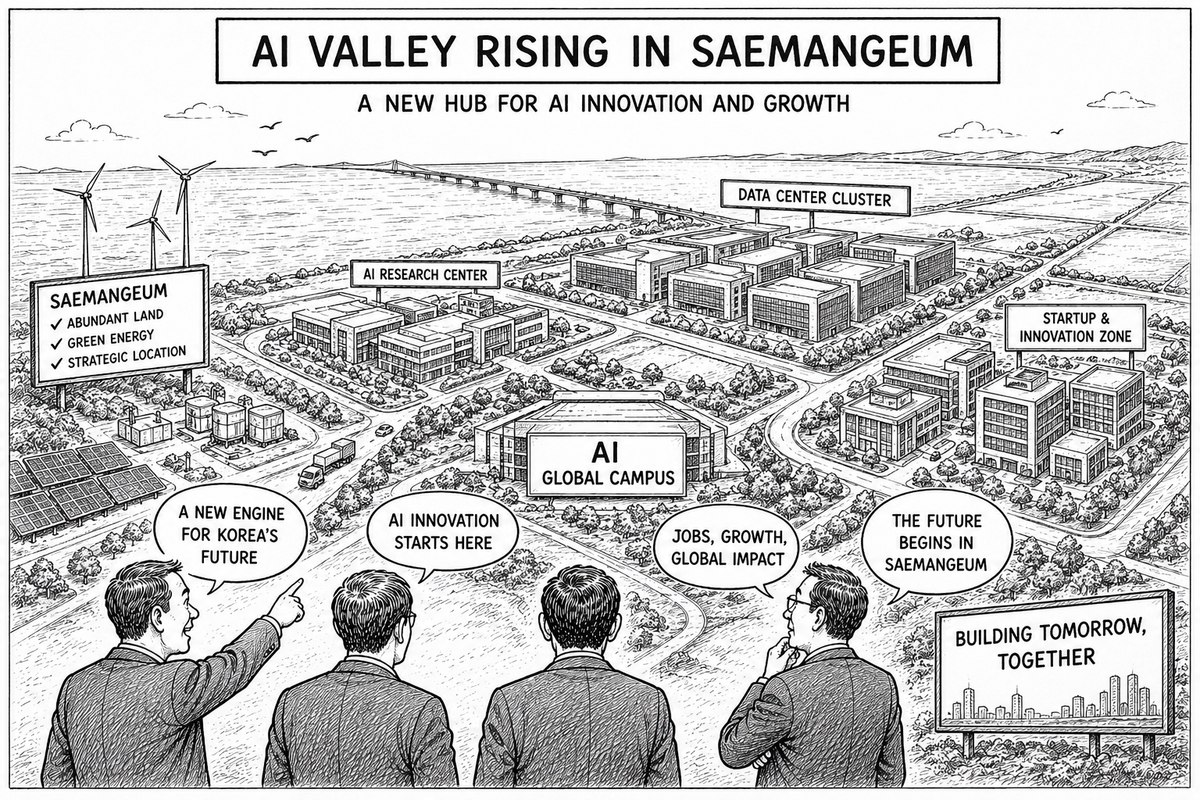
That nickname began to wobble in February, when Hyundai Motor Group announced plans to invest ₩9 trillion (roughly $6.5 billion) in a 1.124 million square metre site at Saemangeum, building what it calls an "AI Hydrogen City": a complex housing AI data centres, robot manufacturing facilities, hydrogen energy infrastructure, and solar power installations. The shift became unmistakable on 8th June, when Jensen Huang, chief executive of Nvidia, met Hyundai Motor Group chairman Euisun Chung at the company's headquarters in Seoul's Yangjae district and publicly dubbed the site "AI Valley". "I'm delighted that we'll be building an Nvidia data centre at Saemangeum," he said. In a single sentence, a new name was laid over 33 years of disappointment.
Why Saemangeum — a rare case where geography provides the answer
The central challenge in building AI data centres is power. Running tens of thousands of graphics processing units (GPUs) demands enormous quantities of electricity, and sites capable of supplying it reliably are scarce. Saemangeum's appeal lies in its ability to tackle this problem through geography alone.
The expansive flatlands created by land reclamation are well-suited to solar power generation. The strong, consistent winds off the Yellow Sea translate directly into wind energy resources. The site's coastal position carries additional significance: the electrolysis process used to produce hydrogen from water requires a steady supply of fresh water — a condition that Saemangeum can naturally satisfy. As one industry official was quoted as saying in a report by the Korea Economic Daily, the site's "abundant renewable energy can address the power shortage that is the fundamental constraint of AI data centres." Data centre, renewable energy, and hydrogen production — three pieces of the puzzle that interlock within a single site.
The breakdown of the ₩9 trillion investment reveals that this is no ordinary data centre project. Roughly ₩5.8 trillion, more than half the total, is earmarked for data centre construction, with 14% allocated to renewable energy utilisation and 11% to hydrogen electrolysis plants. The first phase calls for 100 megawatts of infrastructure capacity using approximately 50,000 GPUs, with a roadmap to expand to 500MW in stages. Hyundai Motor Group estimates the scheme will generate ₩16 trillion in economic output.
Why robots need a brain nearby
Huang's interest in Saemangeum goes beyond a single data centre. At the 8th June meeting, he stated that "an AI factory — the brain for building robots — must be built alongside" the hardware manufacturing facilities. To understand why, one must consider the broader vision Nvidia is pursuing. Physical robots cannot function from hardware alone: the entire stack of perception, decision-making, and movement requires a substantial computational infrastructure — an "AI factory" — operating in parallel.
Saemangeum fits this requirement precisely, because robot manufacturing facilities, AI data centres, and energy infrastructure would coexist on the same site. A North Jeolla Province official predicted that "if the Hyundai investment and Nvidia partnership materialise, demand for autonomous vehicle, robotics, and smart manufacturing demonstration projects around Saemangeum will expand significantly." What is taking shape is not a conventional computing campus, but a closed-loop ecosystem in which robots are manufactured and the AI that trains them is run on the same grounds.
This context also explains why Saemangeum is the frontrunner to host Nvidia's Korea AI Technology Centre (NVAITC). The facility belongs to a small, elite tier of Nvidia's strategic technology hubs, currently operating in only a handful of locations including Singapore, the United Kingdom, and Taiwan. As one industry insider explained, "given that the centre's focus is physical AI research — and robotics in particular — Saemangeum, with its manufacturing and energy infrastructure, is the natural candidate."
A ₩17 trillion belt linking Wirye and Saemangeum
The Saemangeum investment is, in fact, only half of a larger plan. Simultaneously, Hyundai Motor Group is committing ₩8 trillion to build the "HMG Future Complex" in Wirye, a planned district in Seoul's Songpa Borough, targeting completion in 2030. The facility will serve as the group's integrated research and development hub across AI, software-defined vehicles (SDVs), and robotics.
The division of labour between the two sites is clear-cut. Wirye will house the Advanced Vehicle Platform division and autonomous-driving R&D teams, where technology is conceived and designed. Saemangeum will host the manufacturing and computational infrastructure needed to bring that technology to life. The brain sits in Seoul; the muscle sits on the west coast. The two sites together — ₩9 trillion plus ₩8 trillion — represent a combined ₩17 trillion commitment that industry observers have begun calling Hyundai's "AI Belt": the metamorphosis of a carmaker into an architect of an industrial ecosystem spanning robotics and AI infrastructure.
Where 33 years of hope torture ends
Those who know Saemangeum's history well are responding to this announcement with cautious optimism. One regional outlet described it as "the greatest milestone since Saemangeum broke ground in 1991", while hedging that the project "will now be able to spread its wings in earnest" — a conditional phrasing that reflects a hard-won lesson: 33 years of history have taught that variables can intrude at every stage, between announcement and groundbreaking, and between groundbreaking and completion.
Yet the differences from past episodes are genuine. Rather than a government-led blueprint, a concrete private-sector investment plan came first — and the chief executive of the world's most valuable semiconductor company then gave it a name. If the project proceeds as scheduled and breaks ground in 2027, Saemangeum will finally shed, after three decades, its reputation for hope that never quite arrives.
What to watch: whether the Saemangeum AI data centre achieves its 2027 groundbreaking target, and when Nvidia announces the final location of its NVAITC (with an in-year establishment goal). These two milestones will determine whether "hope torture" becomes, at last, a phrase consigned to history.